Quick Summary
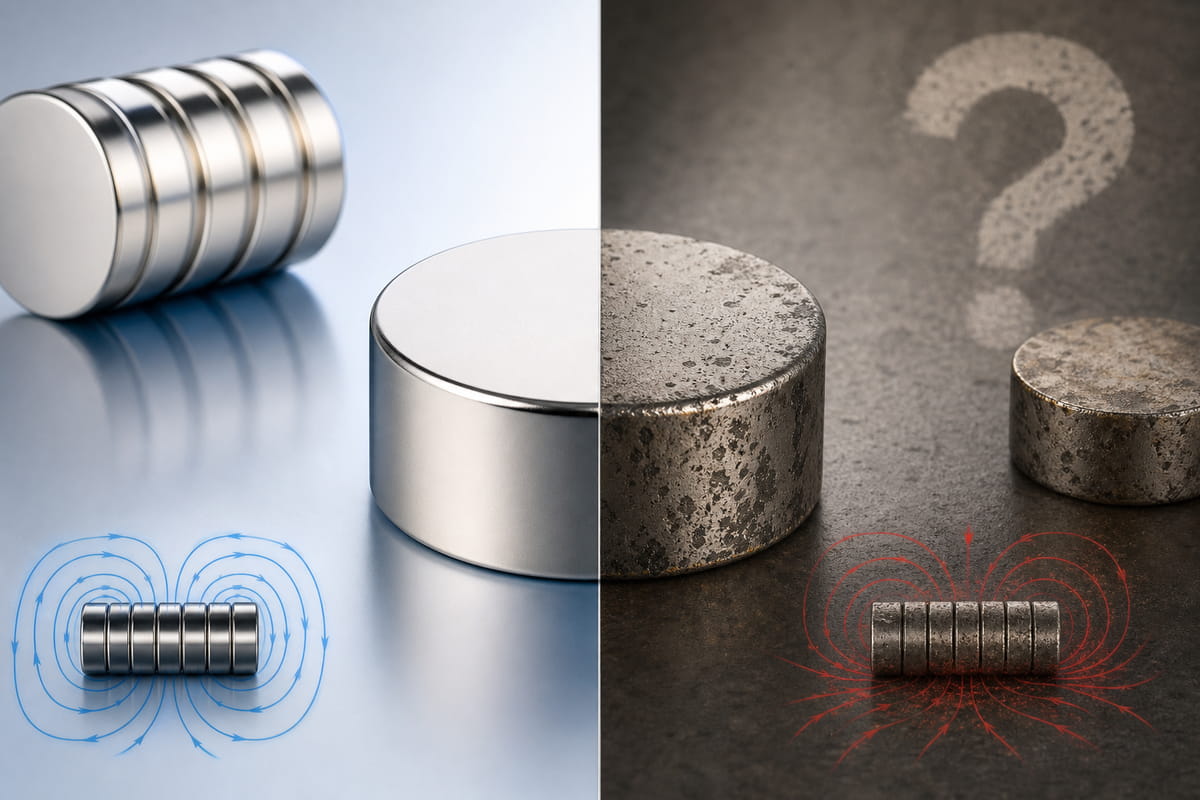
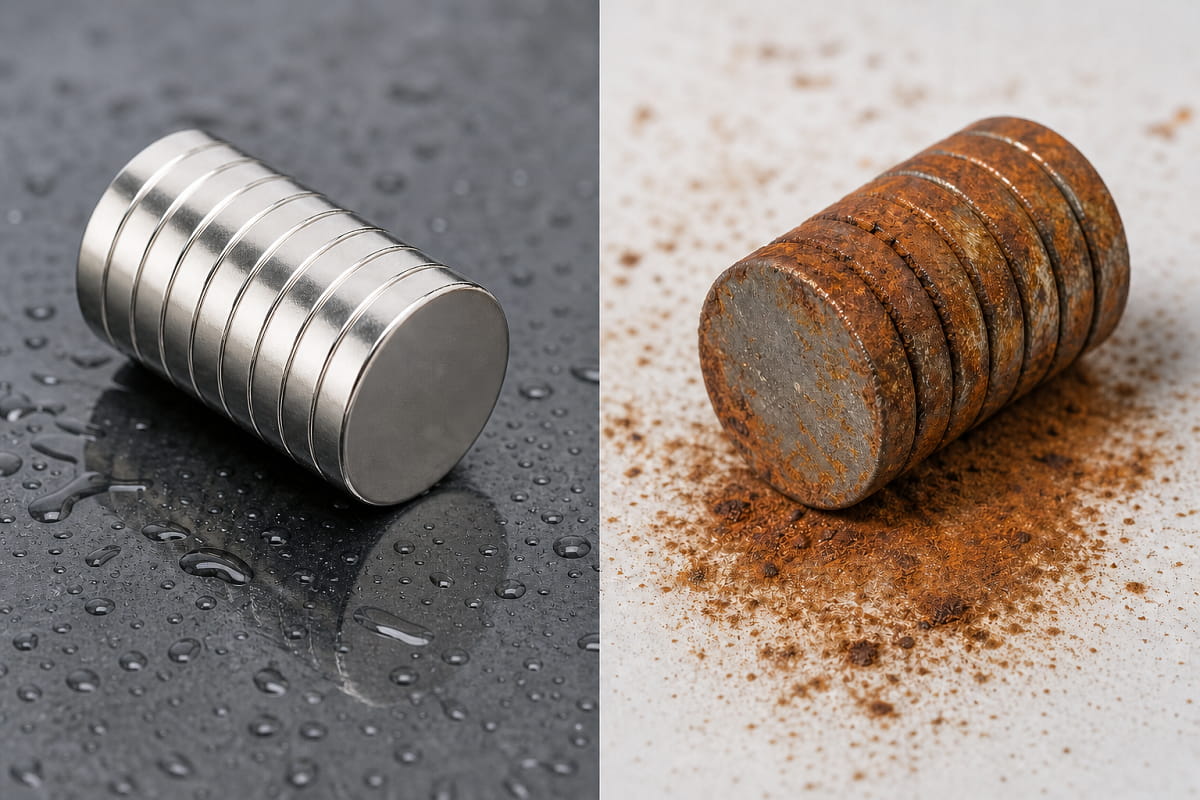
Neodymium magnets are 5 to 10 times stronger than ferrite magnets of the same size, but they’re expensive, lose magnetism above 80°C, and corrode easily without coating. Ferrite magnets are cheap, handle up to 250°C, and resist rust naturally—but they’re weaker and need more space.
Choose neodymium when size and strength matter most; choose ferrite for budget, heat, or outdoor use. Never use both together—neodymium will demagnetize ferrite permanently.
When you are staring at a magnet order form, there have two main options staring back at you: ferrite magnets and neodymium magnets. And on the surface, they seem pretty similar. Both are permanent magnets. Both can hold things. Both have been around for decades.
The difference between ferrite magnet and neodymium really comes down to three factors—strength, cost, and where you’re using the darn thing.
And if you pick the wrong one? You’re either wasting money or getting way less performance than you need.
In this article, as a professional neodymium magnets manufacturer, let me break down the differences between ferrite magnet and neodymium.
The Quick Answer
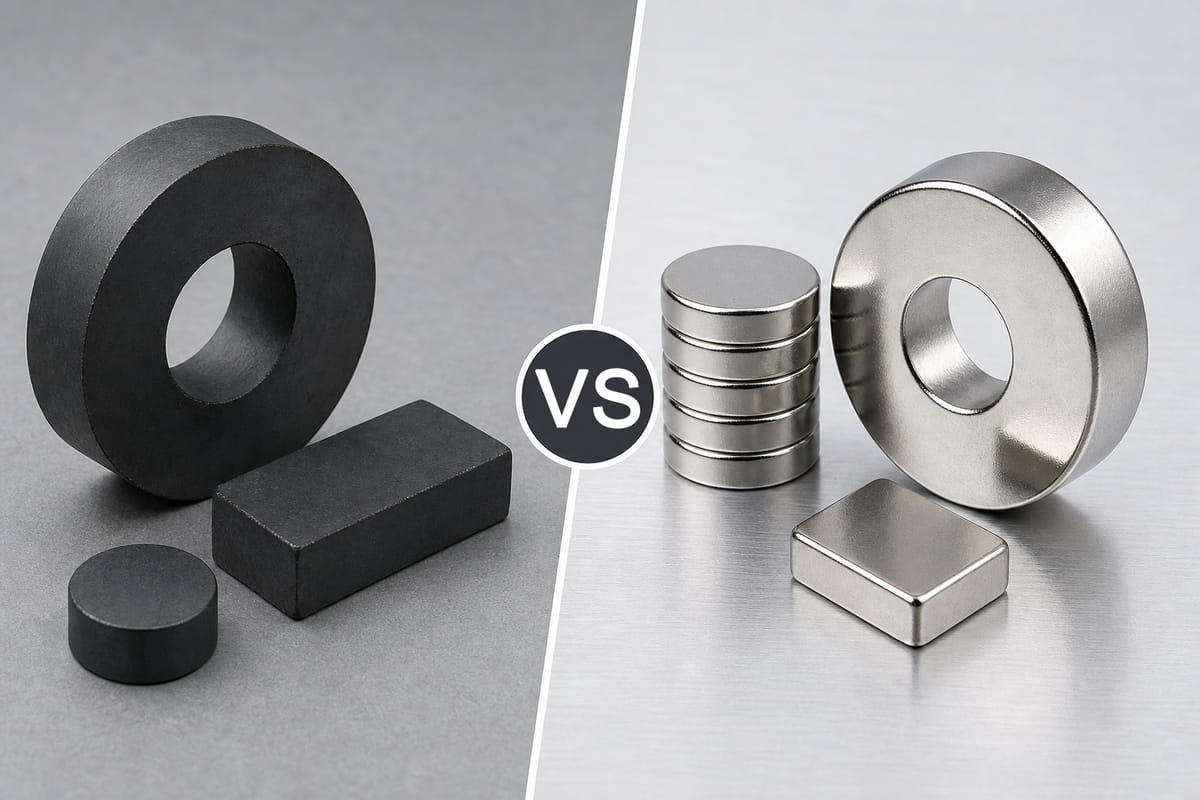
Neodymium magnets are significantly smaller, lighter, and vastly more powerful than ferrite (ceramic) magnets. We’re talking 5 to 10 times more magnetic strength at the same size.
But ferrite magnets are much more affordable, handle extreme heat better, and are highly resistant to corrosion. That makes them the superior choice for heavy-duty or budget-conscious applications.
Sound good? Let’s dig deeper.
Difference Between Ferrite Magnet and Neodymium Magnet
Magnetic Strength

Here’s the biggest difference you’ll notice right away: magnetic pull force.
Neodymium magnets are the strongest commercially available permanent magnets on the planet. Period. They produce magnetic fields up to 1.4 Tesla.
Ferrite magnets? They top out around 0.2 to 0.5 Tesla.
What does that mean in practical terms?
Let me give you a real example.
A neodymium disc magnet that’s 12mm wide and 3mm thick can hold about 1.8 kg of weight. A ferrite magnet of the exact same size? It holds about 0.2 kg.
That’s a 9x difference.
Pro Tip: If you’re working with limited space and need maximum holding power, neodymium is your only real option. There’s no way around it.
Size and Weight
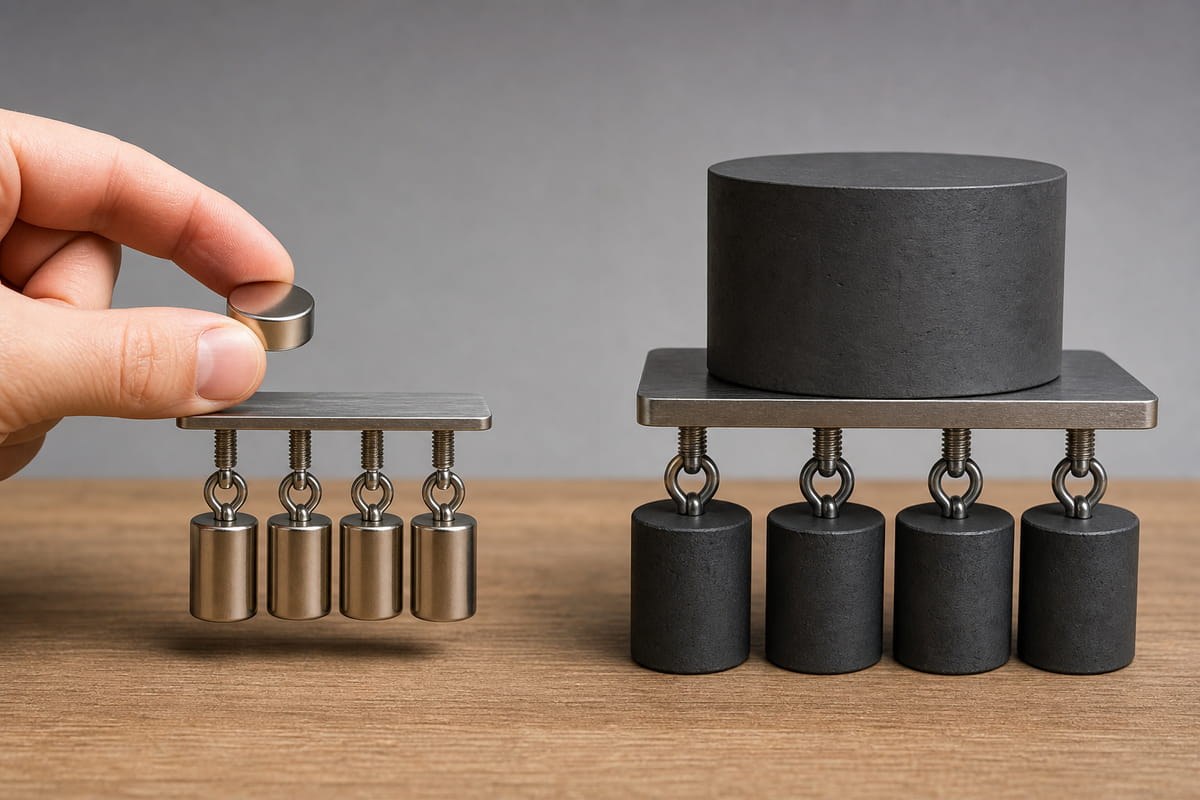
Here’s something that caught me off guard when I first started working with magnets:
Because neodymium magnets are so incredibly powerful, you can use a much smaller magnet to get the same job done.
Let me paint you a picture.
Say you need a magnet that can hold 5 kg. With neodymium, you might use a disc that’s 20mm wide and 5mm thick. With ferrite? You’d need something like a 50mm wide block that’s three times thicker.
That’s a massive size difference.
This is why you’ll find neodymium magnets in:
- Smartphones
- Headphones
- Small electric motors
- Medical devices
- Hard drives
Space is critical in these applications. And ferrite magnets just don’t cut it when you need to pack a punch into a tiny package.
But here’s the flip side…
If you’ve got plenty of space and you’re not worried about weight, ferrite magnets work just fine. You just need to go bigger.
Heat Tolerance

This one trips up a LOT of people.
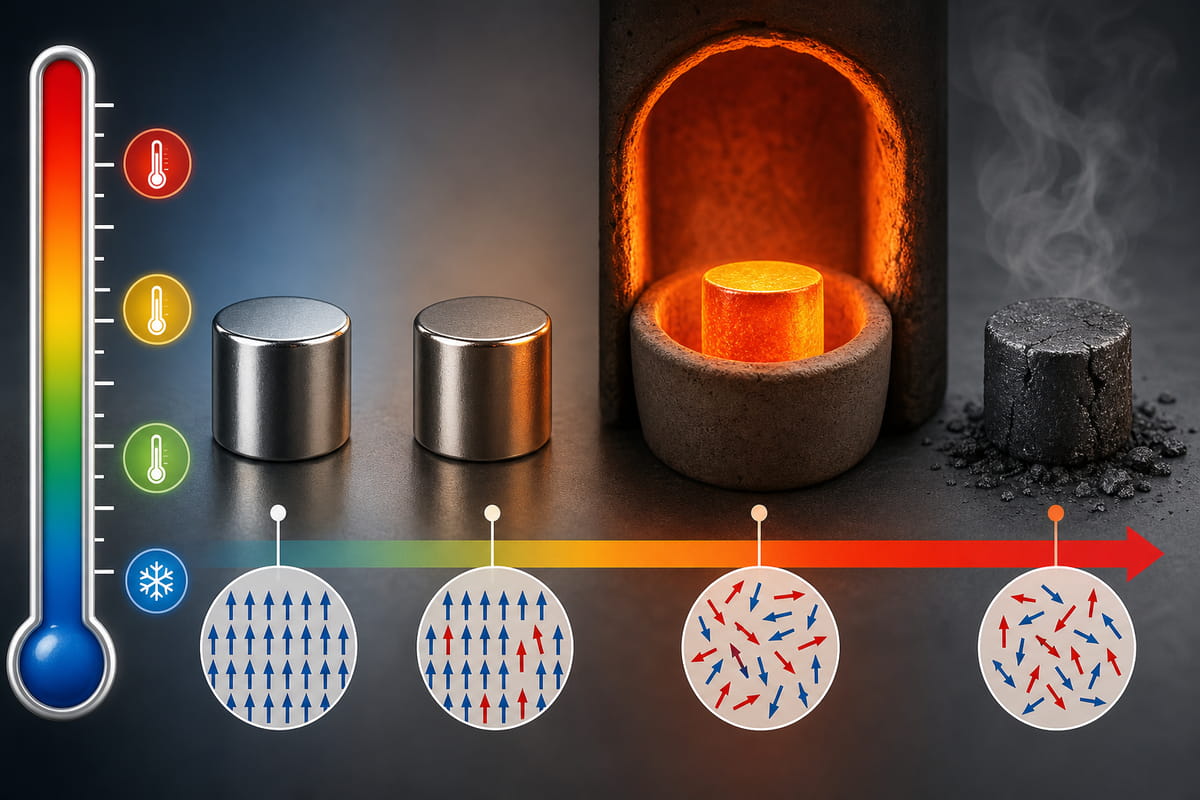
Standard neodymium magnets start losing their magnetic properties at temperatures above 80°C (about 176°F).
Let that sink in.
If you’re using neodymium magnets near a motor, an engine, or any heat source, they can literally demagnetize. Permanently.
Ferrite magnets? They’re comfortable operating up to 250°C or more.
In fact, here’s something wild:
As the temperature rises, ferrite magnets actually get more resistant to demagnetization. Their coercivity increases by about 0.4% for every degree Celsius increase.
Crazy, right?
Now, I should mention that there are special high-temperature neodymium magnets available. You can get grades that handle up to 200°C or even 230°C.
But they cost significantly more.
When to choose ferrite for heat: Any application where temperatures regularly exceed 80°C. Think outdoor equipment, industrial motors, automotive components, and speaker systems that run hot.
When to choose neodymium for heat: Only if you’re willing to pay a premium for special high-temperature grades. And even then, ferrite still wins on overall heat tolerance.
Durability and Corrosion

Here’s a quick story.
A few years back, I recommended neodymium magnets for an outdoor sign-holding project. Big mistake.
Within six months, the uncoated magnets started rusting. Badly.
The issue? Neodymium magnets contain iron. And iron + moisture = rust.
Now, most neodymium magnets come with protective coatings—typically nickel, zinc, or epoxy. These coatings do a decent job. But they’re not foolproof. If the coating gets scratched, corrosion can set in.
Ferrite magnets? They’re made from iron oxide—basically ceramic. They simply don’t rust. No coating needed.
Here’s the bottom line:
| Factor | Neodymium | Ferrite |
|---|---|---|
| Corrosion resistance | Low (needs coating) | Excellent (no coating needed) |
| Brittleness | Moderate | High (very brittle) |
| Impact resistance | Can crack | Can chip or break |
| Outdoor use | Only with proper coating | Excellent as-is |
If you’re using magnets outdoors, in humid environments, or near chemicals, ferrite is almost always the better choice.
The Price Difference

Okay, let’s get real about costs.
Ferrite magnets are cheap. Really cheap.
Why? Because they’re made from abundant, inexpensive raw materials—mainly iron oxide and strontium or barium carbonate. The manufacturing process is well-established and relatively simple.
Neodymium magnets? They rely on rare-earth elements. And those elements are:
- Expensive to mine
- Subject to price fluctuations
- Mostly sourced from China (80-90% of global production)
The result? A neodymium magnet can cost 3 to 20 times more than a ferrite magnet of the same size.
Here’s a real price comparison I pulled together:
| Magnet Size | Ferrite Price | Neodymium N35 Price |
|---|---|---|
| Disc 10x4mm | €0.07 | €0.23 |
| Disc 20x10mm | €0.09 | €1.70 |
| Disc 30x10mm | €0.29 | €3.54 |
But here’s the thing…
If you need a specific amount of magnetic force, a smaller neodymium magnet might actually be cheaper than a huge ferrite one when you factor in the total system cost.
For example, if you need 16 kg of holding force, you could use:
- One neodymium disc (30x10mm) for €3.54
- Or a much larger ferrite assembly that costs more in materials and space
So don’t just look at the magnet price in isolation. Think about the total cost of your application.
Ferrite Magnet vs Neodymium: Which Should You Choose?

Choose Neodymium When:
- Space is limited and you need maximum power
- Weight is a critical factor
- You’re working with modern electronics (headphones, speakers, motors)
- You need high coercivity (resistance to demagnetization)
- The operating temperature stays below 80°C
Choose Ferrite When:
- Budget is your primary concern
- You’re working in high-temperature environments
- The magnet will be exposed to moisture or chemicals
- You have plenty of space to work with
- You need large quantities for a cost-sensitive product
Real-World Applications

Let me give you some concrete examples from each category.
Neodymium Magnet Applications
- Electric vehicle motors
- Hard disk drives
- MRI machines
- High-end headphones and speakers
- Cordless power tools
- Magnetic fasteners in furniture
- Wind turbine generators
Ferrite Magnet Applications
- Refrigerator magnets
- Large speaker woofers
- Guitar pickups
- Magnetic separators in recycling
- Holding magnets for warehouse use
- Magnetic therapy products
- Low-cost toys and crafts
The One Rule You Should Never Break
Here’s a warning that I can’t emphasize enough:
Never use neodymium and ferrite magnets together.
Why?
Because neodymium magnets are so much stronger that they’ll permanently demagnetize the ferrite magnets within months. Sometimes faster.
I’ve seen people ruin perfectly good ferrite assemblies by sticking a neodymium magnet nearby. The ferrite magnets lose their magnetism, and suddenly your project doesn’t work anymore.
If you’re using magnetic tape or magnetic sheets (which are made with ferrite), keep them far away from neodymium magnets.
Final Thoughts
So there you have it.
What is the difference between ferrite magnet and neodymium comes down to a simple trade-off:
You want maximum power in a small package? Go neodymium.
You need something affordable, heat-resistant, and corrosion-proof? Ferrite is your friend.
Neither is “better” than the other. They’re just designed for different jobs.
My advice? Start by figuring out your must-haves: Is it holding force? Temperature resistance? Budget? Then match those requirements to the right magnet type.
Do that, and you’ll never pick the wrong magnet again.