
Sintered NdFeB Magnet Manufacturing
Osenc Magnets manufactures high-performance sintered NdFeB magnets for industrial applications including EV motors, robotics, renewable energy systems, medical devices, magnetic separators, and industrial automation equipment.
Our sintered neodymium magnet manufacturing process includes powder preparation, magnetic field pressing, vacuum sintering, precision machining, surface coating, magnetization, and quality inspection to ensure stable magnetic performance and dimensional accuracy.
What Are Sintered NdFeB Magnets?
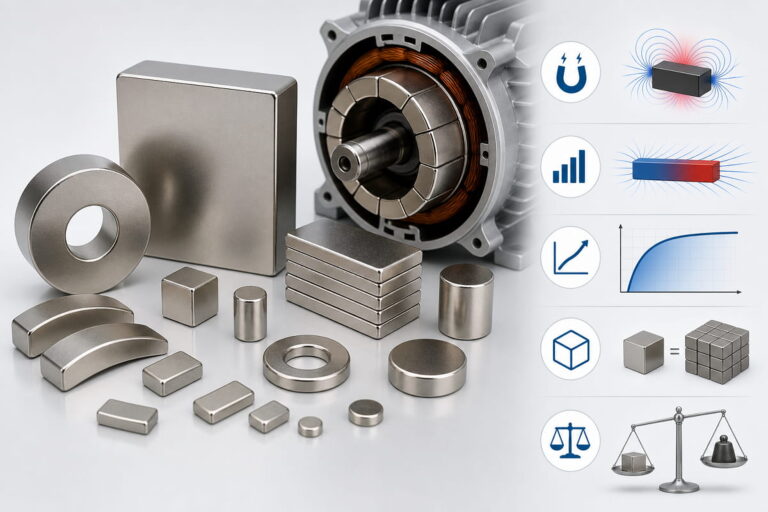
Sintered NdFeB magnets are permanent rare earth magnets manufactured using neodymium, iron, and boron alloy powders processed through pressing and high-temperature sintering.
These magnets provide extremely high magnetic energy density and are widely used in applications requiring compact size, high magnetic force, and strong magnetic performance.

Key Characteristics
- High Magnetic Strength
- High Remanence (Br)
- High Energy Product (BHmax)
- Compact Magnet Size
- Excellent Performance-to-Volume Ratio
Common Applications
- EV Traction Motors
- Wind Turbine Generators
- Robotics
- Magnetic Separators
- Sensors
- Medical Devices
- Industrial Automation Systems

Sintered NdFeB Manufacturing Process
Complete Manufacturing Workflow
Raw Materials → Alloy Melting → Powder Preparation → Magnetic Field Pressing → Sintering → Machining → Coating → Magnetization → Inspection
Each production stage directly affects magnetic performance, dimensional stability, corrosion resistance, and overall product quality.
Rare Earth Raw Materials
NdFeB Alloy Composition
Sintered neodymium magnets are manufactured using rare earth alloy materials containing:
- Neodymium (Nd)
- Iron (Fe)
- Boron (B)
Additional rare earth elements may be added to improve coercivity and temperature resistance for demanding applications.

Material Characteristics
- High Magnetic Energy Density
- Strong Magnetic Flux
- High Coercivity
- Excellent Compact Power

Material Control
Osenc Magnets implements controlled raw material sourcing and inspection procedures to maintain material consistency and magnetic stability.
Alloy Melting & Powder Preparation
Strip Casting & Hydrogen Decrepitation
NdFeB alloy materials are melted and processed into fine magnetic powders suitable for magnetic field alignment and pressing.
Powder Preparation Objectives
- Uniform Particle Distribution
- Controlled Grain Structure
- High Magnetic Orientation Capability
- Stable Material Composition

Process Benefits
Precise powder preparation improves:
- Remanence (Br)
- Coercivity (Hcj)
- BHmax
- Overall Magnetic Performance

Magnetic Field Pressing
Magnetic Orientation & Compaction
The prepared NdFeB powder is pressed under strong magnetic fields to align magnetic grains before sintering.
Pressing Methods
- Die Pressing
- Isostatic Pressing
- Axial Orientation
- Radial Orientation

Manufacturing Advantages
- Improved Grain Alignment
- High Magnetic Flux Density
- Enhanced Material Uniformity
- Optimized Magnetic Properties

Engineering Importance
Magnetic field orientation is a critical process affecting final magnetic performance and magnetization behavior.
Vacuum Sintering Process
High-Temperature Densification
Pressed green compacts are sintered in controlled vacuum environments to form dense permanent magnet structures.
Sintering Objectives
- Increase Material Density
- Improve Mechanical Strength
- Optimize Magnetic Properties
- Stabilize Microstructure

Process Parameters
- Controlled Temperature Curves
- Vacuum Atmosphere
- Cooling Rate Management
- Batch Stability Monitoring

Resulting Benefits
- High Magnetic Energy Product
- Improved Structural Integrity
- Consistent Magnetic Performance

Precision Machining
Tight Tolerance Magnet Processing
Sintered NdFeB magnets are machined into final geometries using precision grinding and cutting equipment.
Machining Services
- CNC Machining
- Surface Grinding
- Wire EDM Cutting
- Hole Drilling
- Slicing
- Profile Machining

Typical Shapes
- Disc Magnets
- Ring Magnets
- Block Magnets
- Arc Magnets
- Tube Magnets
- Custom Geometries

Tolerance Capability
±0.03 mm
Precision tolerance capability depends on geometry, material grade, and machining complexity.
Surface Coating Process
Corrosion Protection for NdFeB Magnets
Neodymium magnets require protective coatings because NdFeB materials are susceptible to oxidation and corrosion.
Common Coating Options
| Coating | Corrosion Resistance | Appearance |
|---|---|---|
| NiCuNi | Medium | Silver |
| Epoxy | High | Black |
| Zinc | Medium | Blue/Silver |
| Gold | Medium | Gold |
| PTFE | High | Dark Gray |
Coating Benefits
- Improved Corrosion Resistance
- Environmental Protection
- Increased Product Durability
- Enhanced Surface Stability

Typical Applications
- Outdoor Equipment
- Humid Environments
- Medical Devices
- Industrial Automation

Magnetization Process
Creating Permanent Magnetic Fields
After machining and coating, magnets are magnetized using high-intensity pulse magnetization equipment.
Magnetization Methods
Axial Magnetization
Magnetic poles positioned on flat surfaces.
Diametrical Magnetization
Magnetic poles positioned on curved sides.
Radial Magnetization
Radial magnetic orientation for motor systems.
Multipole Magnetization
Multiple north and south poles distributed around the magnet surface.

Common Applications
- Brushless Motors
- EV Motors
- Sensors
- Magnetic Couplings
- Encoders

Custom Sintered NdFeB Manufacturing
OEM & Custom Production Support
Osenc Magnets manufactures custom sintered NdFeB magnets based on:
- Engineering Drawings
- CAD Files
- Magnetic Performance Requirements
- Environmental Conditions
- Industry Standards

Customization Options
- Custom Shapes
- Custom Magnetization
- Custom Coatings
- Tight Tolerances
- Multi-Pole Magnetization
- High Temperature Grades

Engineering Support
- Material Selection
- Magnet Design Optimization
- Prototype Development
- Magnetic Circuit Consultation

Frequently Asked Questions
They provide high magnetic energy density, strong magnetic fields, and compact magnet size for demanding industrial applications.
Yes. Osenc Magnets supports custom shapes, grades, coatings, tolerances, and magnetization configurations.
Applications include EV motors, renewable energy systems, robotics, industrial automation, sensors, and medical devices.
High-temperature grades including M, H, SH, UH, and EH are available for elevated operating temperatures.
Custom Sintered NdFeB Magnet Manufacturing
Request engineering consultation, technical support, or a custom quotation for your NdFeB magnet project.