
Neodymium Magnet Technical Resources & Engineering Guides
Explore technical information, engineering resources, and industrial reference guides for neodymium magnets, including magnet grades, pull force, coatings, magnetization directions, temperature resistance, and magnetic properties.
We provide engineering-focused technical resources to help OEM manufacturers, industrial buyers, and product development teams select the appropriate NdFeB magnet solutions for demanding applications.
Technical Resource Categories
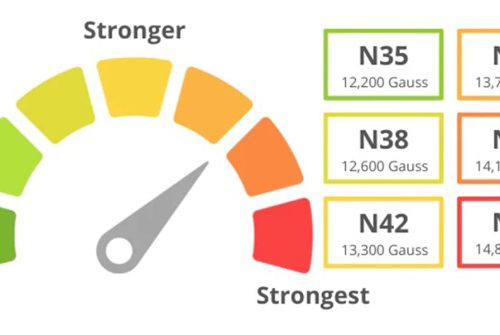
Magnet Grades
Understand the differences between N35, N42, N52, and high-temperature neodymium magnet grades.

Pull Force
Learn how pull force is affected by magnet size, air gap, material grade, and contact surface conditions.
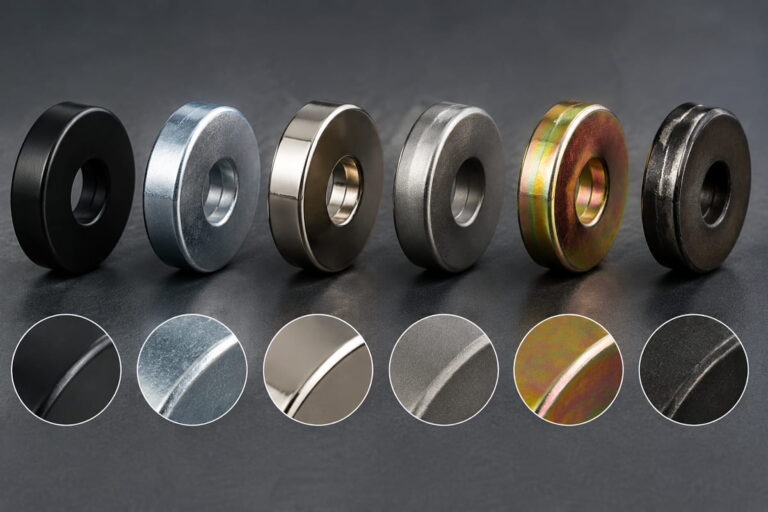
Magnet Coatings
Compare corrosion resistance, durability, and environmental performance of different magnet coatings.
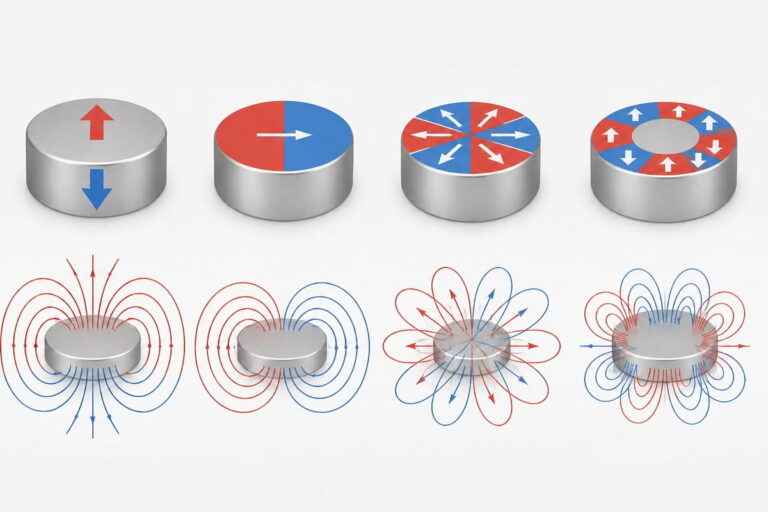
Magnetization Directions
Learn about axial, diametrical, radial, and multipole magnetization methods.

Temperature Resistance
Select the correct magnet grade for high-temperature operating environments.

Magnetic Properties
Understand remanence, coercivity, BHmax, flux density, and magnetic field strength.
Magnet Grades Guide
Understanding NdFeB Magnet Grades
Neodymium magnet grades indicate the magnetic energy product and performance characteristics of sintered NdFeB magnets. Higher grades generally provide stronger magnetic fields and greater magnetic energy density.

Common Neodymium Magnet Grades
| Grade | Remanence (Br) | BHmax | Max Operating Temp |
|---|---|---|---|
| N35 | 1.17–1.21T | 33–36 MGOe | 80°C |
| N42 | 1.29–1.32T | 40–43 MGOe | 80°C |
| N52 | 1.42–1.45T | 50–53 MGOe | 80°C |
High Temperature Grades
| Grade Type | Max Operating Temperature |
|---|---|
| M | 100°C |
| H | 120°C |
| SH | 150°C |
| UH | 180°C |
| EH | 200°C |
Pull Force Guide
What Is Magnet Pull Force?
Pull force refers to the maximum force required to separate a magnet from a flat ferromagnetic surface under ideal testing conditions.
Factors Affecting Pull Force
- Magnet Grade
- Magnet Size
- Steel Thickness
- Air Gap
- Surface Coating
- Contact Area
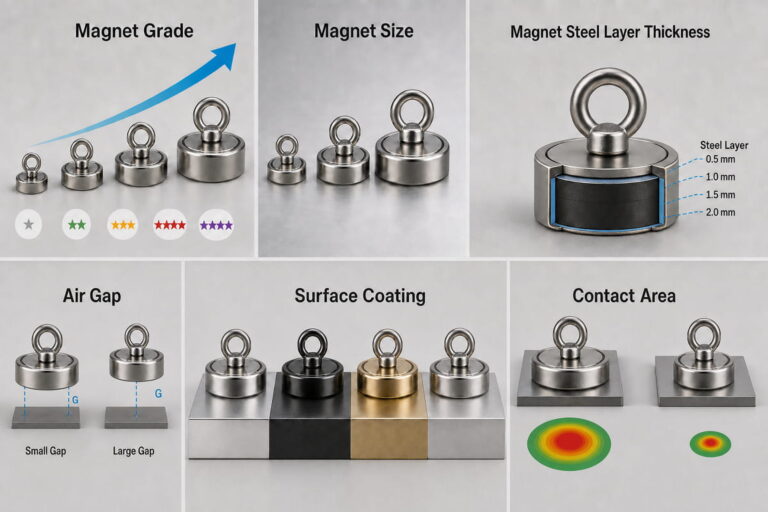
Pull Force Formula

Example Pull Force Table
| Diameter | Thickness | Grade | Pull Force |
|---|---|---|---|
| 10mm | 2mm | N42 | 1.2kg |
| 20mm | 5mm | N52 | 8.5kg |
| 30mm | 10mm | N52 | 28kg |
Magnet Coating Guide
Why Magnet Coatings Are Important
Neodymium magnets are susceptible to corrosion due to the iron content within NdFeB materials. Protective coatings improve corrosion resistance and environmental durability.
Common Magnet Coatings
| Coating | Corrosion Resistance | Salt Spray Resistance | Appearance |
|---|---|---|---|
| NiCuNi | Medium | 24–48h | Metallic Silver |
| Epoxy | High | 96h+ | Black |
| Zinc | Medium | 12–24h | Blue/Silver |
| Gold | Medium | 24–48h | Gold Finish |
| PTFE | High | Excellent | Dark Gray |
Coating Selection by Environment
Indoor Industrial Applications
NiCuNi coating is commonly used for standard industrial environments.
Outdoor & Humid Environments
Epoxy coating provides improved corrosion resistance for moisture-prone environments.
Medical & Specialized Applications
Gold and PTFE coatings may be selected for specialized requirements.

Magnetization Direction Guide
Understanding Magnetization Directions
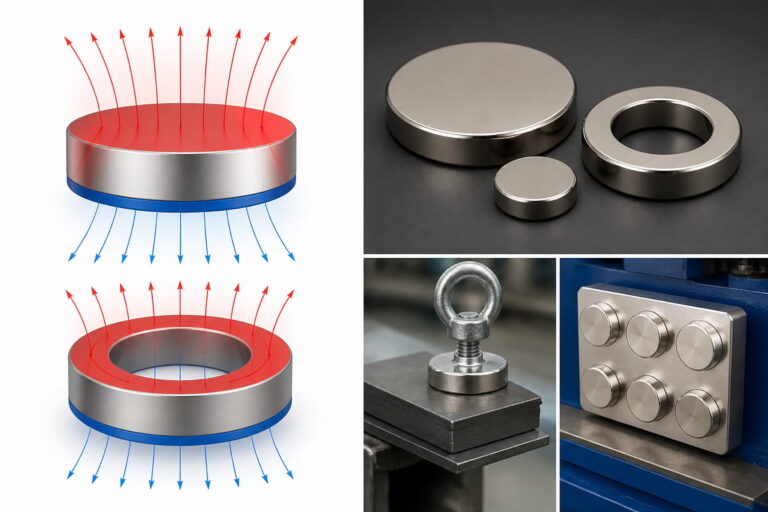
Magnetization direction determines the orientation of the magnetic poles within a magnet and significantly affects magnetic performance in different applications.
Axial Magnetization
Magnetic poles are located on the flat surfaces of the magnet.
Common Uses
- Disc Magnets
- Ring Magnets
- Holding Systems
Diametrical Magnetization
Magnetic poles are positioned on opposite curved sides of the magnet.
Common Uses
- Sensors
- Rotational Systems
- Couplings

Radial Magnetization
Magnetic poles are distributed radially around the magnet.
Common Uses
- Brushless Motors
- EV Motors
- Servo Motors
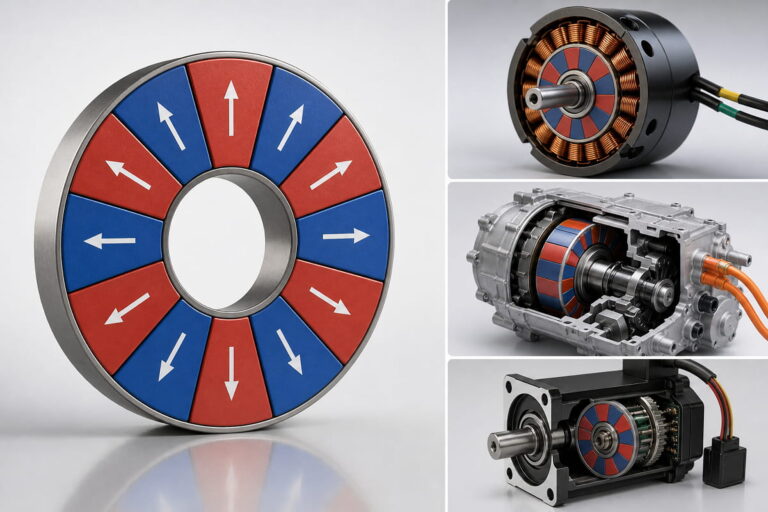
Multipole Magnetization
Multiple north and south poles are distributed around the magnet surface.
Common Uses
- Encoders
- Motor Systems
- High-Precision Rotational Equipment

Temperature Resistance Guide
Maximum Operating Temperature of NdFeB Magnets
Neodymium magnets may experience irreversible demagnetization if exposed to temperatures exceeding their rated operating limits.
Temperature Grade Comparison
| Grade Type | Maximum Operating Temperature |
|---|---|
| Standard | 80°C |
| M | 100°C |
| H | 120°C |
| SH | 150°C |
| UH | 180°C |
| EH | 200°C |
Factors Affecting Temperature Performance
- Magnet Grade
- Magnetic Circuit Design
- Environmental Conditions
- Demagnetization Risk

High-Temperature Applications
- EV Motors
- Industrial Automation
- Aerospace Systems
- Renewable Energy Equipment

Magnetic Properties Guide
Remanence (Br)
Remanence represents the residual magnetic flux density remaining after magnetization.
Coercivity (Hcj)
Coercivity indicates resistance to demagnetization.
Maximum Energy Product (BHmax)
BHmax measures the maximum magnetic energy density available within the magnet material.
Flux Density
Flux density describes the magnetic field intensity at a specific location.
Gauss vs Tesla
1 Tesla = 10, 000 Gauss

Engineering & Manufacturing Support
Osenc Magnets supports engineering teams with technical consultation, custom magnet manufacturing, and application-focused magnetic solutions.
Engineering Services
- Magnet Material Selection
- Magnetization Design
- Flux Optimization
- Prototype Development
- Custom Manufacturing Support

Manufacturing Capabilities
- Sintered NdFeB Production
- Precision CNC Machining
- Multi-Pole Magnetization
- Surface Coating
- Tight Tolerance Processing

Technical Support for Custom Neodymium Magnets
Request engineering consultation, magnet selection assistance, or custom manufacturing support for your project.