Quick Summary:
A bar magnet is strongest at its two poles (North and South), where the field lines are most concentrated, and weakest at its center. The strength comes from tightly aligned magnetic domains inside the material.
You can confirm this at home: sprinkle iron filings over the magnet and watch them cluster densely at the ends. Note that material, size, and especially heat can affect how strong those poles are — high temperatures past the Curie point can permanently weaken the magnet.
In this guide, as a professional custom bar magnets manufacturer, I’m going to break down exactly where a bar magnet is strongest, why it works that way, and how you can actually see it for yourself with a simple kitchen experiment.
Sound good? Let’s dive in.

What Is the Strongest Part of a Bar Magnet?
The magnetic field of a bar magnet is strongest at its two poles — the North pole and the South pole.
These poles sit at the opposite ends of the bar. And here’s the interesting part: both poles are equally strong. The North pole isn’t “stronger” than the South pole, or vice versa.
The weakest spot? The exact center of the magnet.
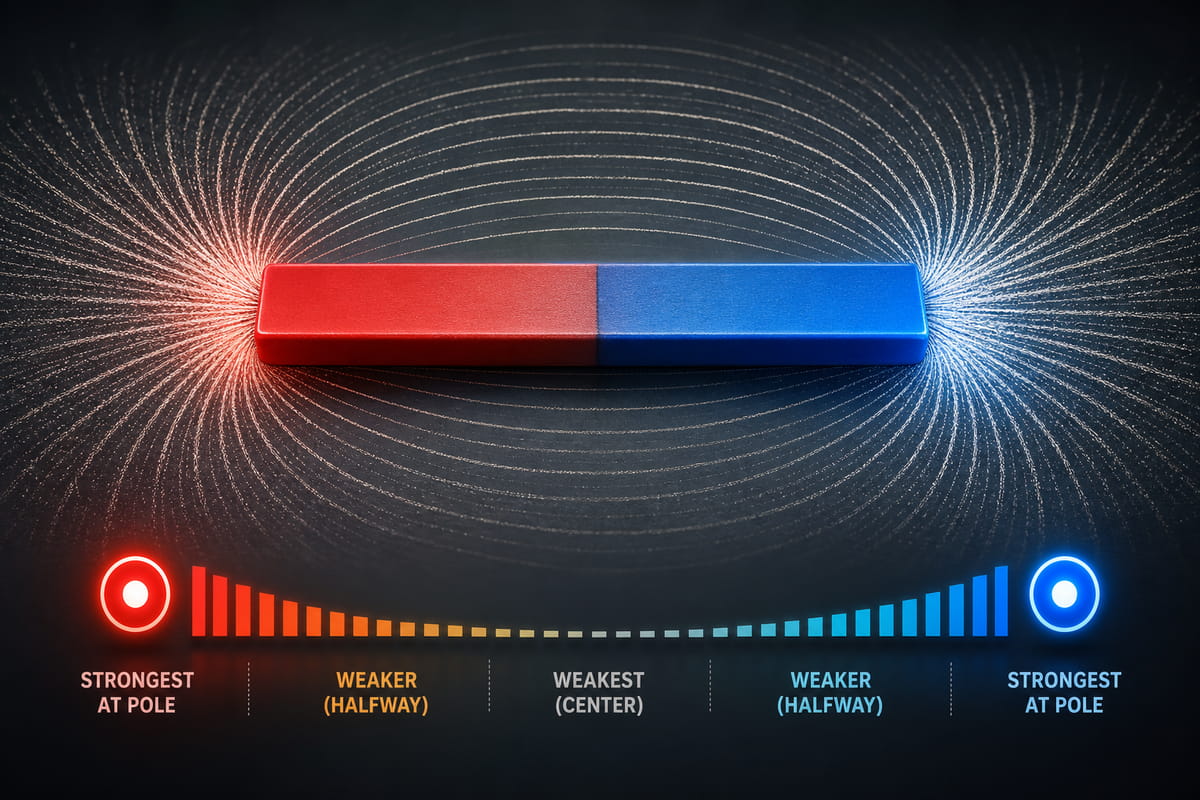
So if you imagine a bar magnet laid out in front of you, the magnetic force looks something like this:
- Strongest: at both ends (the poles)
- Weaker: halfway between a pole and the center
- Weakest: right in the middle
That’s the basic layout. But to really understand it, we need to talk about something invisible.
First, Let’s Talk About Magnetic Fields
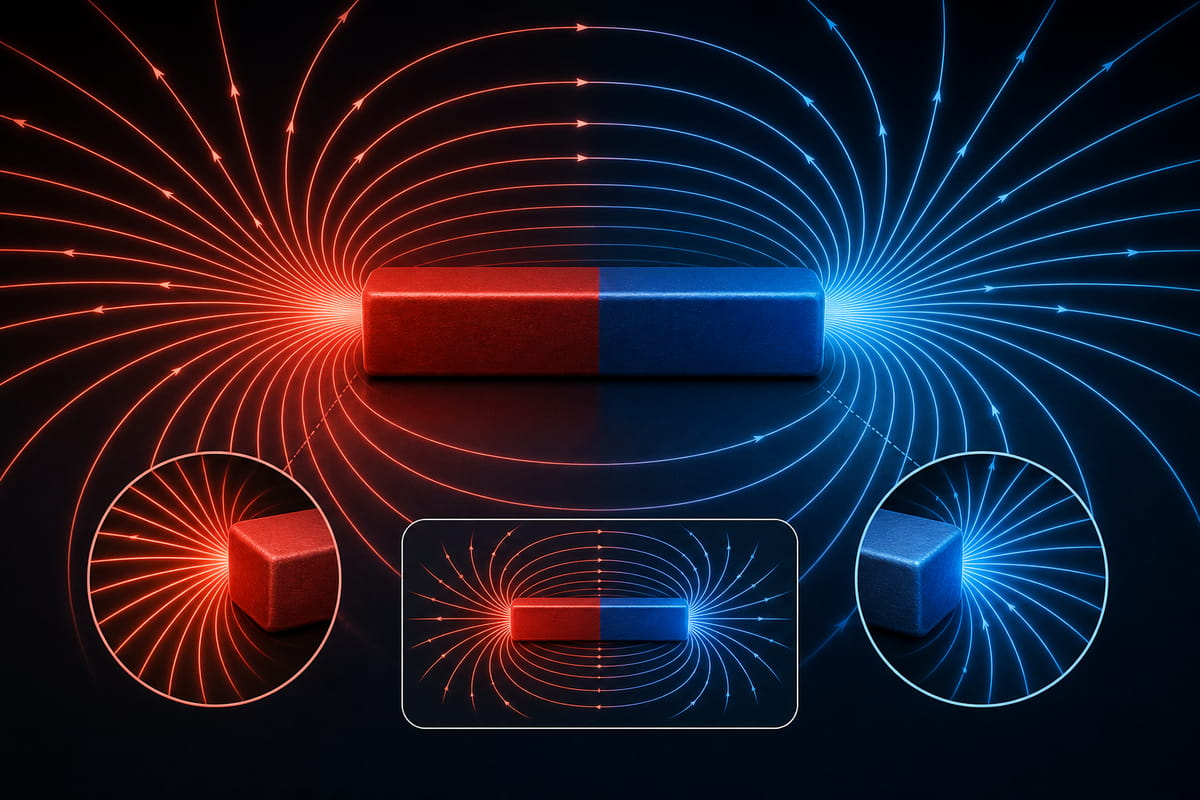
You can’t see a magnetic field. But it’s there, surrounding every magnet, exerting an invisible force on the world around it.
The best way to picture this force is with magnetic field lines.
Think of these lines as imaginary paths that show the direction and strength of the magnetic force. Outside the magnet, they flow from the North pole to the South pole, arching through the air in smooth, curved loops. Inside the magnet, they travel the opposite way — from South to North — completing the loop.
Here’s the key thing to remember:
Where the field lines are packed close together, the field is strong. Where they spread apart, the field is weak.
And guess where those lines are most tightly bunched? You got it — at the poles.
This is why the question “what is the strongest part of a bar magnet” always comes back to the same answer. The field lines crowd together at the ends, creating the most concentrated magnetic force there.
Why Are the Poles So Strong?
Now let’s get into the “why.” Because this is where it gets genuinely cool.
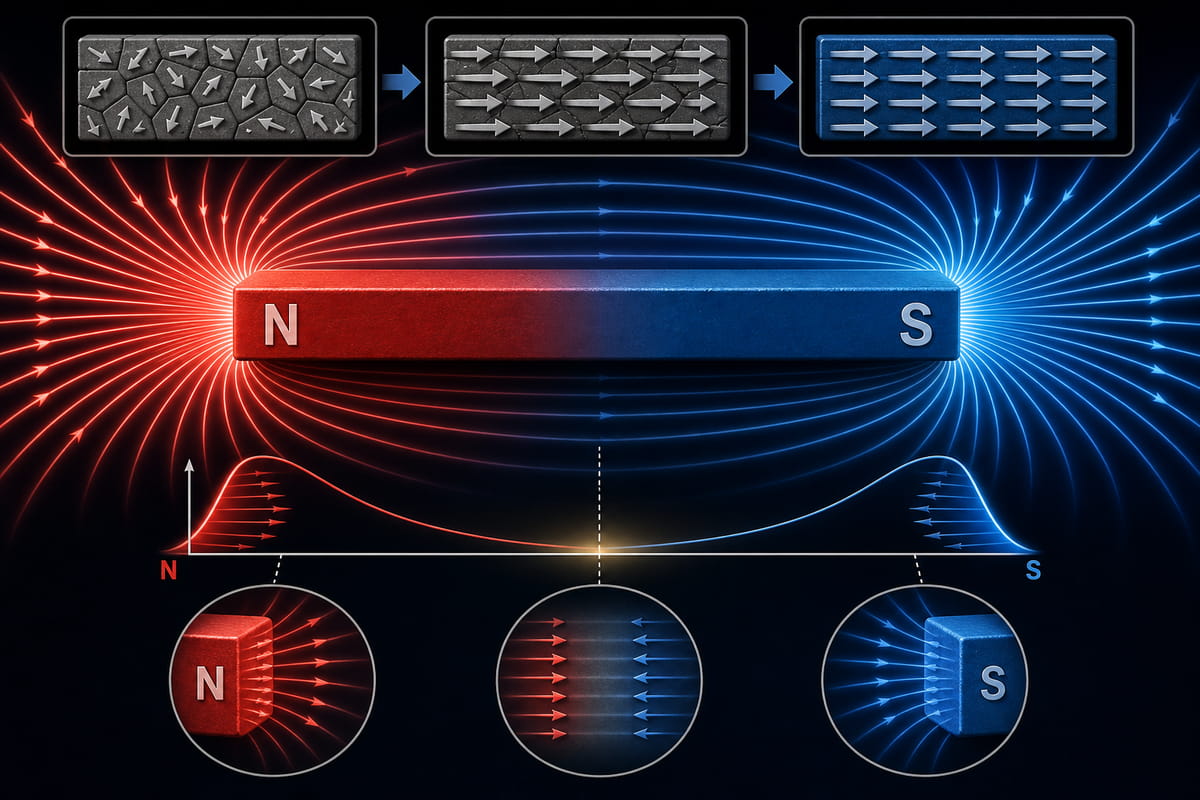
Inside every bar magnet are tiny magnetic regions called domains.
Picture millions of microscopic compass needles inside the metal. In a regular, un-magnetized piece of iron, these domains point in random directions, so their forces cancel each other out.
But in a bar magnet? All those domains are aligned in the same direction.
When they line up like that, their individual magnetic forces add together to create one strong, unified field. And the effect of all that alignment shows up most dramatically at the ends of the magnet, where the field lines emerge and re-enter.
In other words: the poles are strongest because that’s where the magnetic field lines are most concentrated, thanks to all those perfectly aligned domains.
The center, on the other hand, is where the North-seeking and South-seeking forces sort of meet in the middle and balance out. That’s why you get a weak spot — sometimes called a magnetic neutral zone — right at the center.
Wait — Isn’t the Field Strongest INSIDE the Magnet?

Here’s a little wrinkle that confuses a lot of people. (It confused me when I first read about it.)
Technically, the magnetic field is actually strongest inside the magnetic material itself.
But here’s the deal: when we talk about the part of the magnet that’s useful for picking things up, attracting paperclips, or sticking to your fridge, we’re talking about the field outside the magnet.
And the strongest external magnetic field is found near the poles.
So both statements are true:
- The strongest field overall exists inside the magnet.
- The strongest field you can actually use is at the poles, on the outside.
For 99% of real-world situations, the poles are what matter.
See It For Yourself (The Iron Filings Test)
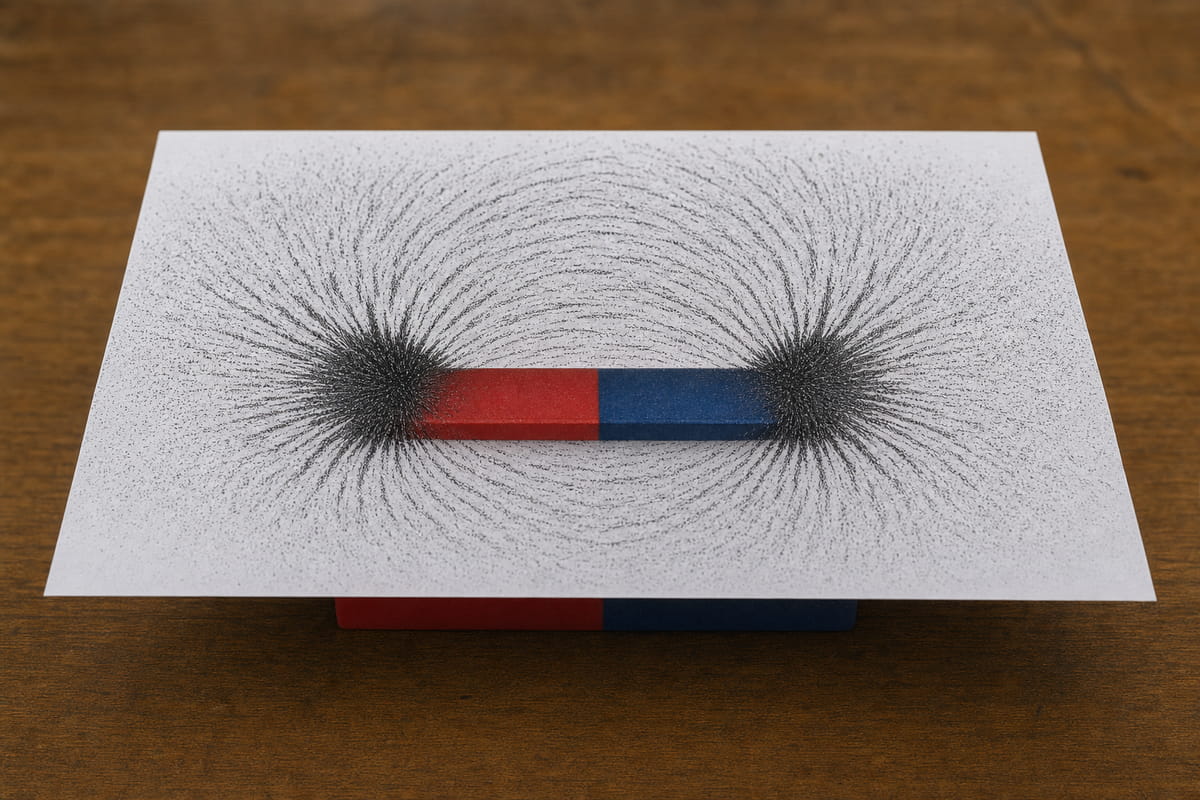
You don’t have to take my word for any of this. There’s a classic experiment you can do at home, and it’s genuinely satisfying to watch.
Here’s how to do it:
- Place a bar magnet on a flat surface.
- Lay a sheet of paper over the top of it.
- Sprinkle iron filings evenly across the paper.
- Tap the paper gently.
Almost instantly, the filings will arrange themselves into a pattern that traces the magnetic field lines.
And here’s what you’ll notice: the filings cluster densely at the two ends of the magnet, forming thick, crowded patterns. As you move toward the center, the filings thin out and spread apart.
That visual is your proof. The dense clusters at the poles show you exactly where the magnetic force is strongest.
Pro Tip: No iron filings? You can get a rough version of this test with a small pile of paperclips. Try picking them up with the end of the magnet, then try the middle. The difference is dramatic — the end grabs a whole chain of clips, while the center barely holds one.
Why This Matters Beyond the Classroom

You might be thinking: “Okay, the ends are strongest. So what?”
Fair question. But understanding magnetic field distribution actually has huge real-world value. Let me explain.
Engineers and designers rely on knowing where a magnet is strongest to build all kinds of devices. Here are just a few examples:
- Electric motors and generators depend on concentrated magnetic fields at the poles to convert energy efficiently.
- Magnetic sensors need precise field strength to detect tiny changes, so engineers carefully orient the poles.
- Magnetic separators in manufacturing use the strong pole fields to pull metal contaminants out of raw materials.
- MRI machines in healthcare rely on powerful, well-mapped magnetic fields to create detailed images of the body.
In every one of these cases, knowing that the poles carry the most force is the foundation of good design. Get the pole placement wrong, and the whole device underperforms.
What Affects How Strong Those Poles Are?
Not all bar magnets are created equal. The strength of the poles depends on a handful of factors. Here are the big ones:
1. The Material
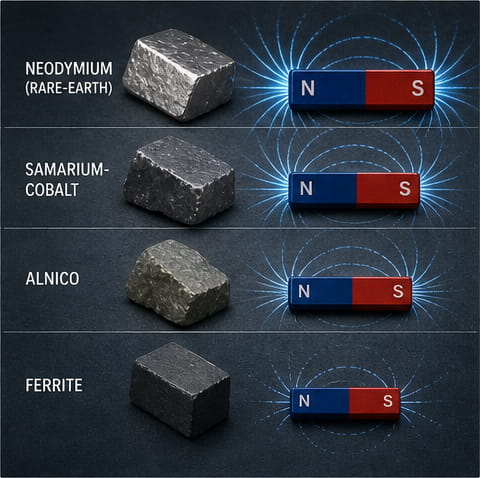
This one’s huge. A magnet’s material determines its maximum strength.
- Neodymium (rare-earth) magnets are among the strongest available, with tightly ordered domains.
- Samarium-cobalt magnets hold their strength even at high temperatures.
- Alnico magnets (made from aluminum, nickel, and cobalt) are durable and common.
- Ferrite magnets are weaker, but cheap and corrosion-resistant.
2. Size and Shape
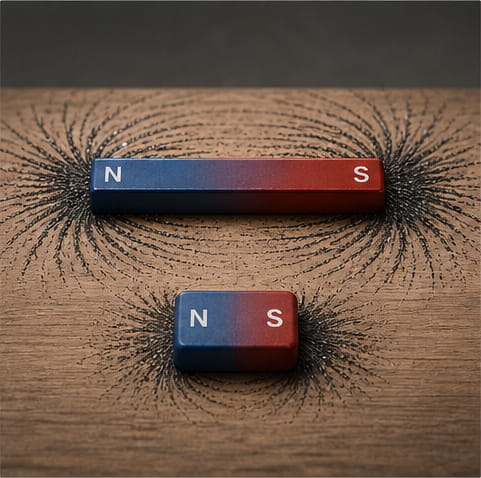
Bigger magnets generally produce stronger fields because they contain more aligned domains. And shape matters too — a longer bar concentrates the field at the ends differently than a short, stubby one.
3. Temperature

Here’s something a lot of people don’t realize: heat weakens magnets.
When a magnet gets hot, it disrupts the alignment of those domains we talked about earlier. Push past a temperature called the Curie point, and the magnet can lose its magnetism permanently.
4. External Magnetic Fields
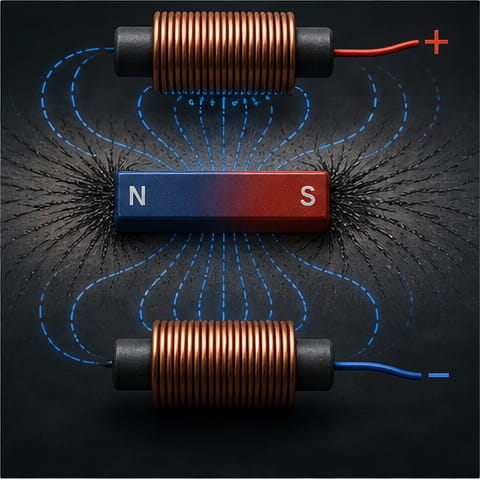
Strong nearby magnets or electromagnetic fields can interfere with a bar magnet’s field, temporarily weakening it or shifting its distribution.
How Do You Actually Measure It?
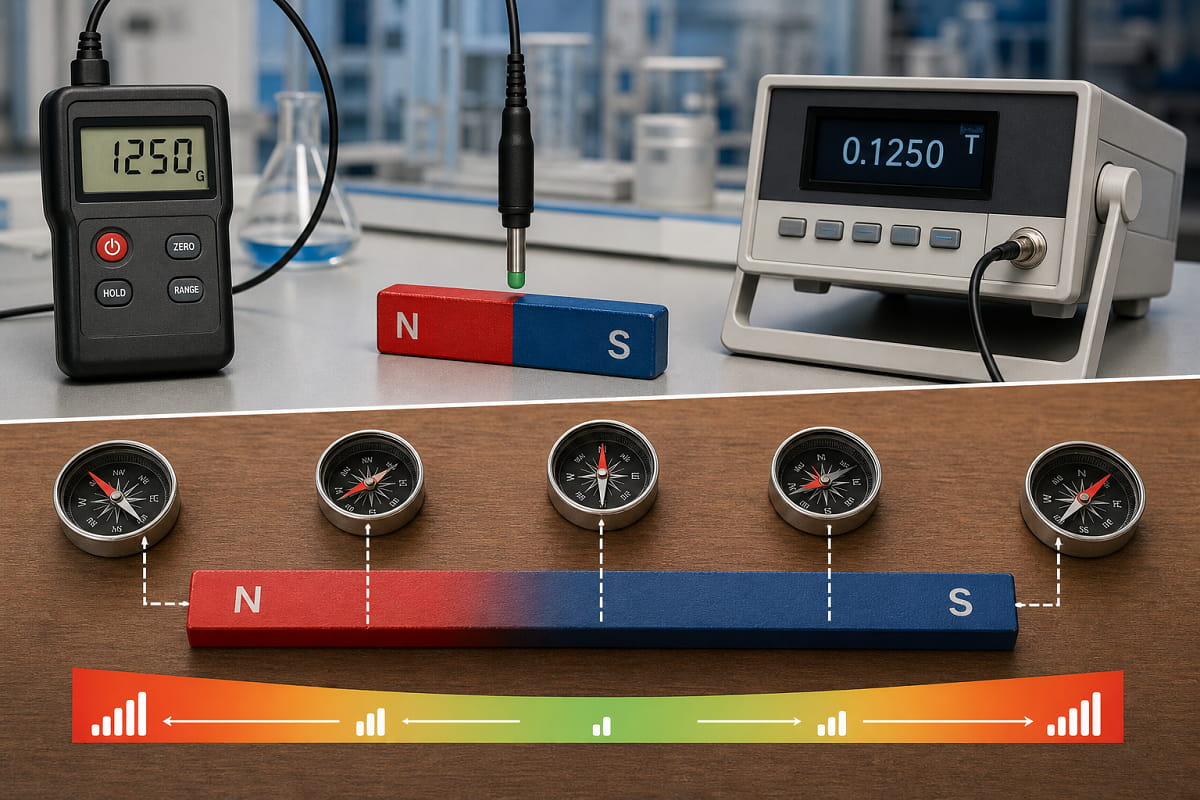
If you want to get precise about it, scientists and engineers use two main tools:
- Gauss meters and magnetometers, which give exact readings in units like gauss or tesla.
These are the standard in research labs and manufacturing, where consistent magnetic strength really matters.
For the rest of us, the DIY methods work great. A compass is perfect — move it around different parts of the magnet and watch how strongly the needle reacts. Near the poles, it’ll swing hard. Near the center, it’ll barely budge.
A Quick Myth-Buster
Before we wrap up, let me clear up two misconceptions I see all the time:
Myth #1: “The magnetic field is the same strength all over the magnet.”
Nope. As we’ve covered, the field is dramatically stronger at the poles than at the center.
Myth #2: “If you cut a bar magnet in half, you’ll get a separate North magnet and a separate South magnet.”
This one surprises everyone. The answer is no.
If you cut a bar magnet in two, you don’t get one isolated North pole and one isolated South pole. Instead, each piece becomes its own complete magnet — with its own North AND South pole.
You can keep cutting forever, and you’ll always end up with smaller magnets that each have two poles. Scientists have never found a magnet with just one pole (called a “monopole”). That’s why magnets are called dipoles — “di” meaning two.
The Bottom Line
So, what is the strongest part of a bar magnet? It’s the poles — the two ends where the North and South forces are concentrated.
This happens because the magnetic field lines bunch together tightly at the poles, driven by millions of aligned magnetic domains inside the material. The center, by contrast, is the weakest spot.
Here’s the simplest way to remember it: a bar magnet does its heavy lifting at the ends, not the middle.
And now you know not just where the strongest part is, but why — plus how to prove it with a handful of iron filings and a piece of paper.