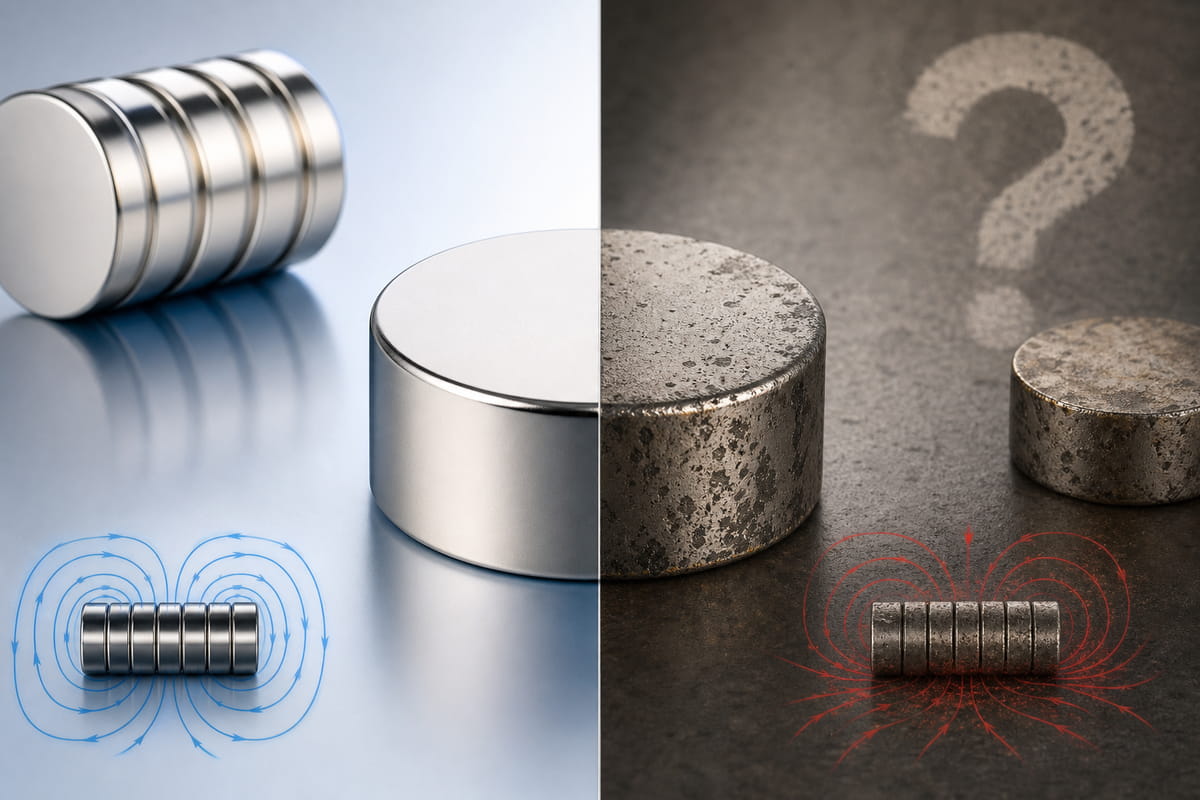
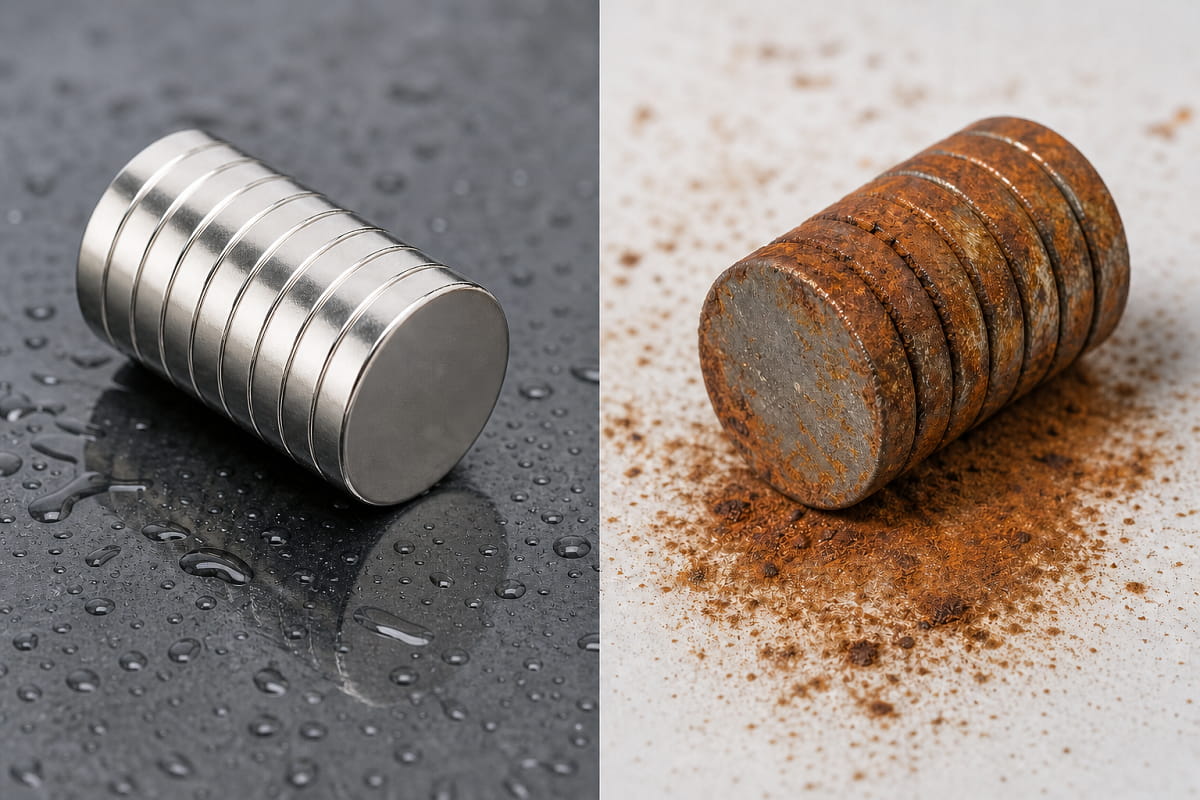
Quick Summary:
N52 is the smarter choice for 95% of applications—it’s widely available, much cheaper, and still incredibly strong. N55 offers only 5–6% more strength but costs 2–3x more, is more brittle, and can have lower temperature tolerance.
Unless you’re building ultra-compact aerospace, defense, or precision medical gear, start with N52. Buy a sample of each and test in your actual application before committing to N55.
N52 vs N55 magnets is a practical choice, not a spec-sheet contest. N55 is only about 5–6% stronger than N52, but that small gain can come with higher cost, limited availability, more brittleness, and possible trade-offs in temperature tolerance.
N52 is easy to find, much cheaper, and strong enough for most uses. N55 is a good choice when space is limited and magnetic force is important. This can be in aerospace, defense, precision medical equipment, or compact high-end devices. If your application doesn’t need extra strength or heat, start with N52.
In this article, as a professional custom N52 magnets and N55 magnets manufacturer, I will make a complete comparison between this two grades of neodymium magnets.
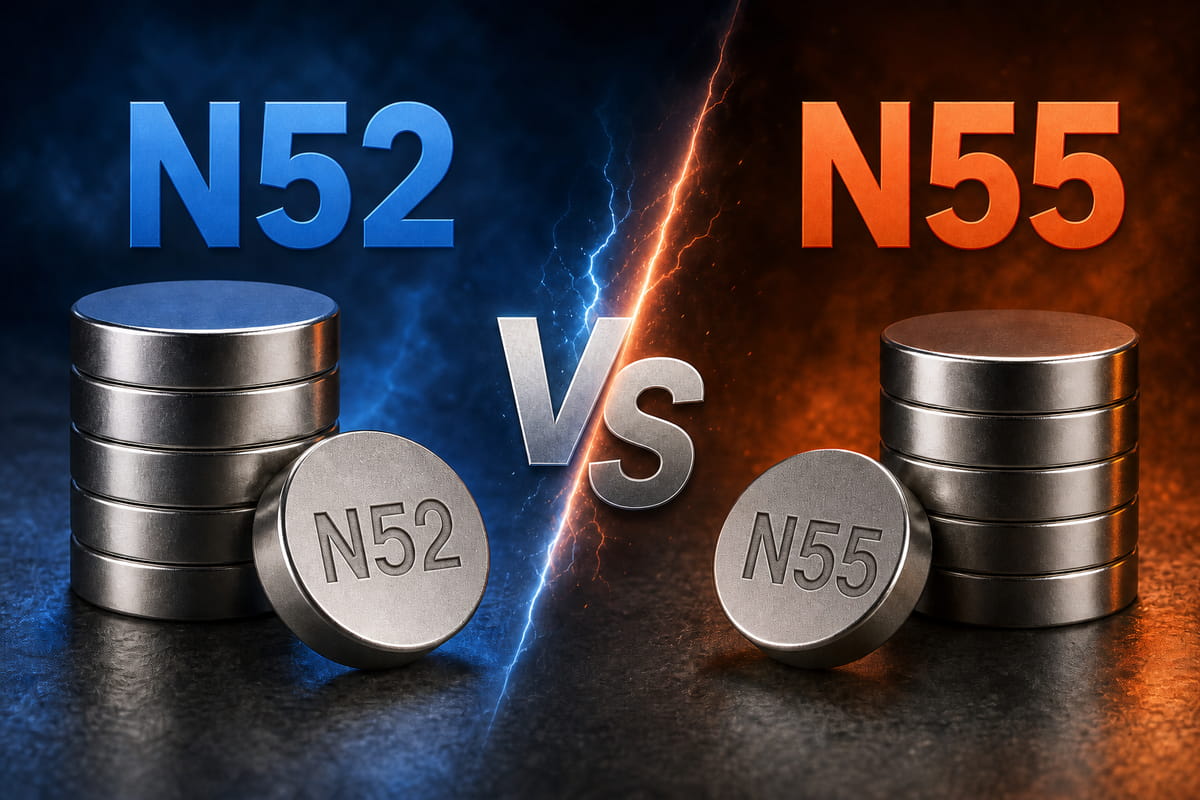
Difference Between N52 and N55 Magnets
In simple terms: N55 magnets are about 5-6% stronger than N52 magnets.
But that small percentage difference comes with some BIG trade-offs.
Let’s look at the raw data.
The Numbers Don’t Lie
| Feature | N52 | N55 |
|---|---|---|
| Max Energy Product (BHmax) | ~52 MGOe | ~55 MGOe |
| Strength vs N52 | Baseline | 5-6% stronger |
| Temperature Limit | 80°C (176°F) | 60-80°C (depends on manufacturer) |
| Cost | Moderate | Very High |
| Availability | Widely available | Limited |
| Brittleness | Can chip | More prone to chipping |
Pro Tip: When I’m choosing between these two grades, I always look at the application first. Not the spec sheet.
N52 vs N55 Magnets: Detailed Cmparison
N55 vs N52 Strength Compare: The Raw Data
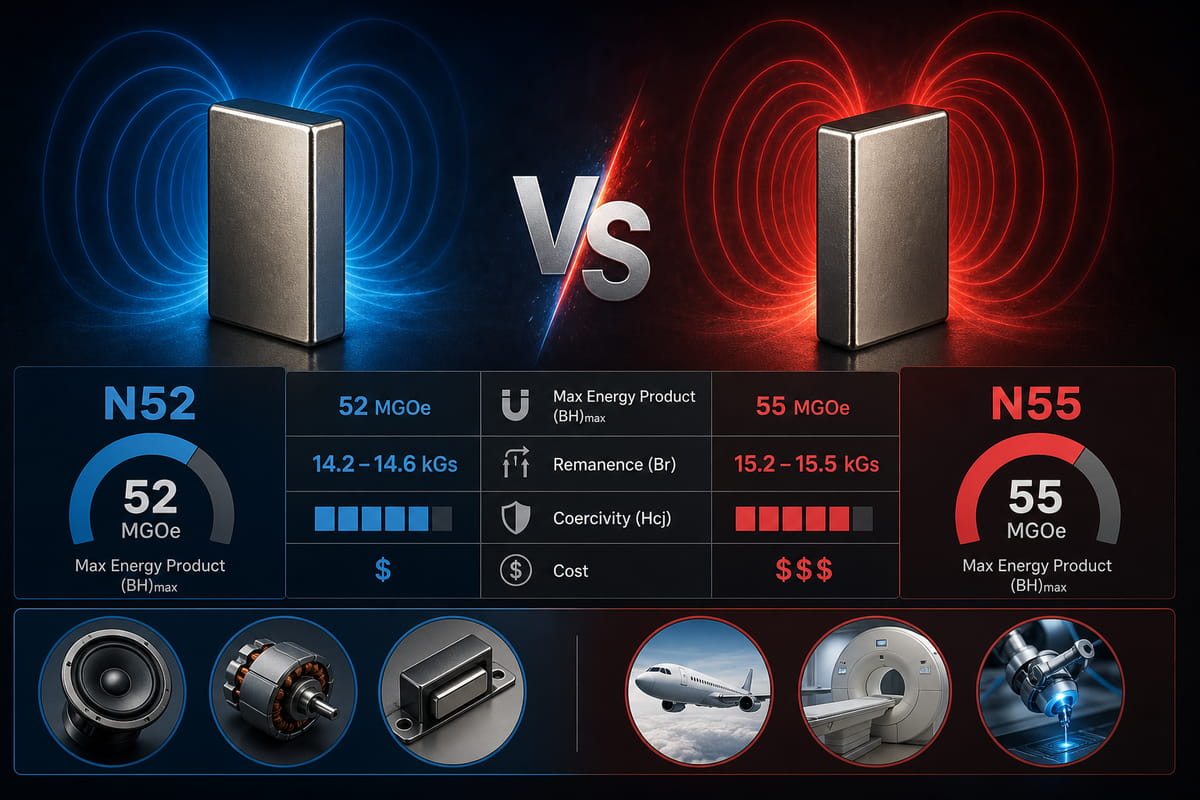
An N52 magnet has a maximum energy product of about 52 MGOe (Mega-Gauss Oersteds). An N55? You guessed it—around 55 MGOe.
That’s roughly 5-6% more magnetic punch per volume.
But here’s what most people don’t tell you:
That extra strength comes at a steep price.
I’ve seen N55 magnets cost 2-3x more than their N52 counterparts. And for most applications? You won’t even notice the difference.
Remanence and Coercivity
N52 magnets typically have a remanence (Br) of 14.2-14.6 kGs.
N55 magnets? About 15.2-15.5 kGs.
Sounds impressive, right?
But unless you’re working in aerospace or cutting-edge medical devices, that extra 1 kGs probably won’t matter.
The Cold, Hard Truth About Cost
Let’s talk money.
N55 magnets are expensive. Really expensive.
Why?
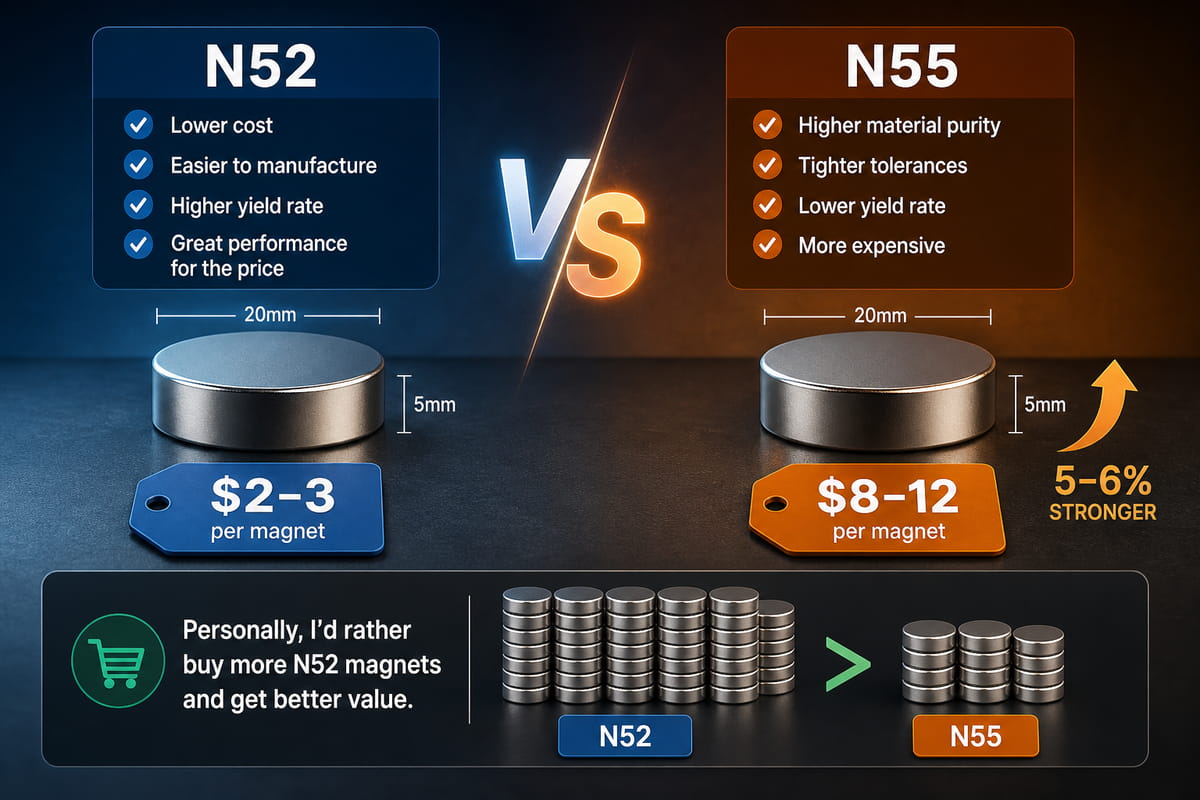
Because manufacturing N55 requires higher material purity and tighter tolerances. It’s harder to produce consistently. And the yield rate? Lower than N52.
All of that gets passed on to you.
Real-World Example
Let’s say you need a 20mm x 5mm disc magnet.
An N52 version might cost you $2-3 per magnet.
An N55 version? Could easily be $8-12.
For a 5-6% strength increase.
Is that worth it? Only you can answer that. But personally, I’d rather buy more N52 magnets and get better value.
Temperature Tolerance: A Hidden Difference
This is where things get tricky.
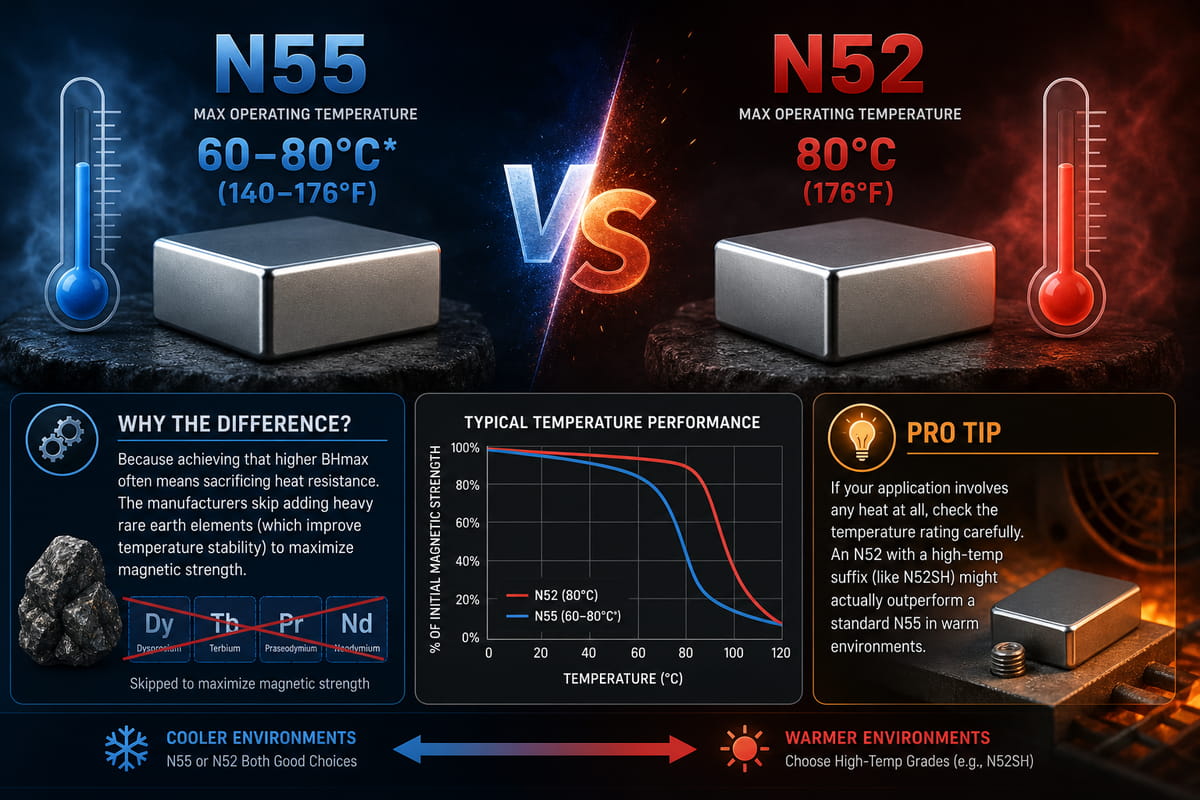
Standard N52 magnets have a maximum operating temperature of about 80°C (176°F).
N55 magnets? Some manufacturers rate them at 80°C. Others drop to 60°C.
Why the difference?
Because achieving that higher BHmax often means sacrificing heat resistance. The manufacturers skip adding heavy rare earth elements (which improve temperature stability) to maximize magnetic strength.
Pro Tip: If your application involves any heat at all, check the temperature rating carefully. An N52 with a high-temp suffix (like N52SH) might actually outperform a standard N55 in warm environments.
What About Coercivity?
Coercivity is a magnet’s resistance to demagnetization.
N52 magnets generally have good coercivity. N55? It can vary.
Some N55 magnets have lower Hcj (intrinsic coercivity) than N52. That means they’re more likely to lose their magnetism under stress or in opposing magnetic fields.
Not ideal for critical applications.
When Should You Choose N55?
N55 magnets shine in very specific situations.
And I mean very specific.
Ultra-Compact Designs
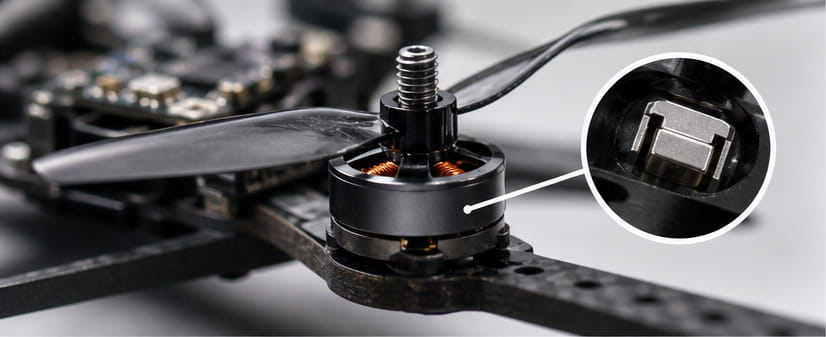
You’re working with a tight footprint. Like, really tight.
Maybe you’re designing a high-end sensor. Or a miniature motor for a drone. Or some precision medical equipment where millimeters matter.
In those cases, N55 can be a lifesaver.
Here’s why:
If you can’t fit a bigger N52 magnet, an N55 gives you more pull force in the same space. Simple as that.
Aerospace and Defense Applications

This is where N55 really earns its keep.
When you’re building something that goes into space or gets deployed in military gear, every ounce of performance counts. And the budget? It’s usually not a concern.
Research and Scientific Equipment

I’ve seen N55 magnets used in university labs and research facilities.
Why? Because when you’re pushing the boundaries of science, you want the best tools available. Even if that means paying a premium.
When N52 Is the Smarter Choice
Here’s the truth:
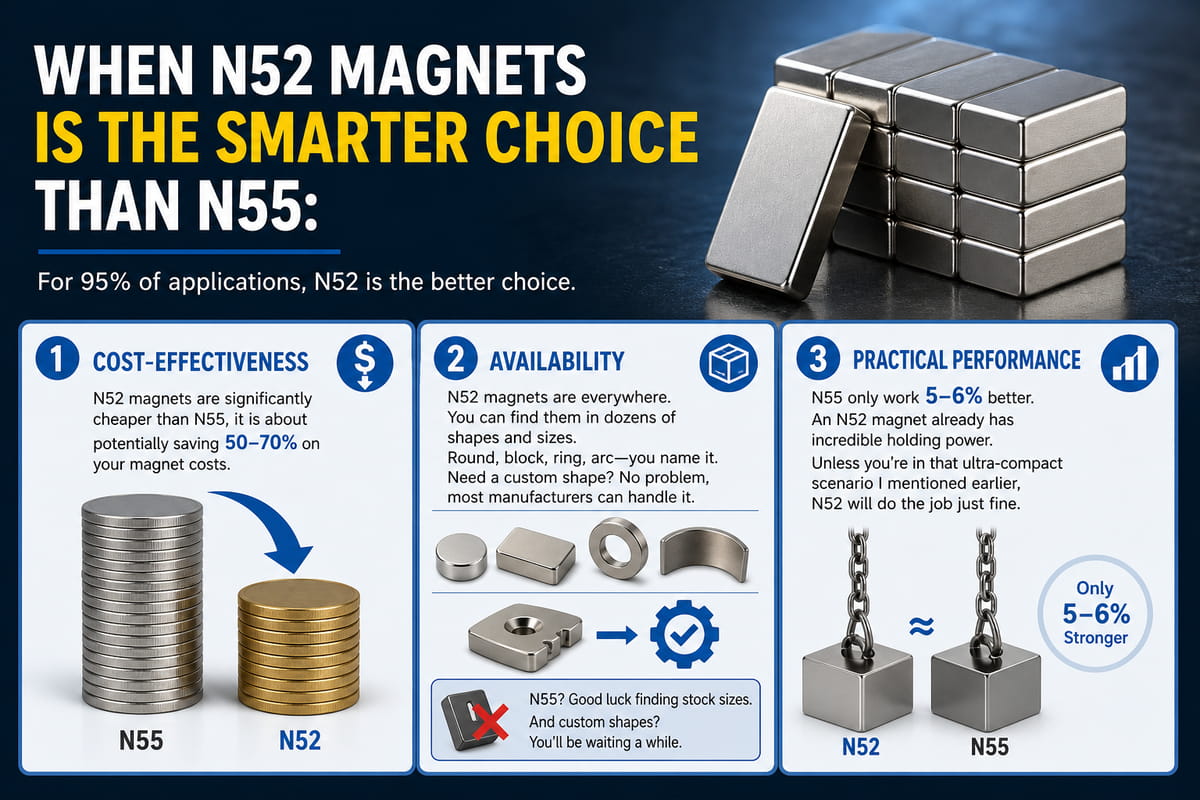
For 95% of applications, N52 is the better choice.
I’m not exaggerating.
Cost-Effectiveness
N52 magnets are significantly cheaper than N55.
And I’m not talking about a small difference. We’re talking about potentially saving 50-70% on your magnet costs.
Availability
N52 magnets are everywhere.
You can find them in dozens of shapes and sizes. Round, block, ring, arc—you name it. Need a custom shape? No problem, most manufacturers can handle it.
N55? Good luck finding stock sizes. And custom shapes? You’ll be waiting a while.
Practical Performance
Here’s a question I ask my clients:
“Will you actually notice that 5-6% difference?”
For most people, the answer is no.
An N52 magnet already has incredible holding power. Unless you’re in that ultra-compact scenario I mentioned earlier, N52 will do the job just fine.
My Personal Recommendation
I’ve worked with magnets for years. And here’s my honest advice:
Start with N52.
Unless you have a specific reason to need N55, go with N52. It’s stronger than 99% of applications will ever need. It’s widely available. And it won’t break the bank.
If you test your prototype and find you need more strength? Then consider upgrading.
But don’t start with N55. You’ll likely overpay for performance you don’t need.
Applications Where N52 Shines
- Consumer electronics: Headphones, speakers, smartphone accessories
- Industrial automation: Motors, sensors, magnetic clamps
- Renewable energy: Wind turbines, generators
- Woodworking: Jigs, fixtures, magnetic holders
- DIY projects: Crafts, models, hobbyist builds
Applications Where N55 Makes Sense
- Aerospace components: Space-constrained, high-stakes environments
- Defense technology: Where performance is non-negotiable
- Precision medical sensors: When every millimeter and gauss counts
- High-end motors: Racing drones, specialized robotics
The Bottom Line
N52 vs N55 magnets isn’t really a competition.
N52 is the workhorse. It’s reliable, affordable, and available.
N55 is the specialist. It’s powerful but expensive, brittle, and hard to find.
For most people, N52 is the right choice.
But if you’re pushing the limits of what’s possible in a tiny space? N55 might be worth the premium.
Just make sure you actually need it.