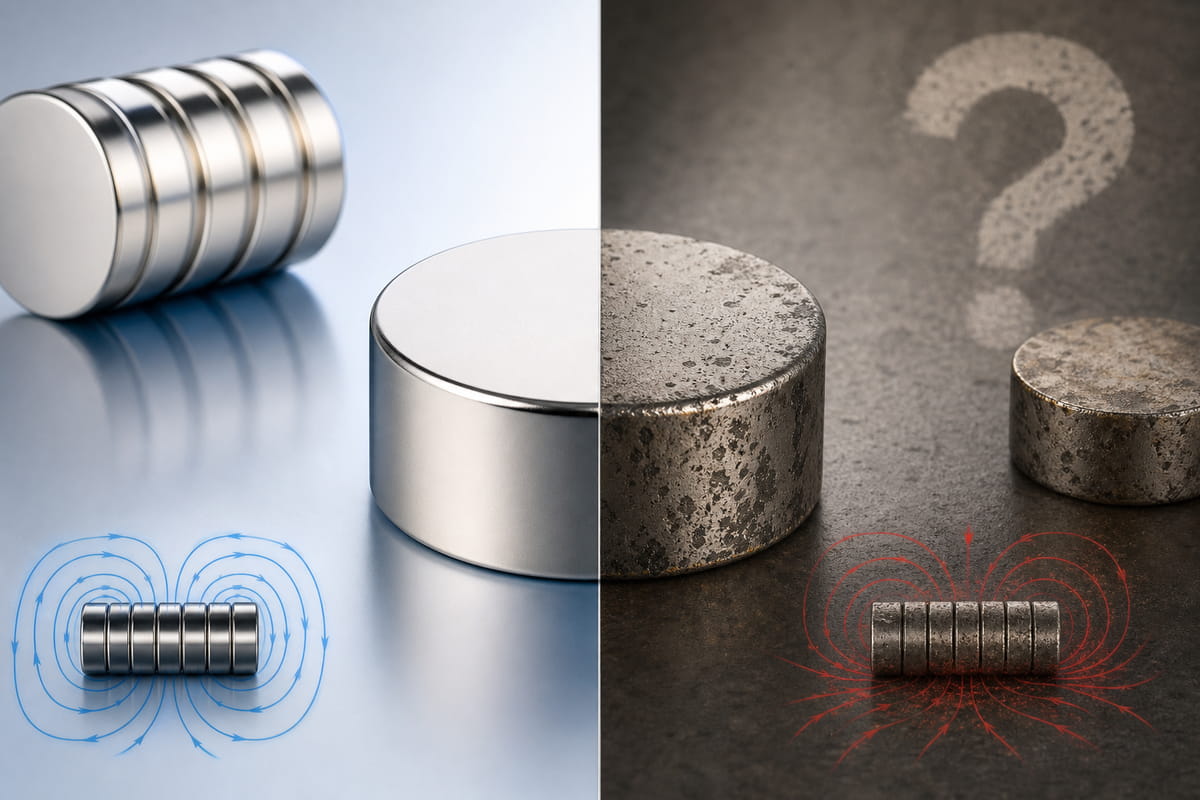
Quick Summary:
N45 magnets deliver 20–30% more magnetic strength than N35 but cost 15–30% more. Both grades share the same 80°C maximum temperature limit unless you add a suffix like M, H, or SH.
N35 is the cost‑effective choice for everyday applications, while N45 shines in compact, demanding jobs where every bit of holding power counts. Start with N35; only upgrade to N45 if testing shows you genuinely need the extra strength.
Are you trying to decide between N35 and N45 magnets?
You’ve probably seen both grades listed online. Maybe you’re building a project and need something that holds tight. Or perhaps you’re just curious about what those numbers actually mean.
Either way, I’ve got you covered.
As a professional custom N35 magnets and N45 magnets manufacturer, let me break down the real differences between N35 vs n45 magnets so you can make the right call for your specific situation.
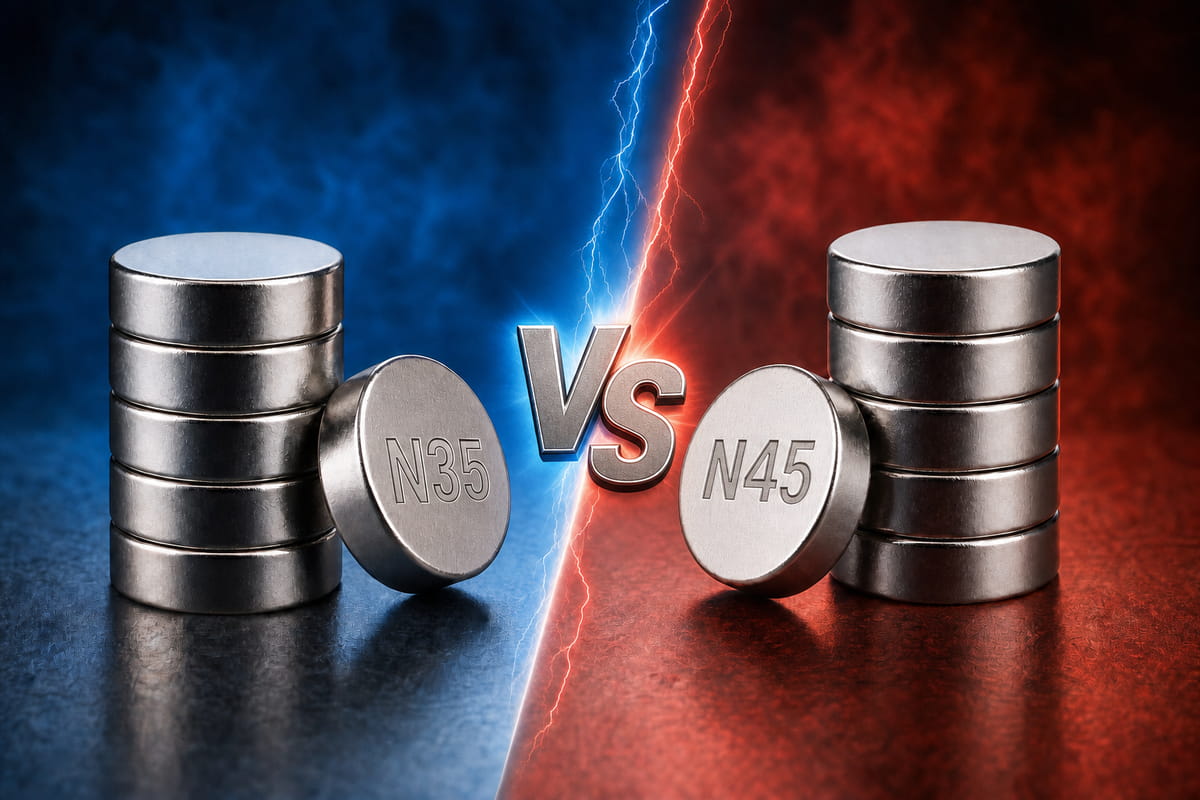
N35 vs N45: What The Numbers Mean
The “N” stands for Neodymium. And the number? That’s the magnet’s Maximum Energy Product—measured in Mega-Gauss Oersteds (MGOe).
Think of it like a horsepower rating for magnets.
- N35 = 35 MGOe
- N45 = 45 MGOe
Higher number = stronger magnet.
But that 10-point difference translates into a roughly 20-30% boost in magnetic strength. Which is significant. Especially when space is tight.
Let’s look at the actual numbers:
N35 magnets typically have a residual induction (Br) of 11.7–12.2 kGs. Their coercive force sits around 868 kOe. And the max energy product? 33–36 MGOe.
N45 magnets crank things up. Residual induction hits 13.2–13.7 kGs. And the max energy product climbs to 43–45 MGOe.
N45 packs more punch per square inch.
N35 vs N45 Magnets: Complete Comparison
Magnetic Strength: The Real Difference
This is what everyone wants to know.
How much stronger is N45 than N35?
In my experience testing these magnets side by side, the difference is noticeable right away.
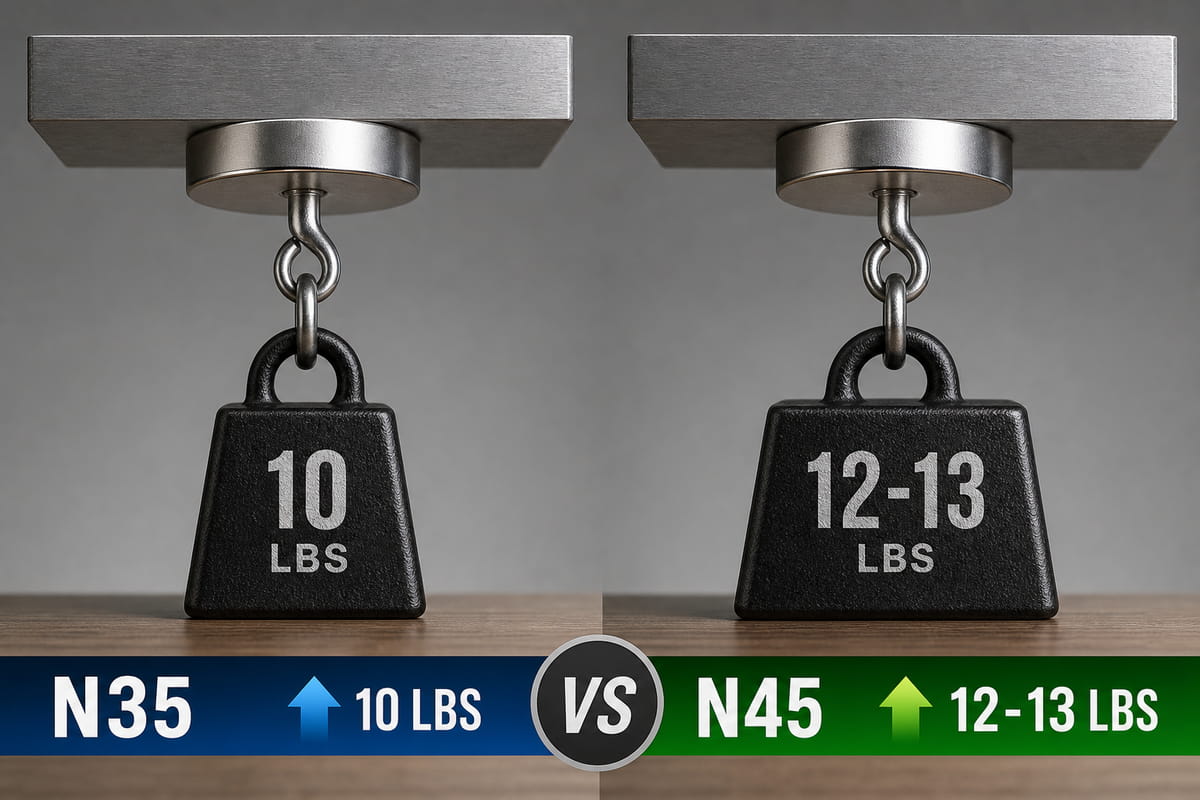
Take two identically-sized disc magnets. Say, 1 inch diameter, 1/4 inch thick.
The N35 might hold 10 pounds. The N45? You’re looking at roughly 12-13 pounds of holding force.
That extra 20-30% can make or break certain applications.
Pro Tip: If you’re trying to match the holding power of a larger N35 magnet, you can often use a smaller N45 magnet instead. This is huge when space is limited.
Temperature Resistance: Same But Different
Here’s something most people get wrong:
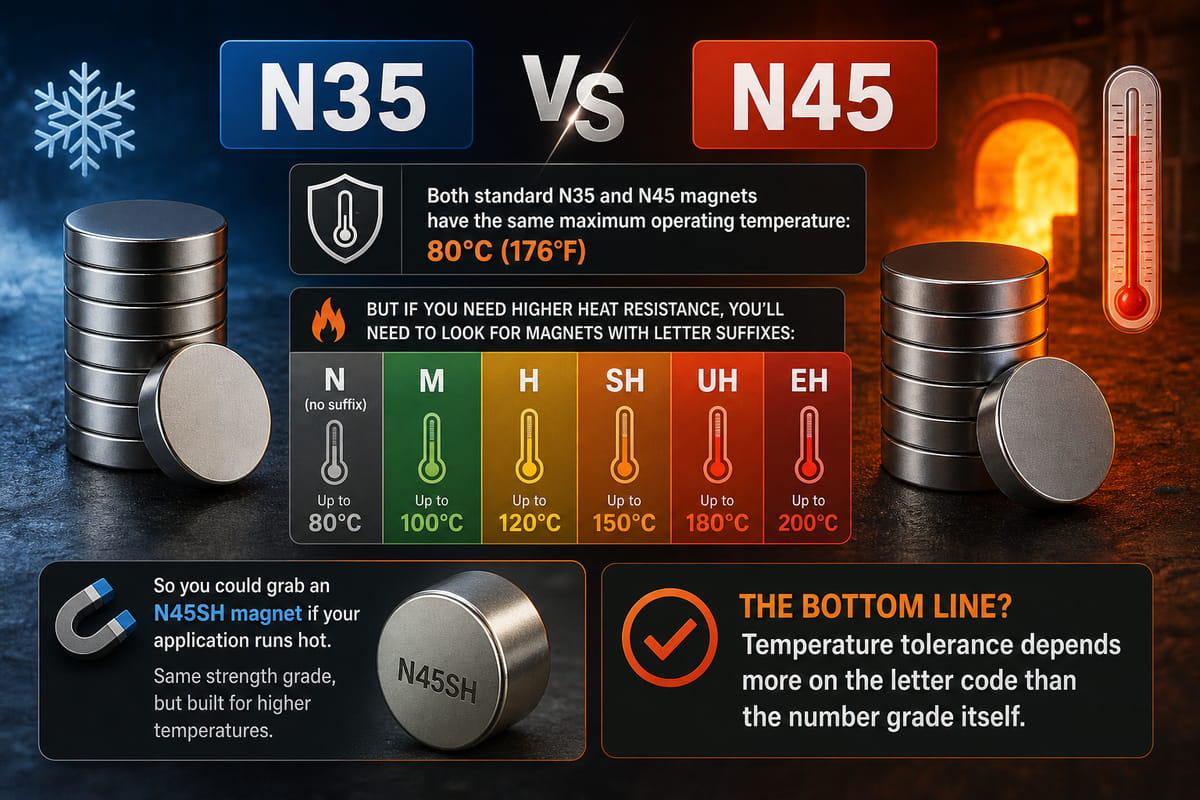
Both standard N35 and N45 magnets have the same maximum operating temperature: 80°C (176°F).
No difference there.
But—and this is important—if you need higher heat resistance, you’ll need to look for magnets with letter suffixes.
Let me explain:
- N (no suffix): Up to 80°C
- M: Up to 100°C
- H: Up to 120°C
- SH: Up to 150°C
- UH: Up to 180°C
- EH: Up to 200°C
So you could grab an N45SH magnet if your application runs hot. Same strength grade, but built for higher temperatures.
The bottom line? Temperature tolerance depends more on the letter code than the number grade itself.
Price: What You’ll Actually Pay
Let’s talk money.
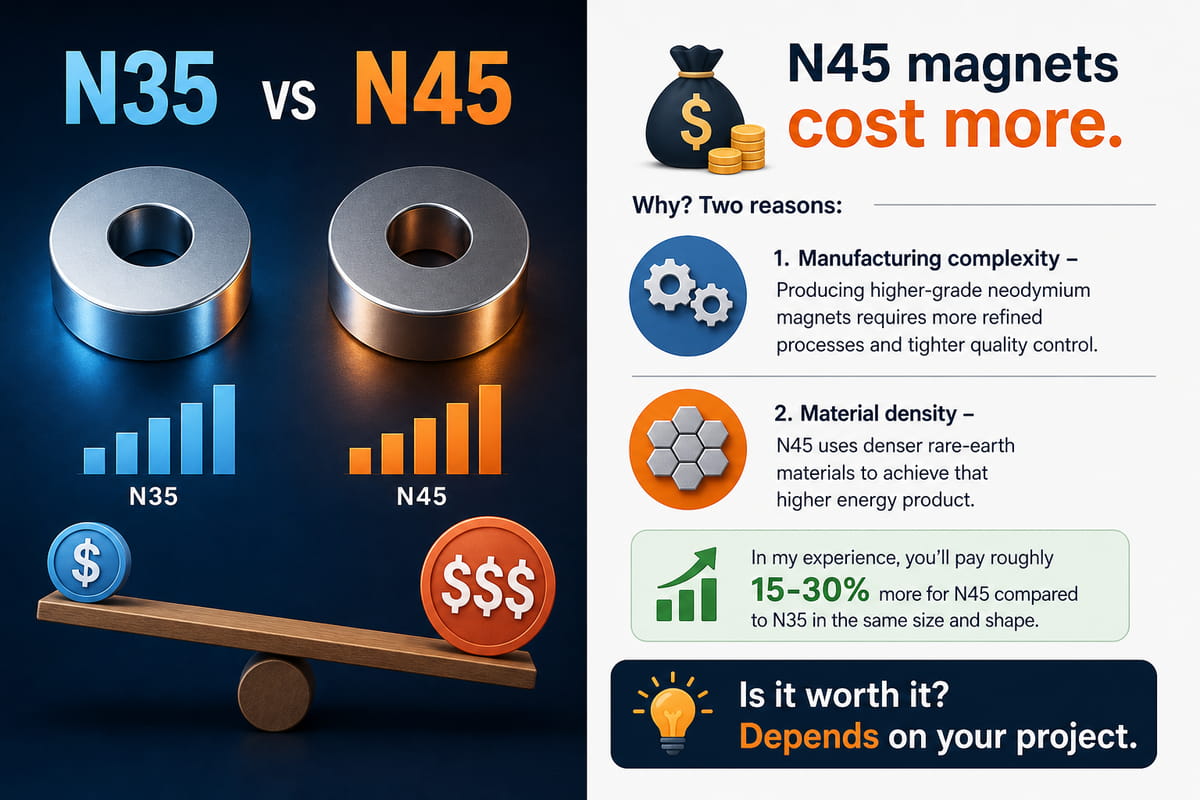
N45 magnets cost more. Period.
Why? Two reasons:
- 1. Manufacturing complexity – Producing higher-grade neodymium magnets requires more refined processes and tighter quality control.
- 2. Material density – N45 uses denser rare-earth materials to achieve that higher energy product.
In my experience, you’ll pay roughly 15-30% more for N45 compared to N35 in the same size and shape.
Is it worth it?
Depends on your project.
Coercive Force: What You Need to Know
This one trips people up.
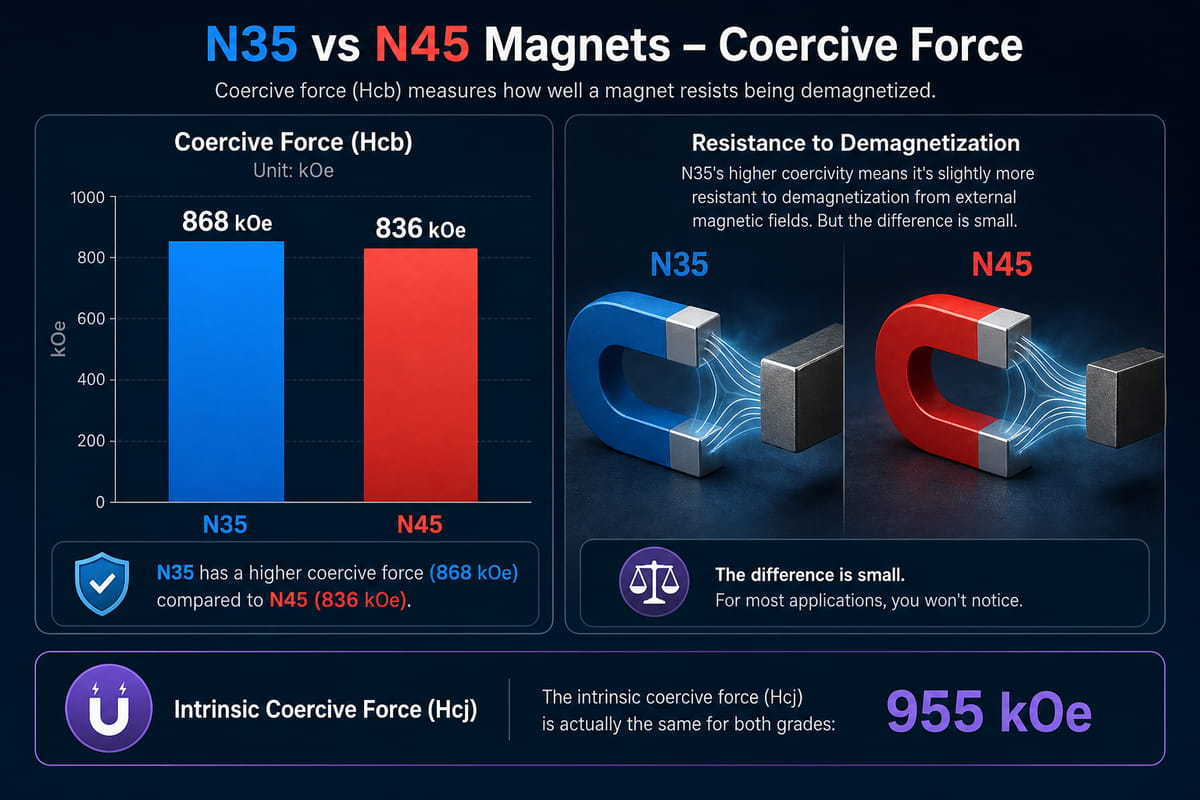
Coercive force (Hcb) measures how well a magnet resists being demagnetized.
Here’s the interesting part:
N35 has a higher coercive force (868 kOe) compared to N45 (836 kOe).
Wait—doesn’t that mean N35 is “better” in some way?
Sort of.
N35’s higher coercivity means it’s slightly more resistant to demagnetization from external magnetic fields. But the difference is small. For most applications, you won’t notice.
The intrinsic coercive force (Hcj) is actually the same for both grades: 955 kOe.
So don’t let this be a deciding factor unless you’re working in specialized environments with strong opposing magnetic fields.
Common Shapes and Sizes
Both N35 and N45 come in a wide variety of shapes:
- Discs
- Blocks
- Cylinders
- Rings
- Cubes
- Rods
- Spheres
- Custom shapes
The grade doesn’t limit your shape options. Your manufacturer can produce either grade in almost any configuration.
I personally recommend disc and block shapes for most applications. They’re easier to work with and offer predictable magnetic fields.
Coatings Matter More Than You Think
Here’s something that doesn’t get enough attention:
The coating on your magnet can be just as important as the grade.
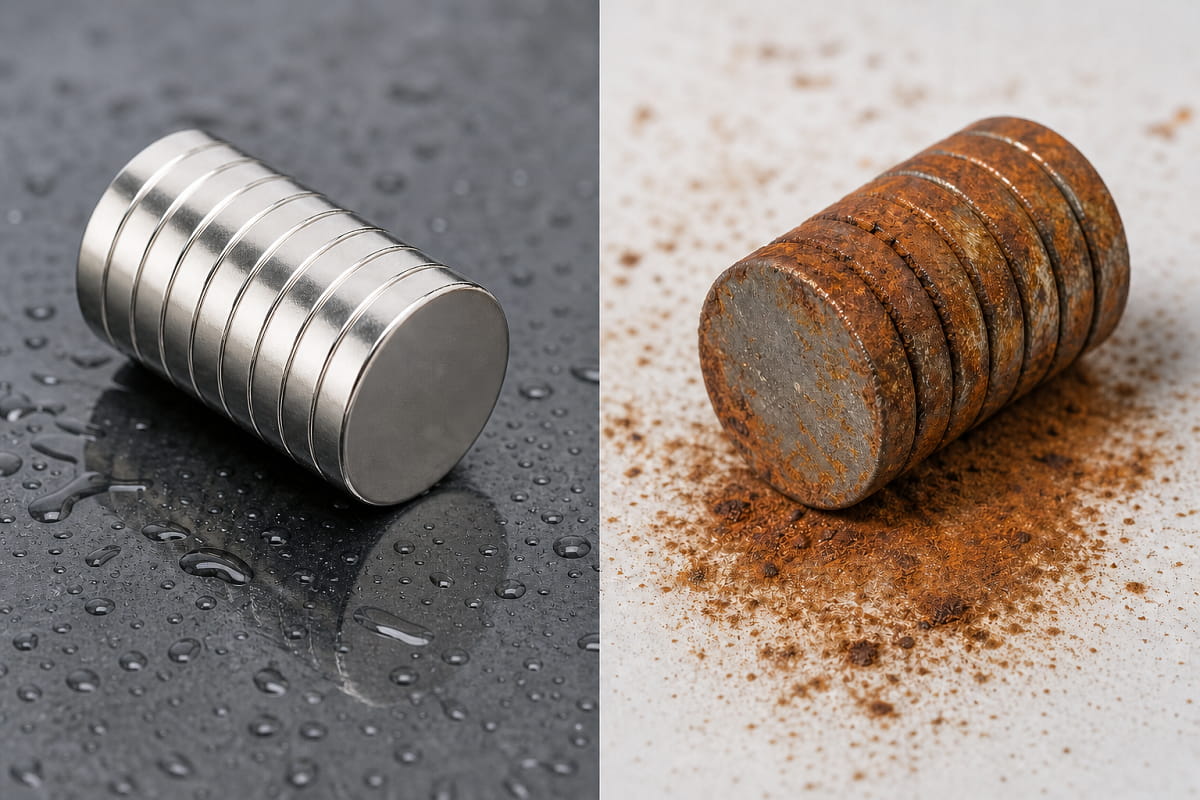
Neodymium magnets are prone to corrosion. Especially in humid environments. The right coating extends their life dramatically.
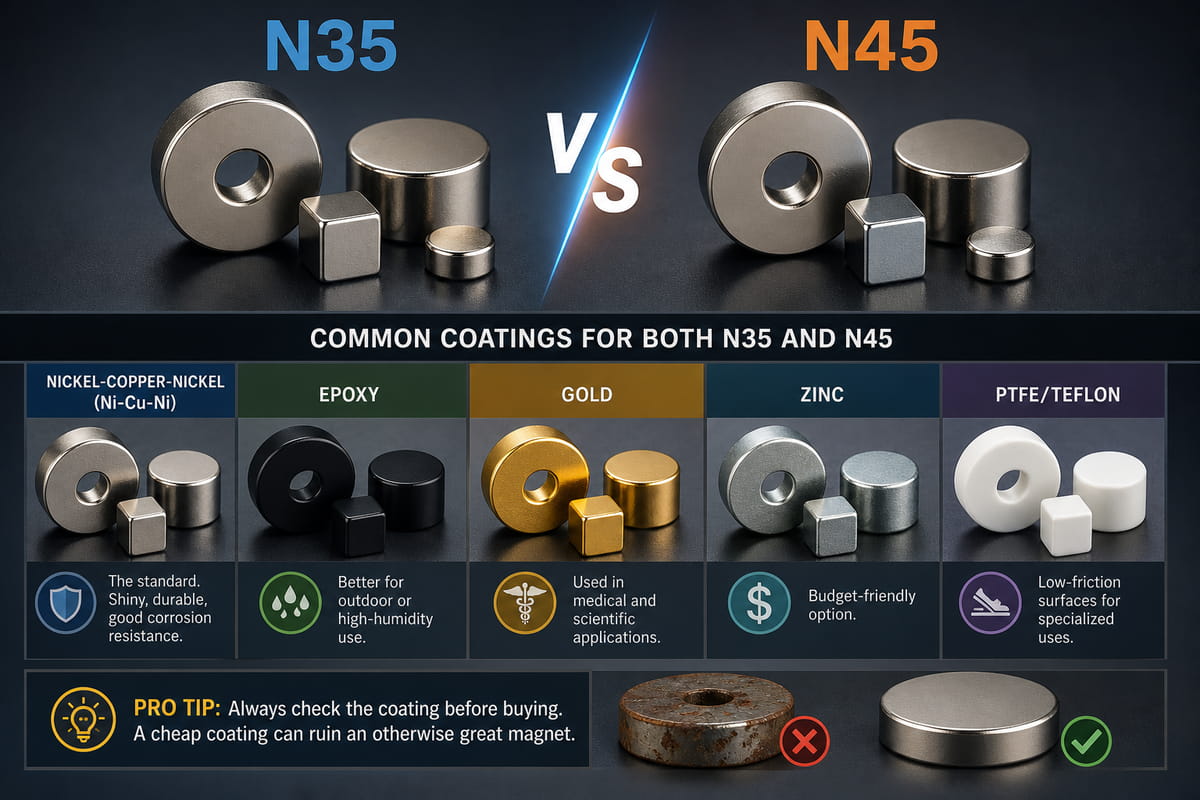
Common coatings for both N35 and N45:
- Nickel-Copper-Nickel (Ni-Cu-Ni) – The standard. Shiny, durable, good corrosion resistance.
- Epoxy – Better for outdoor or high-humidity use.
- Gold – Used in medical and scientific applications.
- Zinc – Budget-friendly option.
- PTFE/Teflon – Low-friction surfaces for specialized uses.
Pro Tip: Always check the coating before buying. A cheap coating can ruin an otherwise great magnet.
Real-World Application Examples
Scenario 1: Craft Project

You’re making magnetic name tags for a conference. The magnets need to hold a small piece of metal through fabric.
N35 works perfectly. Save your money.
Scenario 2: Robotic Arm Gripper

You’re building a gripper that needs to pick up metal parts in a factory. Space is tight. Holding force is critical.
Go with N45. The extra 20-30% strength ensures reliability.
Scenario 3: Wind Turbine Generator

You need compact, powerful magnets for a small wind turbine. The generator runs warm, so you need heat resistance too.
N45SH. That’s your sweet spot. Strong enough to generate power efficiently, with the ‘SH’ suffix for high-temperature operation.
Scenario 4: Magnetic Closures for Furniture

Cabinet doors, jewelry boxes, display cases.
N35 is your go-to. Standard strength, lower cost, gets the job done.
The Cost-Benefit Analysis
Let me be straight with you:
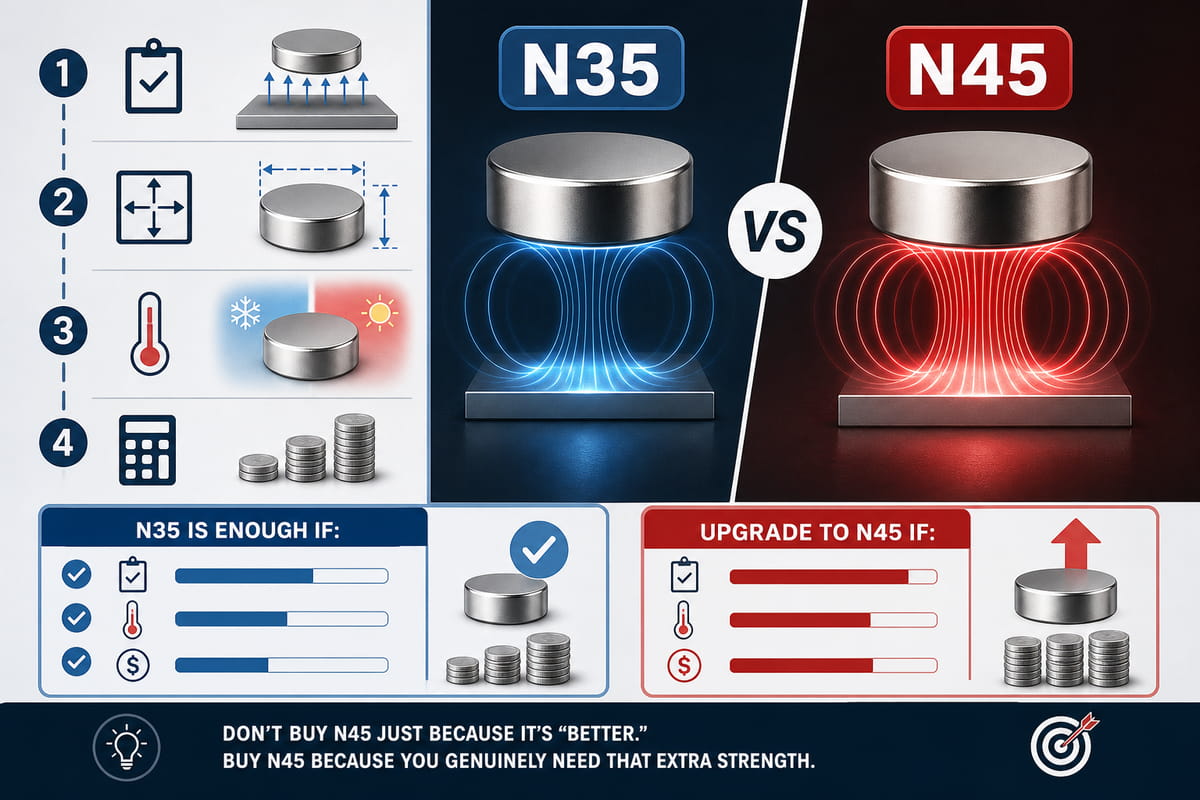
Don’t buy N45 just because it’s “better.”
Buy N45 because you genuinely need that extra strength.
Here’s a simple framework I use:
- 1. Calculate your minimum holding force requirement
- 2. Determine your available space for the magnet
- 3. Check your operating temperature
- 4. Consider your budget
If N35 meets your requirements in steps 1-3, use N35. You’ll save money without sacrificing performance.
If N35 falls short—especially in compact spaces—upgrade to N45.
It’s that simple.
N35 vs N45 Magnets: When to Use Each
When to Use N35 Magnets

Look, you don’t always need the strongest magnet available. Sometimes N35 is the smarter choice.
Here’s when I recommend N35:
Everyday crafts and DIY projects – Making fridge magnets? Building a simple closure for a cabinet? N35 is more than enough.
Cost-effective prototyping – When you’re testing designs and need to iterate quickly, go with N35. Save money while you figure out what works.
Basic electronic devices – Sensors, basic motors, simple magnetic switches. N35 handles these just fine.
Large surface area applications – If you’ve got plenty of space, using a larger N35 can match the holding power of a smaller N45. And it’ll likely cost less.
Low-temperature environments – Standard room temperature applications? N35 is your friend.
The magnetic field strength of N35 is still impressive. It’s just not in the same league as N45.
When to Use N45 Magnets
Now here’s where N45 shines:
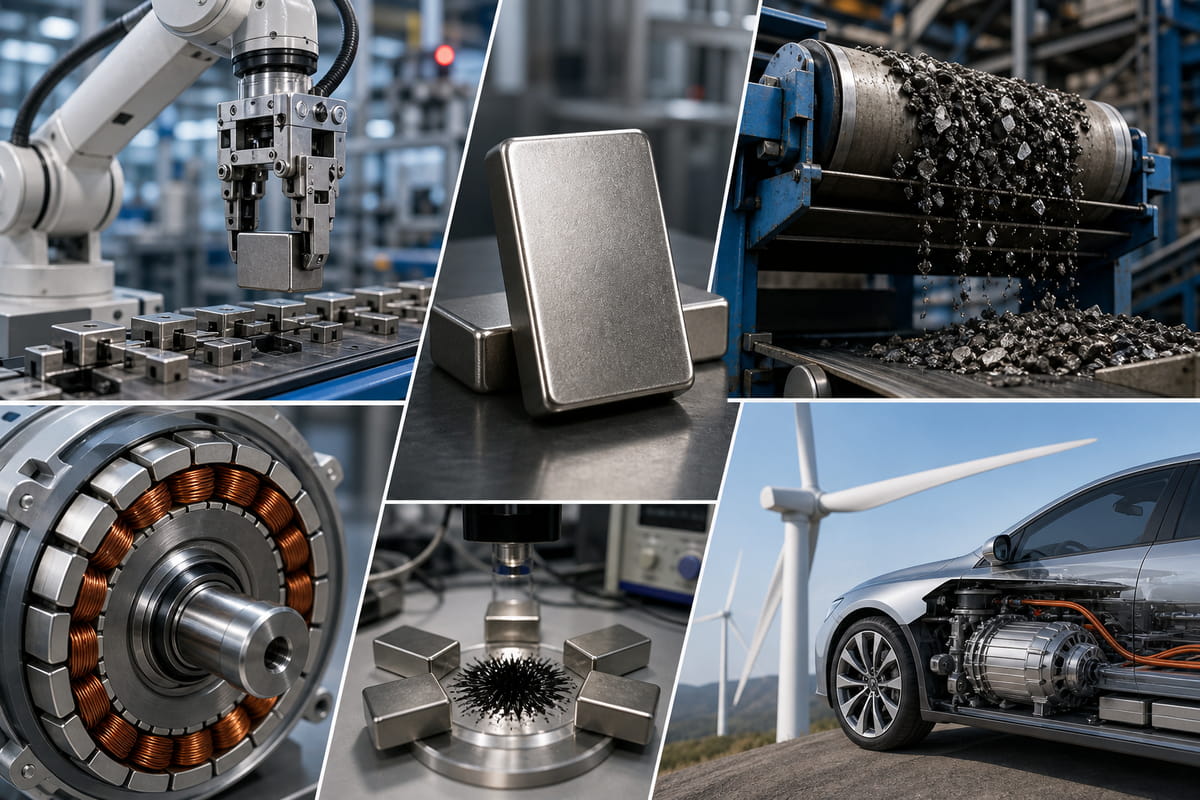
Compact, demanding applications – This is the sweet spot. When you need maximum holding power but have limited space, N45 is the answer.
Robotics and automation – Precision movements require strong, reliable magnetic fields. N45 delivers.
Commercial and industrial equipment – Think magnetic separators, heavy-duty clamps, and industrial sensors.
High-performance motors – Wind turbine generators, electric vehicle motors, precision instruments. These demand the extra strength.
Scientific experiments – When consistent, strong magnetic fields are critical for your results.
In my experience, once you move into professional or industrial territory, N45 becomes the standard choice.
Final Thoughts
Choosing between these two grades doesn’t have to be complicated.
N35 magnet is your everyday workhorse. Reliable, cost-effective, and powerful enough for most applications.
N45 magnet is your specialist. Stronger, denser, and worth the premium when you need maximum performance in a small package.
The decision comes down to your specific needs: required holding force, available space, temperature environment, and budget.
And remember—both grades max out at 80°C unless you add a temperature suffix. So don’t assume N45 magnet handles heat better.
In my experience, the best approach is to start with N35 magnet for most projects. If testing shows you need more strength, then make the jump to N45 magnet.
That way, you’re not overpaying for performance you don’t need.
Bottom line? Understand your application, match the grade to your requirements, and you’ll make the right choice between N35 vs n45 magnets every time.