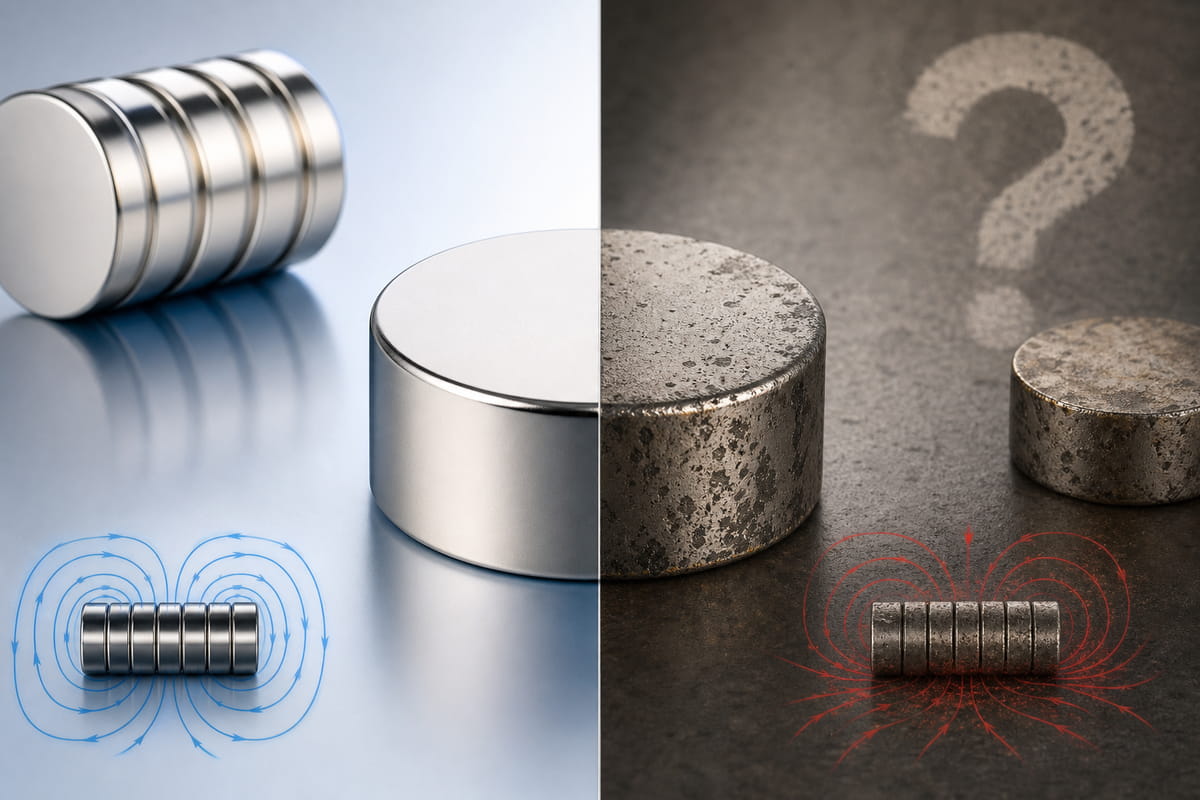
Quick Summary:
N54 is only 2–4% stronger than N52—most people can’t feel the difference without precision equipment. But N54 costs 25–50% more, is harder to find, and is more susceptible to demagnetization and heat damage.
For 95% of applications, N52 is the smarter choice: 97% of the performance at half the price, with better availability and stability. Only choose N54 if space is extremely limited, weight is critical, or budget isn’t a concern.
You’re stuck choosing between N52 and N54 magnets, and you just want the strongest one. Maybe you think a higher number guarantees way more power—so N54 seems like the obvious pick. But N54 is only 2–4% stronger than N52, yet it costs 25–50% more, is harder to find, and is actually more prone to demagnetization and heat damage. Most people can’t even feel the difference without lab equipment.
So you’re paying a huge premium for a gain you’ll never notice—and risking permanent failure if things get hot. Sound terrible? In this article, as a professional custom N52 magnets and N54 magnets manufacturer, I will break down the real strength gap, the hidden trade-offs, and exactly when each grade makes sense between N52 and N54 magnets—so you can stop guessing and pick the right magnet for your project.
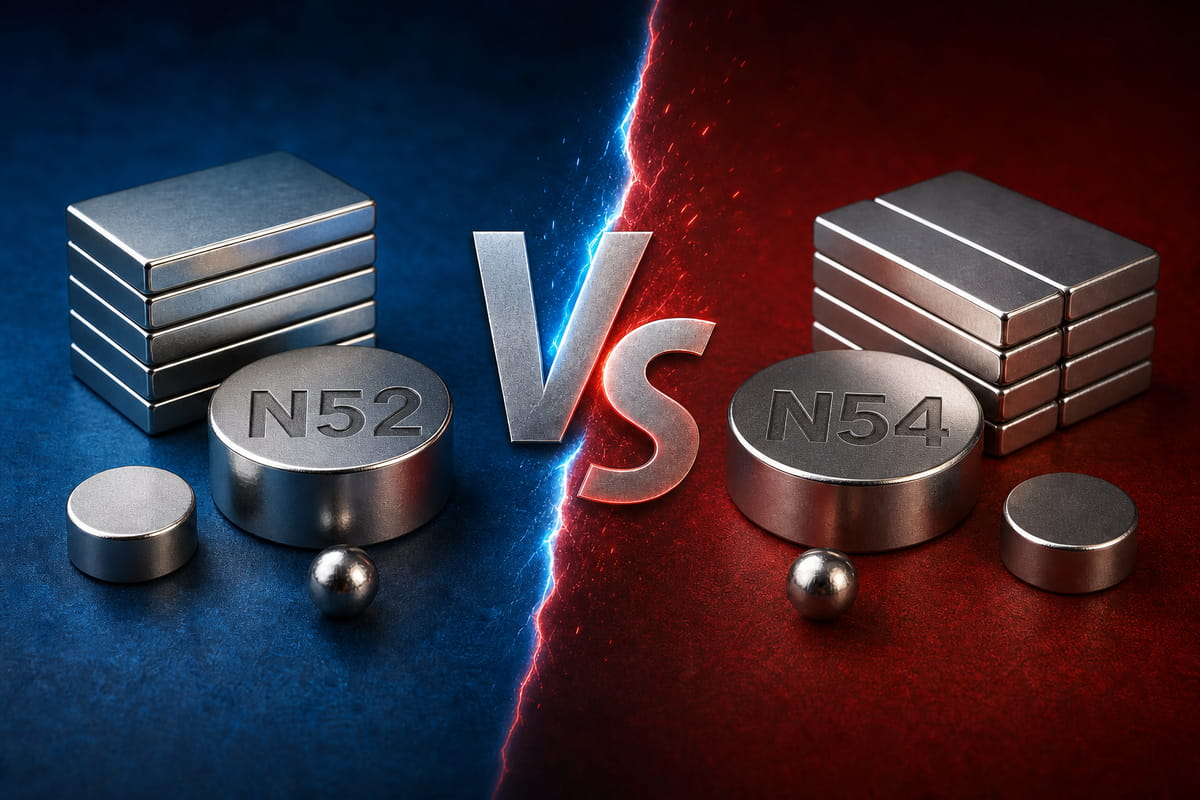
What Do N52 and N54 Actually Mean?
The “N” stands for Neodymium. And the number (52 or 54) refers to the Maximum Energy Product of the magnet. This is measured in MGOe (Mega-Gauss Oersteds).
Think of it like horsepower for a car. A higher number means more magnetic energy packed into the same space.
- N52 magnets have a BHmax of 50-52 MGOe.
- N54 magnets have a BHmax of 53-55 MGOe.
N52 vs N54 Magnets Comparison
The Real Difference in Strength
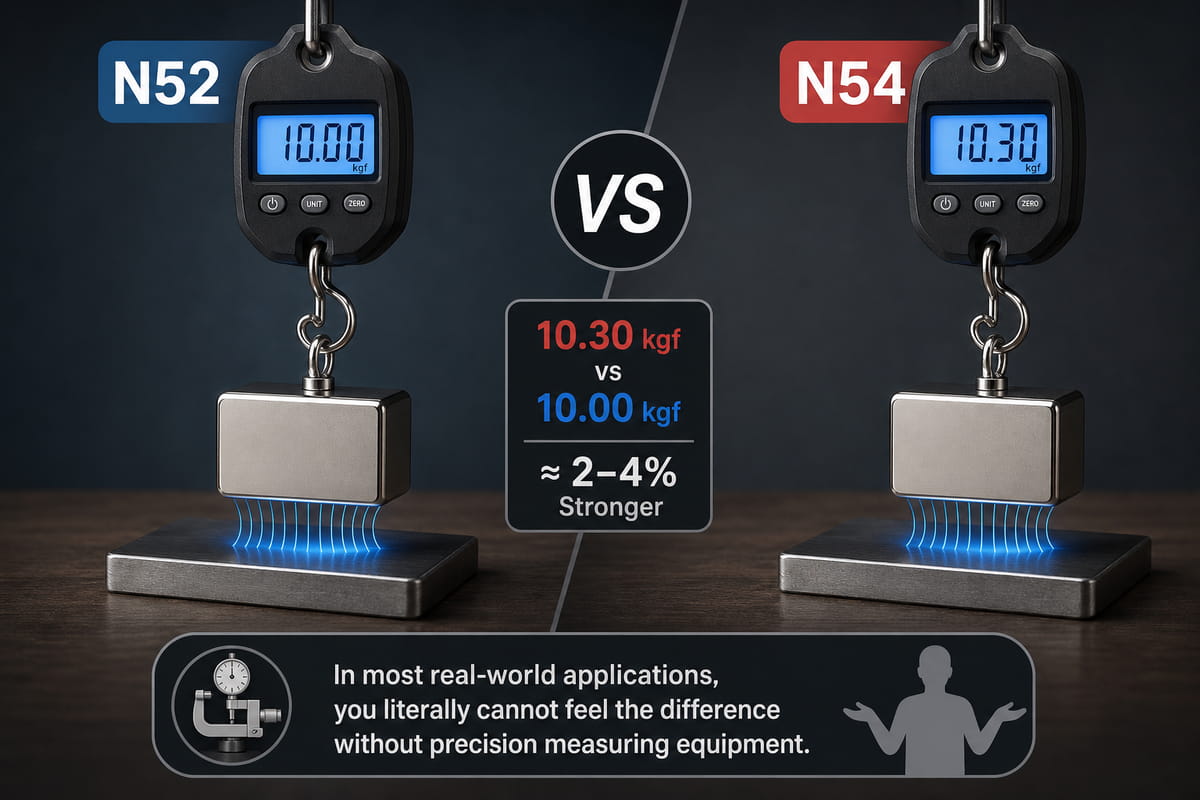
Most people expect N54 to blow N52 out of the water. But the reality? N54 is only about 2-4% stronger than N52.
Let me put that in perspective.
If you have two magnets of the exact same size and shape, an N54 magnet will give you roughly 2-4% more pull force than an N52 magnet.
That’s it.
In most real-world applications, you literally cannot feel the difference without precision measuring equipment.
I’ve tested this myself. And honestly? I couldn’t tell which was which just by pulling them apart.
The Trade-Off You Need to Know

Here’s the thing about pushing magnets to their physical limits:
You always lose something in return.
When manufacturers push a magnet from N52 up to N54, they’re squeezing every last bit of magnetic energy out of the material. And that comes with trade-offs.
Lower Coercivity
Coercivity is just a fancy word for “how well a magnet resists demagnetization.”
As the grade of a Neodymium magnet increases, its coercivity often decreases.
What does that mean for you?
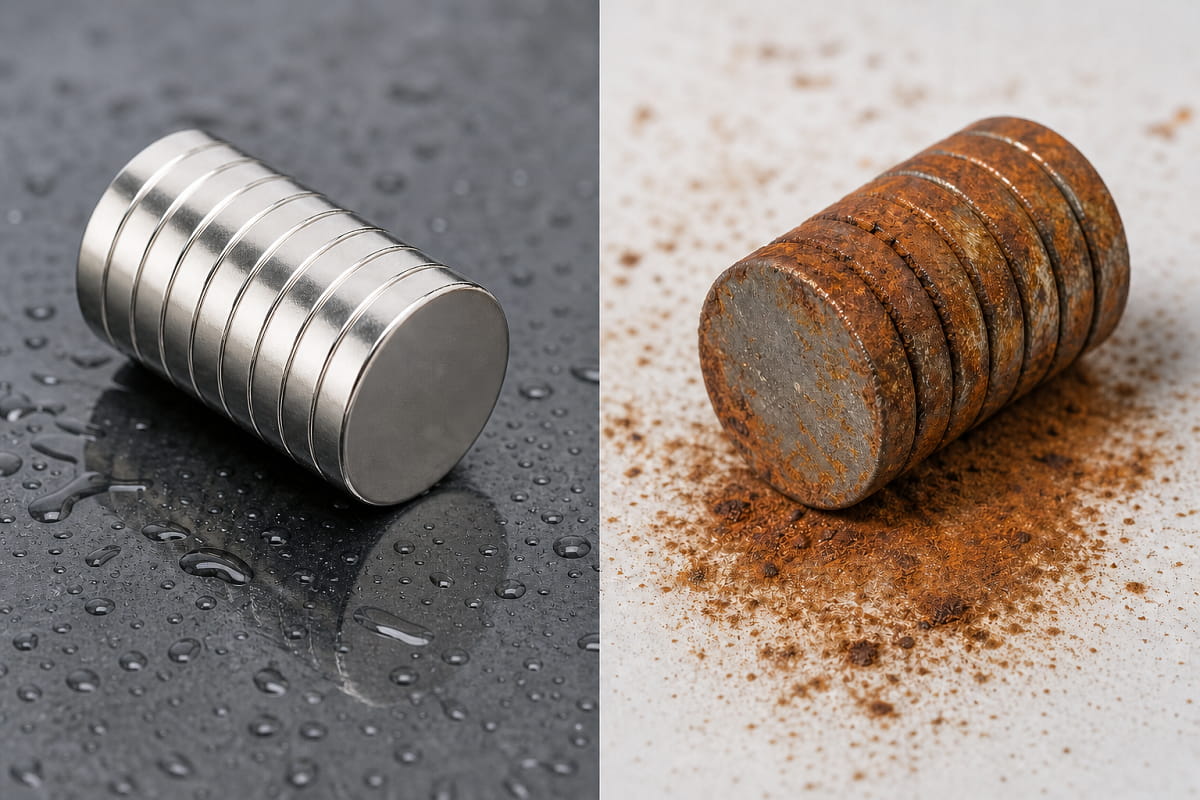
An N54 magnet is theoretically more susceptible to demagnetization than an N52 magnet. If you accidentally expose it to a strong opposing magnetic field or high temperatures, it could lose its magnetism permanently.
Temperature Sensitivity
Both N52 and N54 magnets have a maximum operating temperature of 80°C (176°F).
But here’s the catch: N54 magnets are more prone to “heat stroke.” That’s permanent loss of magnetism if they exceed their rated temperature.
So if your application involves any heat at all? N54 is riskier.
Brittleness
Higher-grade Neodymium magnets are more brittle. N54 magnets are harder to machine and more prone to chipping or cracking during handling.
The Price Gap
Now let’s talk about the elephant in the room: cost.
N52 magnets are already expensive compared to lower grades like N35 or N42. But N54? It’s a whole different ballgame.
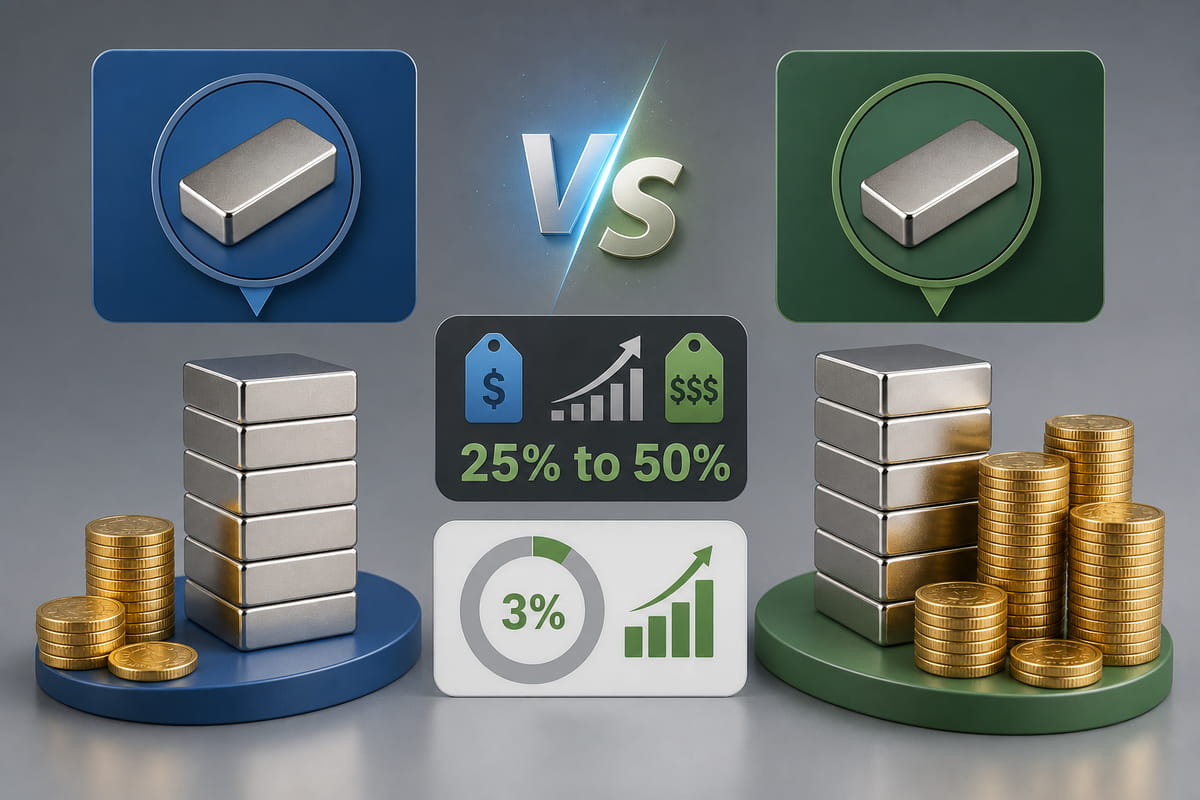
You’re looking at a 25% to 50% premium for N54 compared to N52.
For what?
A 3% increase in performance.
Let me ask you: would you pay 50% more for a car that goes 3% faster? Probably not.
Availability Matters
Here’s something most guides don’t mention:
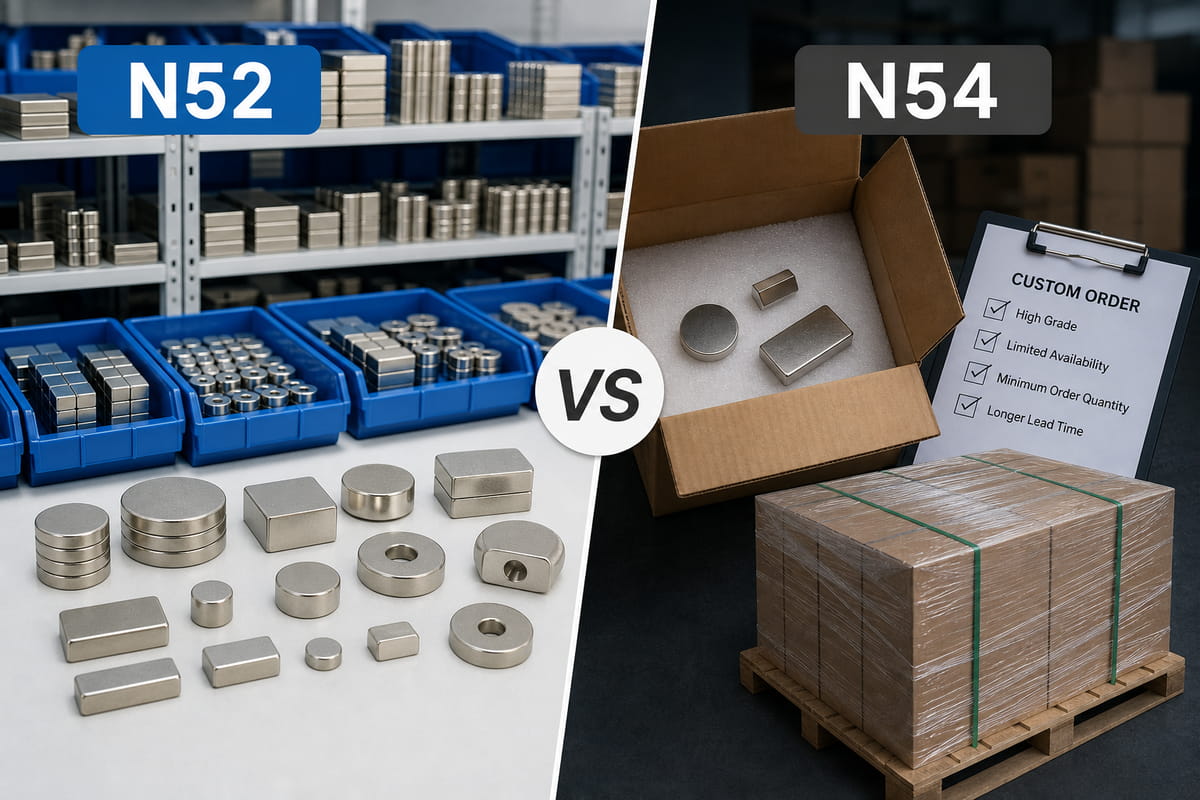
N52 is mass-produced and widely available.
You can find N52 magnets in virtually any size and shape. Discs, blocks, rings, countersunk—you name it, someone stocks it.
N54? That’s a different story.
N54 magnets are rare and often require custom orders. Many suppliers don’t stock them at all. And if they do, you’re looking at minimum order quantities that make sense for industrial buyers, not hobbyists or small businesses.
When to Choose Each?
When Should You Choose N54?
Look, I’m not saying N54 is useless. It has its place.
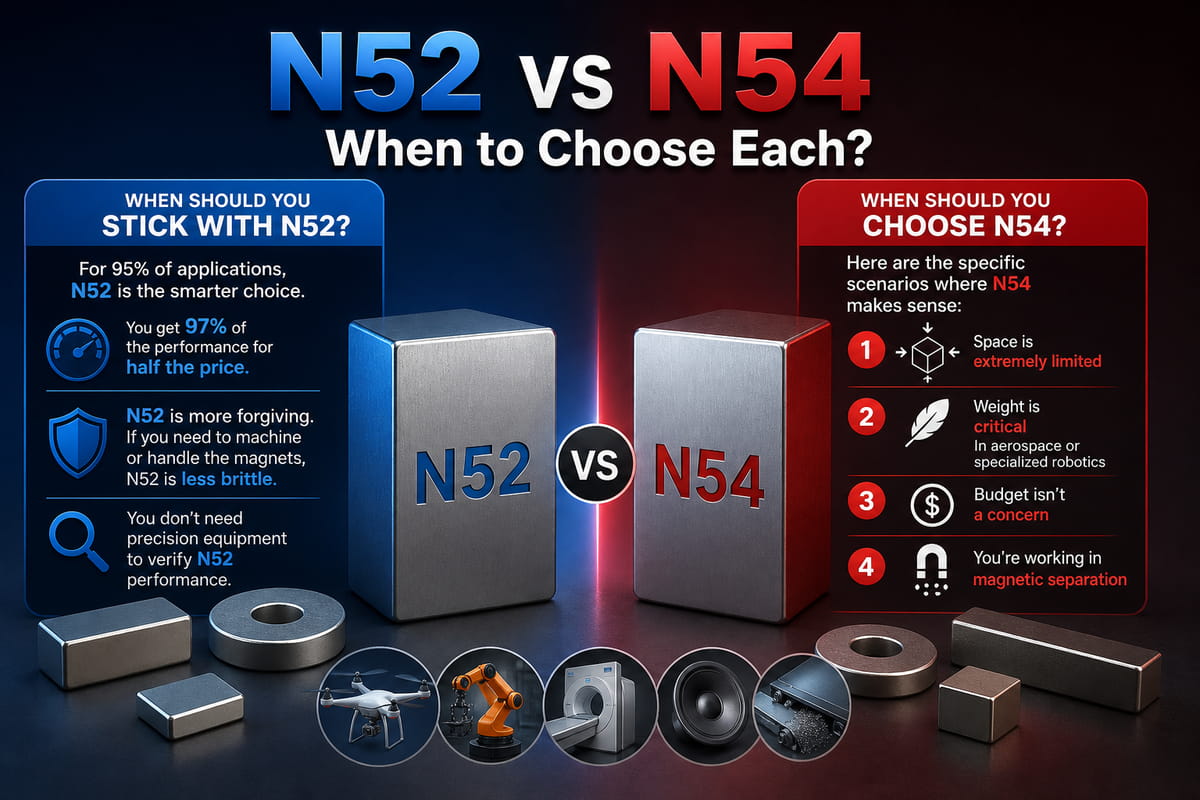
Here are the specific scenarios where N54 makes sense:
1. Space is extremely limited
If you absolutely cannot make the magnet any larger, and you need every fraction of a Tesla you can get, N54 might be your only option.
2. Weight is critical
In aerospace or specialized robotics, every gram matters. If an N52 magnet is just barely too weak, but an N54 gives you enough strength without adding weight, go for it.
3. Budget isn’t a concern
If you’re building a prototype where money doesn’t matter, and you want the absolute strongest magnet available—even if the improvement is marginal—N54 is technically superior.
4. You’re working in magnetic separation
In magnetic separation equipment, manufacturers want to push surface gauss to extreme levels. N54 is ideal for this specific use case.
When Should You Stick With N52?
For 95% of applications, N52 is the smarter choice.
Here’s why:
You get 97% of the performance for half the price.
N52 is the “sweet spot” for high-performance applications. It’s widely available, affordable (relatively speaking), and proven reliable.
N52 is more forgiving.
If your application involves heat, N52 is more stable. If you need to machine or handle the magnets, N52 is less brittle.
You don’t need precision equipment to verify N52 performance.
With N54, you’re paying a premium for a difference you literally cannot feel. With N52, you get consistent, verifiable performance that’s been tested millions of times.
Real-World Applications
Let me give you some concrete examples of where each grade shines.
N52 Magnets:
- Consumer electronics (speakers, headphones, vibration motors)
- Electric vehicle motors
- Industrial automation and sensors
- DIY projects and hobbyist applications
- Magnetic couplings
- Renewable energy (wind turbines)
- Medical devices
N54 Magnets:
- Magnetic separation equipment (where every gauss matters)
- Aerospace components (where weight is critical)
- Specialized robotics (extremely tight space constraints)
- High-end R&D prototypes
- Custom applications where budget isn’t a concern
My Personal Recommendation
After working with Neodymium magnets for years, here’s my honest advice:
Unless you have a very specific reason to choose N54, go with N52.
The 2-4% performance gain just isn’t worth the 25-50% price increase for most people.
And here’s a pro tip: if you really need more magnetic strength, consider increasing the size of your magnet instead of chasing a higher grade. A slightly larger N52 magnet will outperform a smaller N54 magnet almost every time.
The Bottom Line
N54 is technically stronger than N52. There’s no denying that.
But the difference is so small that most people won’t notice it in real-world use. And when you factor in the higher cost, lower availability, and increased risk of demagnetization, N52 is the better choice for most applications.
N52 vs N54 magnets: N52 wins for value, reliability, and availability. N54 wins only if you absolutely need that last 3% of performance and budget isn’t a concern.
Choose wisely.