Quick Summary:
N52 is the strongest magnet most people can realistically buy and use, even though N55 is technically stronger. N55 is harder to produce, more expensive, and less consistent at scale.
Before choosing N52, check operating temperature, size and shape, coating needs, and supplier quality. A cheap “N52” from an unknown source may perform more like a much lower grade, so documentation and testing matter.
You’ve probably seen N52 magnets marketed as “the most powerful permanent magnets on Earth.” And maybe you’ve already bought a set, only to discover they don’t hold as well as you expected. Or worse, you paid a premium for what you thought was N52, but the magnets feel weak and unreliable.
The truth is, N52 isn’t even the strongest grade — N55 edges it out by about 5%. But N55 is expensive, hard to find, and temperature-sensitive. Meanwhile, counterfeit “N52” magnets flood the market, often performing closer to N33. So is N52 the strongest magnet you can actually use? Not exactly.
In this article, as a professional custom N52 magnets manufacturer, I wrote this article to break down the grades, the risks, and the smartest choice for your project.

The Short Answer: No, But Yes
Technically, N55 is the strongest commercially available neodymium magnet grade. It has a maximum energy product of about 55 MGOe (Mega-Gauss Oersteds), which makes it roughly 5% stronger than N52.
But N55 magnets are really hard to produce consistently at scale. They’re expensive. And most manufacturers struggle to maintain quality control with them.
That’s why N52 remains the strongest magnet that most people can actually get their hands on. It’s the gold standard for high-performance applications where you need maximum pulling force in a compact package.
So when someone asks is n52 the strongest magnet, I usually say:
“It’s the strongest magnet you can realistically buy and use.”
What Does “N52” Even Mean?
Neodymium magnets are made from an alloy of neodymium, iron, and boron (NdFeB). They’re part of the “rare earth” magnet family. And they’re absurdly strong for their size.
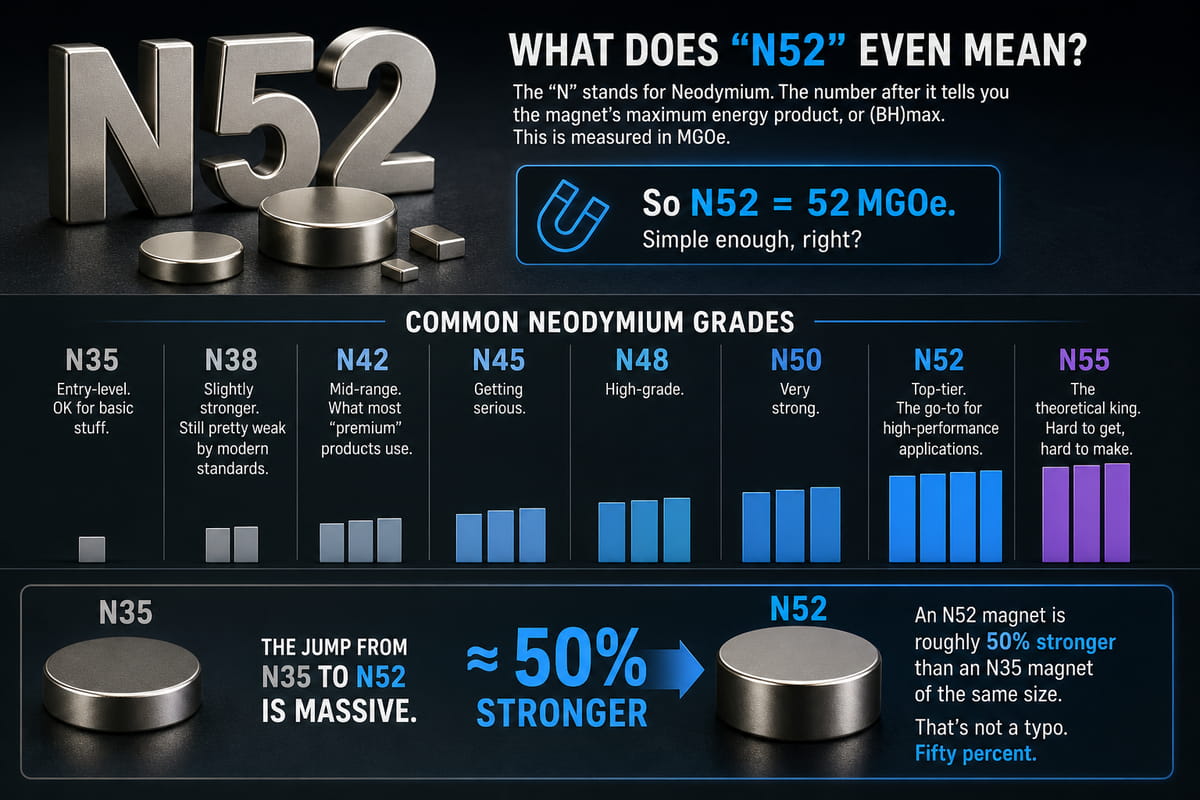
The “N” stands for Neodymium. The number after it tells you the magnet’s maximum energy product, or (BH)max. This is measured in MGOe.
So N52 = 52 MGOe.
Simple enough, right?
Here’s a quick breakdown of common neodymium grades:
- N35 – Entry-level. OK for basic stuff.
- N38 – Slightly stronger. Still pretty weak by modern standards.
- N42 – Mid-range. What most “premium” products use.
- N45 – Getting serious.
- N48 – High-grade.
- N50 – Very strong.
- N52 – Top-tier. The go-to for high-performance applications.
- N55 – The theoretical king. Hard to get, hard to make.
The jump from N35 to N52 is massive. An N52 magnet is roughly 50% stronger than an N35 magnet of the same size. That’s not a typo. Fifty percent.
But Wait… Isn’t There an N56?
You might have seen some websites selling “N56” magnets.
Here’s the truth: there’s no official international standard for N56. Some manufacturers slap that label on magnets that might hit 56 MGOe in ideal conditions. But it’s not a recognized grade.
Think of it like “turbo” mode on a laptop. Sure, it can run faster for a few seconds. But it’s not sustainable.
Stick with N52 or N55 from reputable suppliers if you want real, consistent performance.
How Strong Is an N52 Magnet?
Numbers are nice. But let’s talk real-world.
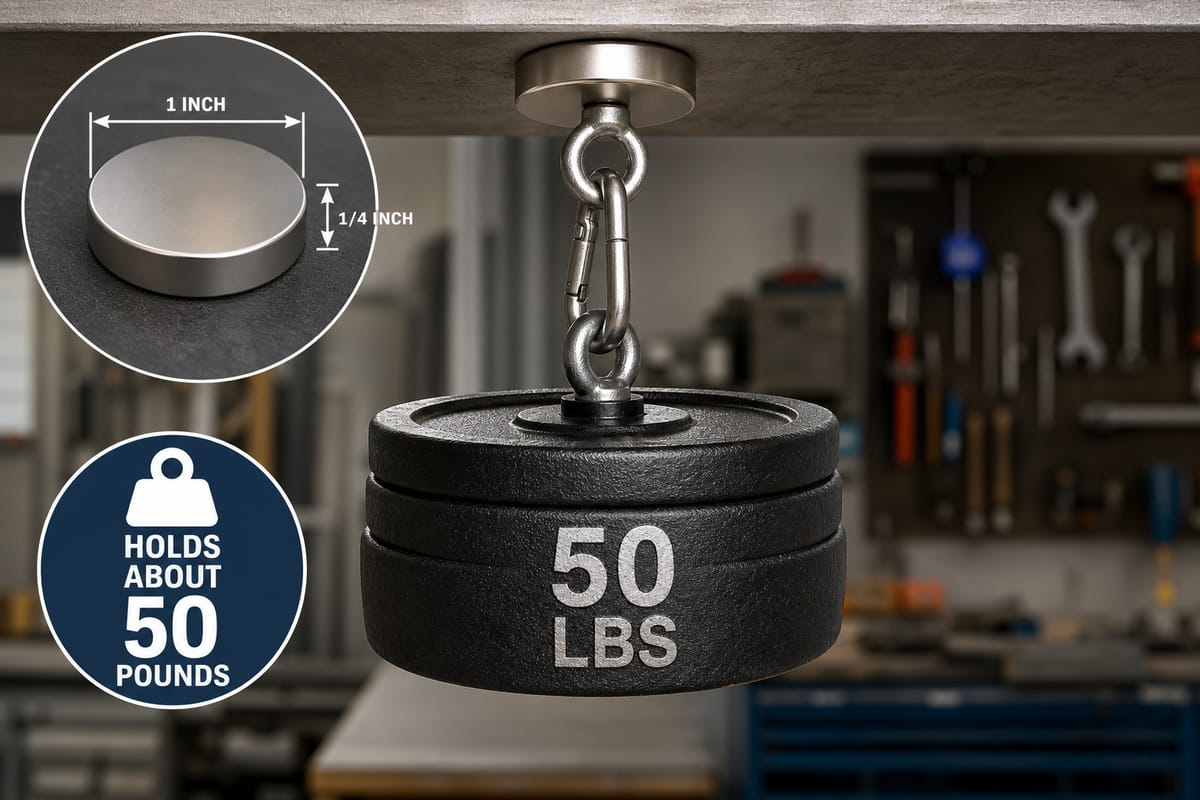
A typical N52 disc magnet that’s 1 inch in diameter and 1/4 inch thick can hold about 50 pounds under ideal conditions.
That’s a lot of weight for something that fits in the palm of your hand.
Pro Tip: The actual holding force depends on a bunch of factors – the surface you’re sticking it to, the thickness of the magnet, the air gap, and even the temperature.
Temperature: The Silent Killer
Here’s something most people don’t think about:
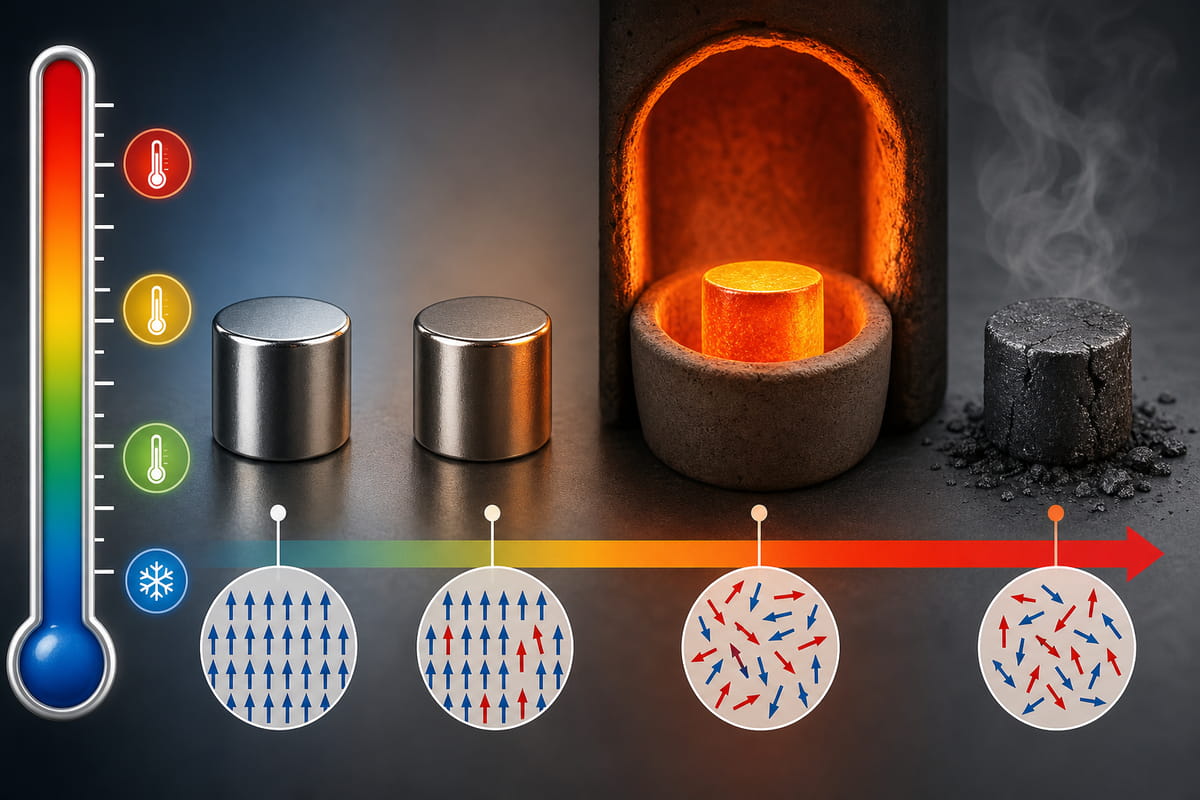
N52 magnets have a maximum operating temperature of 80°C (176°F).
That’s not super hot. Your phone can hit 40-45°C during wireless charging. A car dashboard in summer can easily exceed 80°C.
If your N52 magnet gets too hot, it starts to lose its magnetic strength. And here’s the scary part: it can lose its magnetism permanently.
So if you’re using N52 magnets in a high-temperature environment (like an engine bay or near heat-producing electronics), you might want to look at high-temperature grades like N42SH or N48H instead.
Those grades have lower absolute magnetic strength but maintain their performance at higher temperatures.
Why N52 Magnets Are Worth the Extra Cost

Let’s talk money.
N52 magnets cost more than lower grades. A lot more. An N42 magnet might cost $0.05. An N52 magnet can cost 3X that or more.
So why would you pay the premium?
Three reasons:
1. Strength-to-size ratio.
N52 magnets are incredibly dense with magnetic energy. You can use a smaller N52 magnet to do the same job as a much larger N42 magnet. That saves space in your product or project.
2. Better holding force.
When you need something to stay put – like a magnetic latch, a phone mount, or a sensor – N52 gives you confidence that it won’t fail.
3. Efficiency.
Smaller magnets mean less weight, less material, and sometimes less overall cost when you factor in the reduced size.
Real-World Applications: Where N52 Magnet Shines

I’ve seen N52 magnets used in all sorts of creative ways. Here are some of the most common:
Consumer electronics. MagSafe cases, laptop closures, wireless charging pads. The iPhone’s MagSafe ring uses neodymium magnets – you can bet Apple doesn’t cheap out on grade.
DIY projects. Hanging tools, making magnetic knife strips, creating custom closures for cabinets. N52 magnets let you do more with less.
Industrial automation. Picking and placing ferrous objects in manufacturing lines. Small N52 magnets can lift surprising amounts of weight.
Medical devices. MRI scanners need massive magnetic fields. While they use superconducting electromagnets for the big stuff, N52 permanent magnets show up in other medical equipment.
Audio equipment. Speakers, headphones, microphones – N52 magnets provide the strong, stable field needed for high-fidelity sound.
Jewelry clasps. A tiny 5mm N52 disc magnet can hold a necklace clasp securely. Try doing that with a weaker grade.
The Quality Problem: Watch Out for Fakes
Here’s a story that’ll make your blood boil.
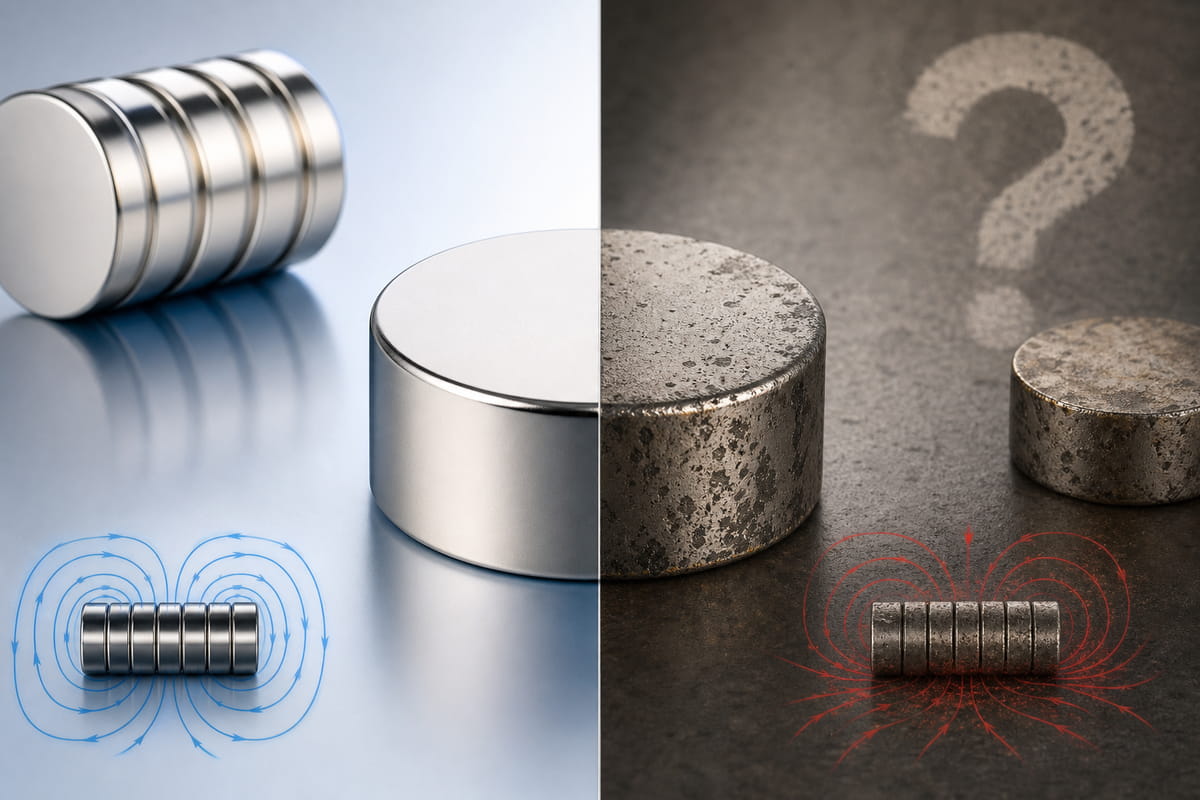
A customer came to us with a batch of “N52” magnets they bought from an overseas supplier. The magnets weren’t performing as expected.
We tested them in-house.
They were equivalent to N33 grade. Not N52. Not even close.
This happens all the time. Unlicensed mills “rubber-stamp” inferior material and pass it off as high-grade N52. The customer gets a “deal” but ends up with magnets that barely hold their weight.
How do you avoid this?
Buy from reputable suppliers who test every batch. Ask for documentation showing the BH curve. Make sure the material is traceable to licensed patent holders.
Don’t just look at the price tag. A cheap “N52” magnet that’s actually N33 is no bargain.
Factors to Consider Before Choosing N52 Magnets
Before you rush out and buy N52 magnets for your project, ask yourself these questions:
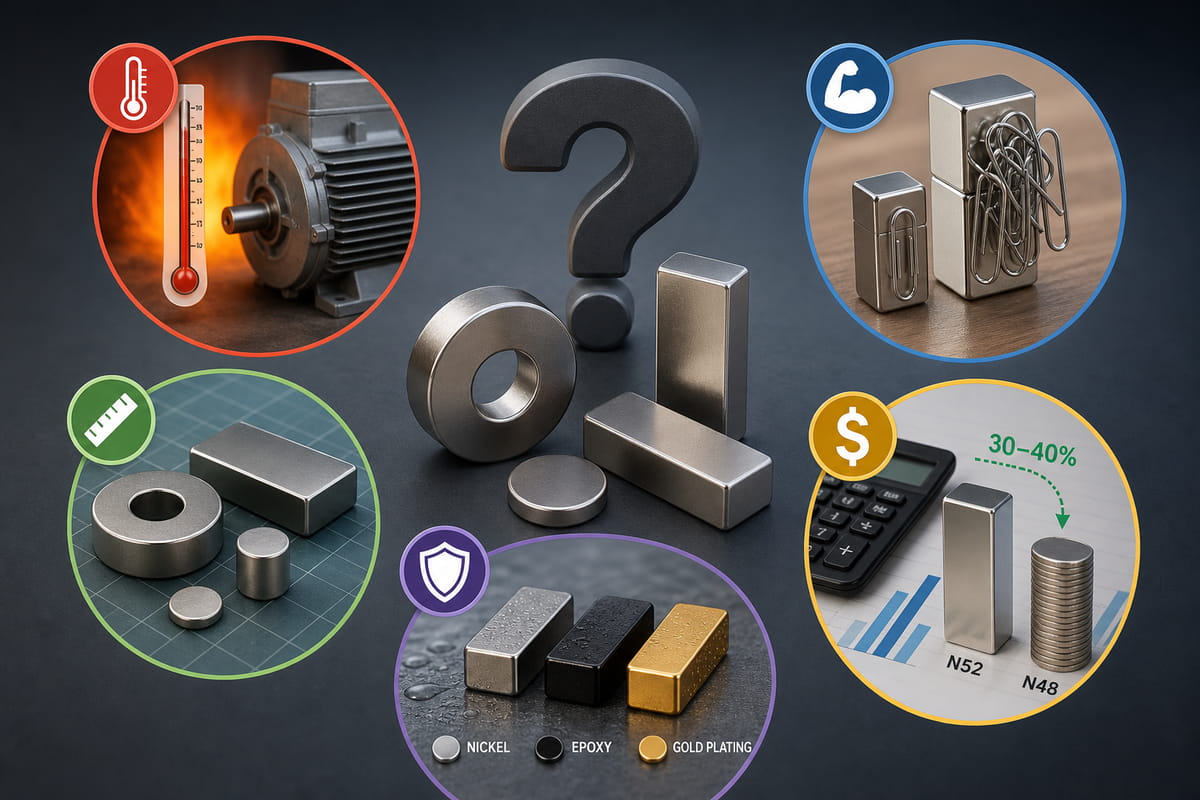
What’s the operating temperature?
If your application runs above 80°C, N52 isn’t your friend. Look at high-temperature grades instead.
Do you actually need this much strength?
Sometimes a lower grade like N42 or N48 will do the job perfectly well. And it’ll cost a fraction of the price.
What’s the shape and size?
The same N52 grade performs differently in a disc, block, or ring shape. Your geometry matters.
Is the magnet going to be exposed to corrosive environments?
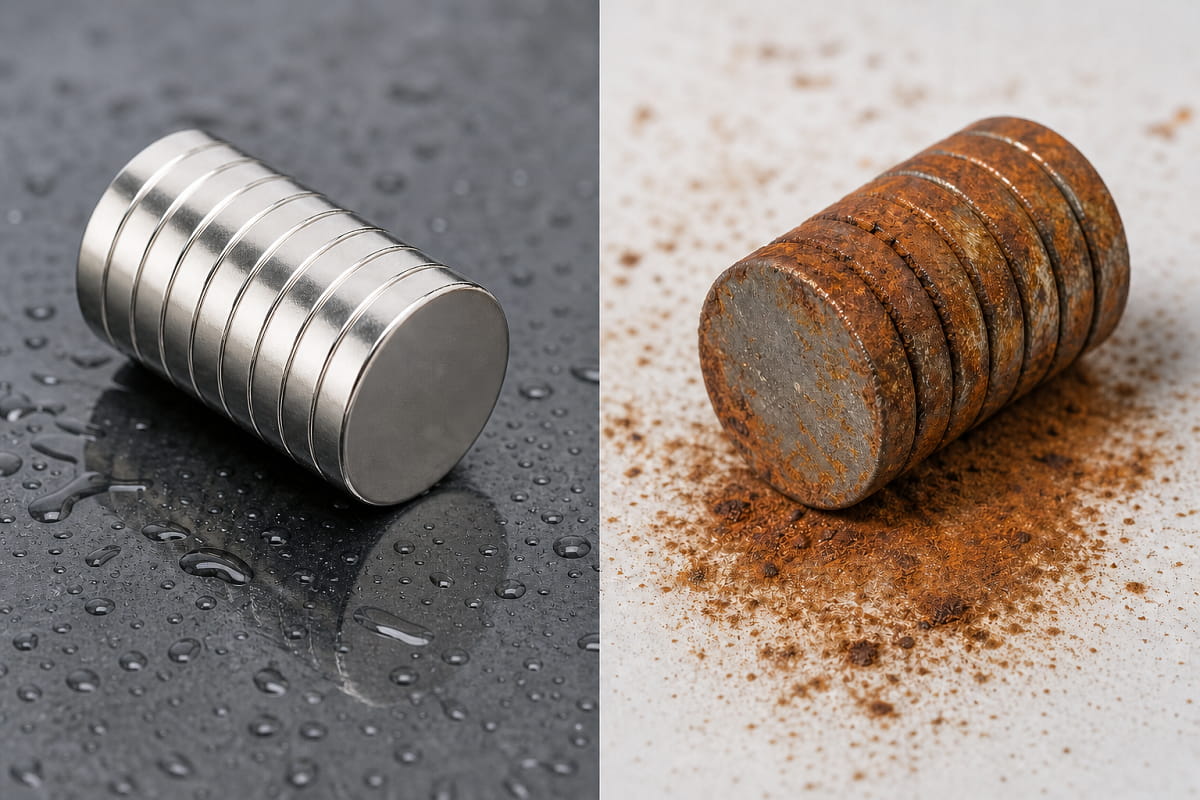
Neodymium magnets rust. You’ll need a coating – nickel, epoxy, or gold plating – depending on the environment.
What’s your budget?
N52 is premium. If you can get away with N48, you might save 30-40%.
N52 vs. Other Magnet Types
Let’s zoom out for a second.
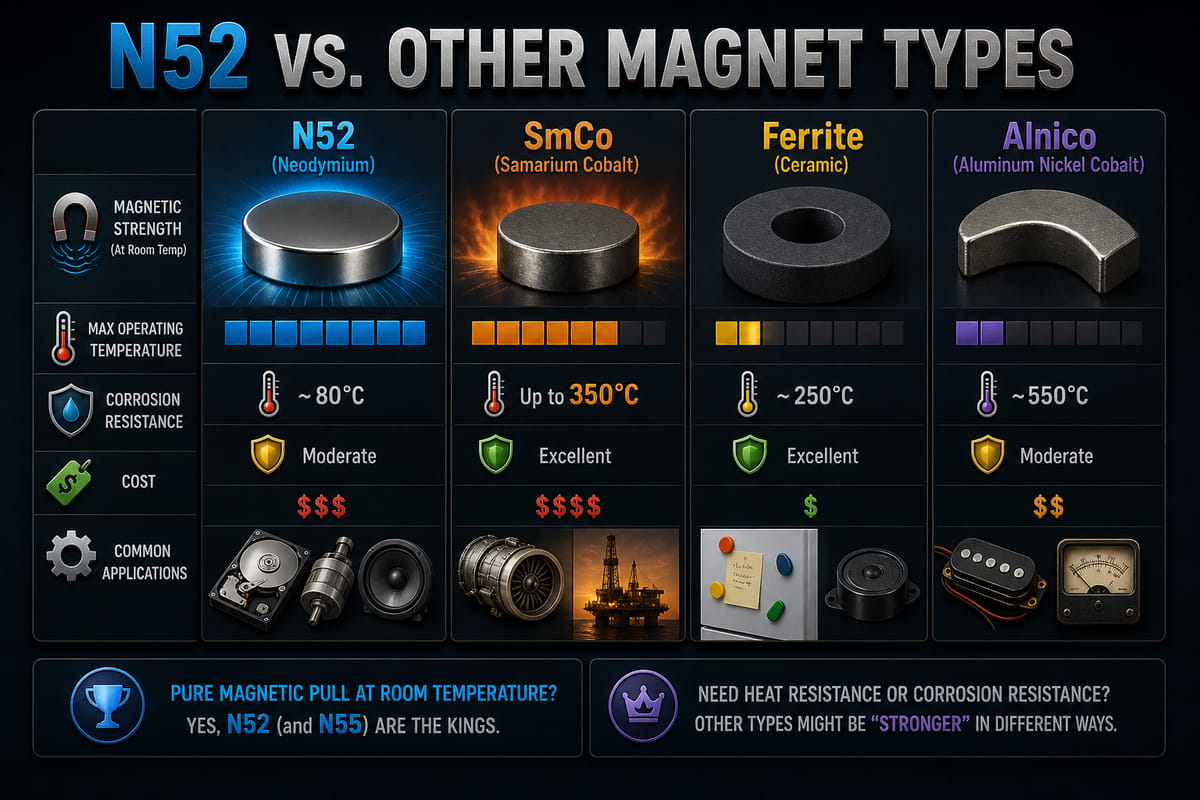
Neodymium magnets (including N52) are the strongest permanent magnets available. But “strongest” can mean different things.
Samarium Cobalt (SmCo) – Not as strong as N52, but it can handle temperatures up to 350°C. If your magnet lives in a hot environment, SmCo might be your best bet.
Ferrite (Ceramic) – Much weaker, but dirt cheap and resistant to corrosion. Good for fridge magnets and basic applications.
Alnico – Old-school. Weak compared to N52. But it has excellent temperature stability. Used in some sensors and guitar pickups.
So when you ask is n52 the strongest magnet, the answer depends on what you’re measuring.
In terms of pure magnetic pull at room temperature? Yes, N52 (and N55) are the kings.
But if you need heat resistance or corrosion resistance, other types might be “stronger” in different ways.
A Quick Comparison Chart
| Grade | (BH)max (MGOe) | Max Temp | Cost | Best For |
|---|---|---|---|---|
| N35 | 35 | 80°C | Low | Basic uses |
| N42 | 42 | 80°C | Medium | Most consumer products |
| N48 | 48 | 80°C | High | Better performance |
| N50 | 50 | 80°C | Higher | Serious applications |
| N52 | 52 | 80°C | Highest | Maximum strength |
| N55 | 55 | 60°C | Very High | Niche, extreme uses |
Notice that N55 actually has a lower max temperature than N52. That’s because achieving that higher energy product makes the magnet more thermally sensitive. Trade-offs everywhere.
My Personal Take
I’ve been working with magnets for years. And here’s what I’ve learned:
N52 is the sweet spot for most people. It’s strong enough to handle demanding applications. It’s widely available. And the quality is consistent when you buy from a good supplier.
N55 is technically stronger, but it’s harder to source, more expensive, and more brittle.
So if you’re asking is n52 the strongest magnet that matters?
Yes. For all practical purposes, it is.
The Bottom Line
Here’s what I want you to remember:
1. N55 is technically stronger than N52, but it’s rare and expensive.
2. N52 is the strongest magnet that’s widely available and consistent in quality.
3. Temperature, shape, and surface contact matter just as much as grade.
4. Don’t buy cheap “N52” magnets from unknown suppliers. Get them tested.
5. Sometimes a lower grade is actually the smarter choice for your specific application.
So is n52 the strongest magnet?
For 99% of people and projects? Yes. Absolutely.
And now you know why.