Quick Summary:
- Cutting a bar magnet never isolates a single pole—you always get two smaller magnets, each with a North and South pole.
- A crosswise cut makes the halves attract; a lengthwise cut makes them repel. Each piece is slightly weaker, and rare earth magnets like neodymium can lose significant strength or shatter if cut improperly.
- Always use proper tools (diamond-tipped saw or laser cutter), wear protective gear, and watch for sharp fragments.
When you’ve got a bar magnet in your hand, and you’re wondering: What happens if you cut a bar magnet in half? Do you end up with a single North pole on one side and a lonely South pole on the other?
Here’s the short answer: No.
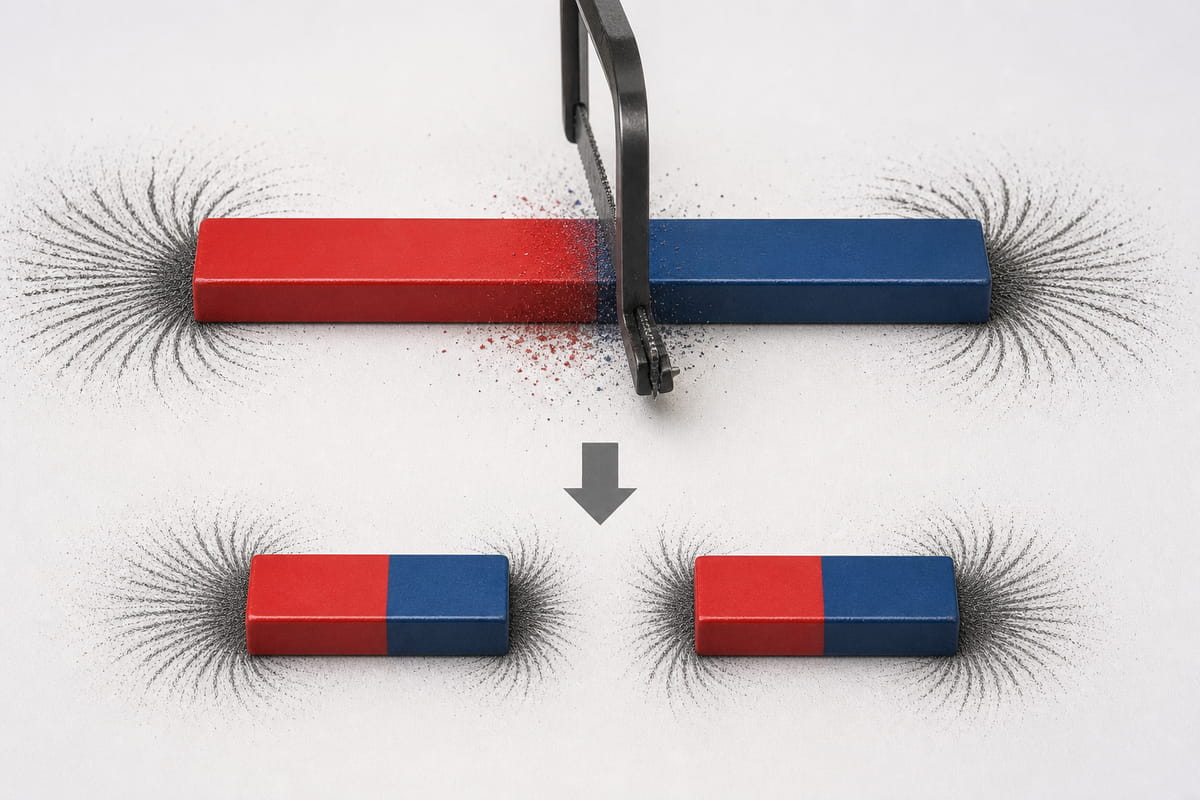
When you cut a bar magnet in half, you don’t separate the poles. Instead, you get two brand new, fully functional magnets. Each piece instantly grows its own North and South pole at the freshly cut surface.
It’s a little like cutting an earthworm in half. (Except, you know, way less messy.)
In this guide, as a professional custom bar magnets manufacturer, I’m going to break down exactly what happens, WHY it happens, and what most people get wrong about it.
Sound good? Let’s dive in.
What Happens If You Cut a Bar Magnet in Half?
Cutting a magnet in half never isolates a single pole. Ever.
No matter how many times you slice it, every single piece ends up with two poles. One North. One South.
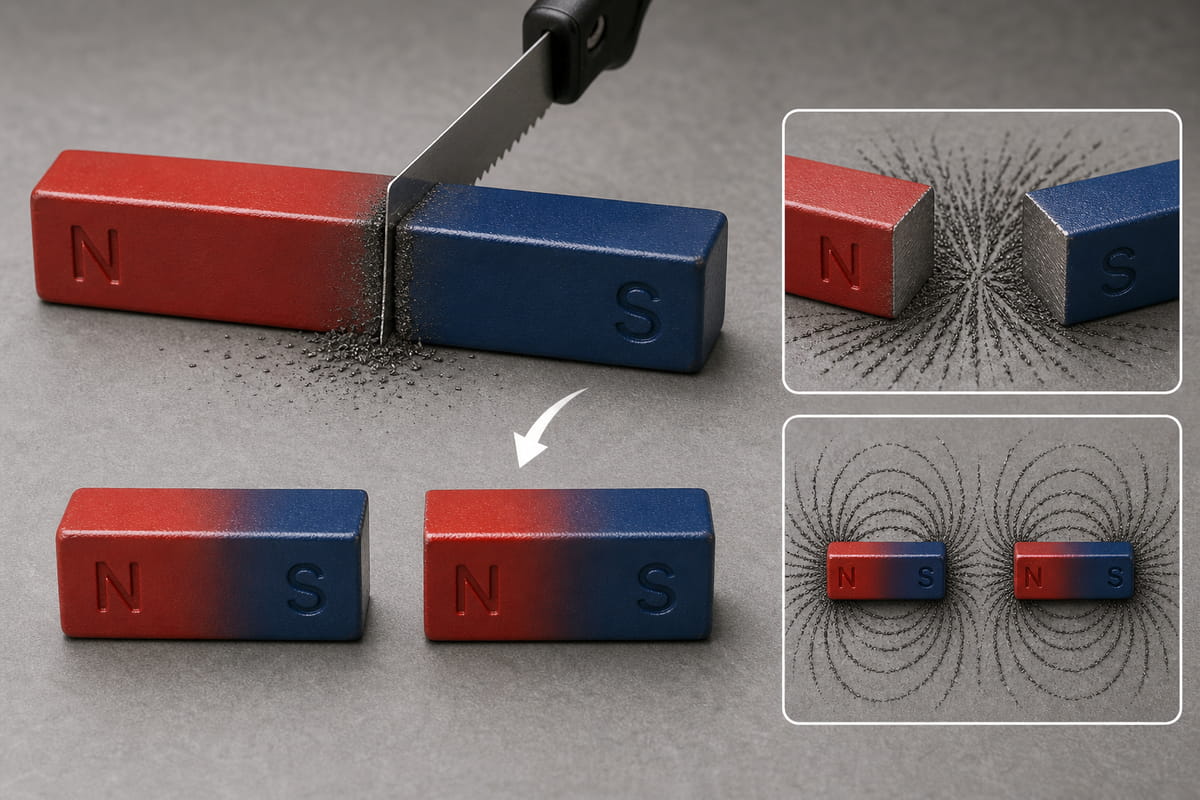
Here’s what you actually walk away with:
- Two smaller magnets (not two “half magnets”)
- New poles that form instantly at the cut surface
- Slightly weaker magnetic strength per piece (more on that later)
- The same basic behavior as the original magnet
That’s the gist. But the direction you cut matters a LOT for how the two pieces interact. Let me explain.
How You Cut the Magnet Changes Everything
This is the part most people miss.
The way the two halves behave depends entirely on how you cut them. There are two ways to slice a bar magnet, and they give you wildly different results.
1. Cutting Crosswise (Perpendicular to the Length)
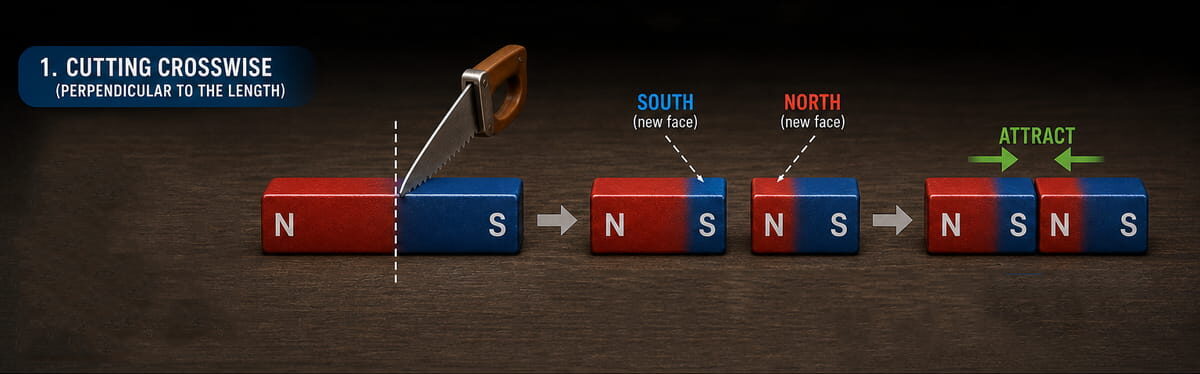
When you cut a bar magnet straight across the middle — perpendicular to its length — you get two shorter magnets.
And here’s the cool part:
The newly exposed ends have opposite polarities. Which means if you try to put the two halves back together, they’ll happily snap right back into place.
They attract each other.
Why? Because the freshly cut face on one piece becomes a South pole, and the matching face on the other piece becomes a North pole. Opposite poles attract.
So they go right back together like nothing ever happened.
2. Cutting Lengthwise (Parallel to the Length)
Now here’s where it gets weird.
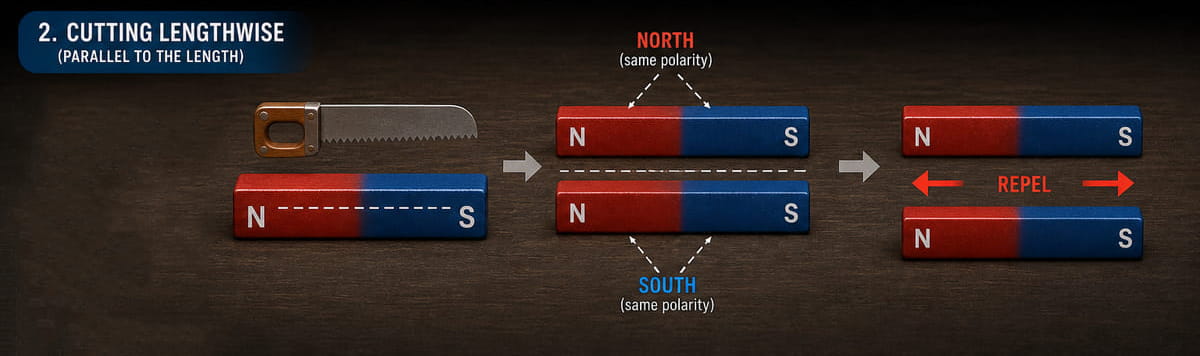
If you cut a bar magnet lengthwise — from North pole down to South pole — you get two skinnier, full-length magnets.
But this time, the two adjacent faces share the same polarity.
The result? They repel each other.
I love this question from a reader named Michael, who dropped his bar magnet and it broke lengthwise:
“It wouldn’t fit back together again because it broke lengthwise. If the poles lined up before they broke, what keeps the magnet together to begin with? If they repel now, why didn’t they before it broke?”
Great question.
The answer is simple: before the magnet broke, the physical strength of the material was strong enough to hold those repelling forces together. The atoms were literally bonded into one solid chunk.
Once you break that bond? The repulsion takes over, and the pieces push away from each other.
Pro Tip: If you ever drop a neodymium magnet and it chips, the fracture usually happens parallel to the magnetic axis. That’s why the broken piece almost never wants to go back on.
Why Does This Actually Happen?
Okay, so now you know WHAT happens. Let’s talk about WHY.
To understand this, you need to know about something called magnetic domains.
It’s All About Magnetic Domains
Here’s the deal:
Every magnet is made up of millions of tiny, microscopic regions called magnetic domains. And each domain acts like its own teeny-tiny magnet, complete with its own North and South pole.
In a regular piece of iron, these domains all point in random directions. They cancel each other out. So you get… nothing. Just a plain old chunk of metal.
But in a bar magnet, something special happens:
All of the domains line up in the same direction.
When every domain points the same way, their magnetic forces add up. And BAM — you’ve got a strong, permanent magnet.
So What Happens When You Cut It?
When you slice the magnet in half, those internal domains stay perfectly aligned. They don’t suddenly scramble or reset.
The domains at the newly exposed surface simply create a new pole.
That’s why every fragment — no matter how small — keeps both a North and a South pole. The alignment is baked into the material itself.
This works for magnets of every shape, too. Bar magnets, rings, horseshoes… cut any of them, and you’ll still get standard dipole magnets with two poles each.
Can You Cut a Magnet Down to a Single Atom?
Now here’s a question I find absolutely fascinating:
If you keep cutting a magnet in half… over and over and over… do you eventually reach a single atom with a North and South pole?
A lot of physics textbooks make it sound like you can keep cutting forever and always get two poles.
But that’s not quite right.
The Superparamagnetic Limit
Here’s the truth: you cannot cut a magnet down to a single atom and keep its magnetism.
You can cut a 10cm magnet down to 5cm. Then 2.5cm. Then down to a few hundred micrometers. And it’ll still be a magnet the whole way.
You can even cut it down to the size of a single domain — a few thousand atoms across. (This is actually how the data on your hard drive is stored.)
But once you go smaller than that?
Things get strange.
At a certain tiny size, the energy holding those magnetic moments in place drops below the thermal energy at room temperature. The poles start flipping like crazy — North to South and back again — faster than you can blink.
At that point, your “magnet” stops being a permanent magnet. Scientists call this the superparamagnetic limit.
The bottom line? You can chop a magnet down to a few hundred atoms and still have a magnet. But push past that, and it’s just a chunk of metal again.
(Fun fact: this exact question has top magnetic researchers around the world scratching their heads. So if it confuses you a little, you’re in good company.)
What About Magnetic Monopoles?
You might be wondering:
If we could just isolate a single pole, we’d have something called a magnetic monopole — a particle with only ONE magnetic pole.
Physicists working on Grand Unified Theories have actually predicted these might exist.
But here’s the thing: nobody has ever detected one. And you’re definitely not going to create one by snapping a bar magnet in half in your garage.
Magnetic poles, as far as we know, always come in pairs.
Does Cutting a Magnet Make It Weaker?
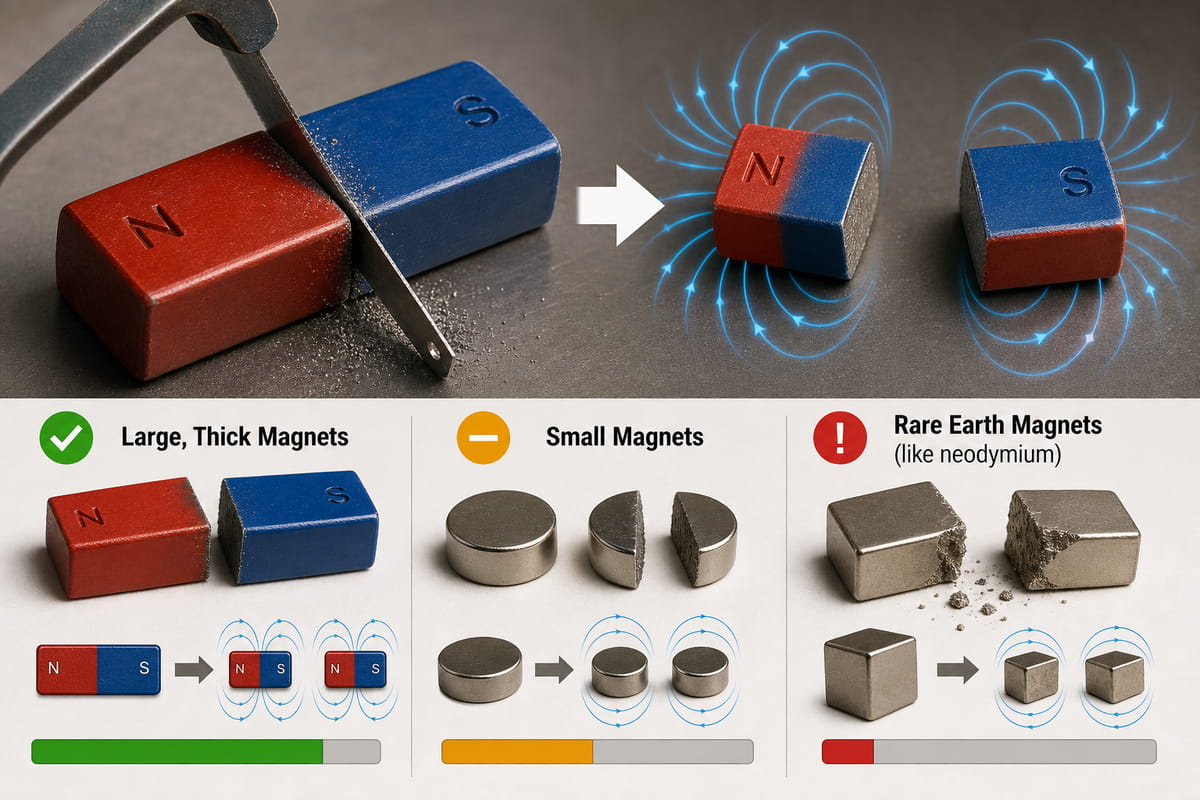
Yes — but probably not the way you think.
When you cut a magnet, each individual piece will be slightly weaker than the original. That’s because each piece now has less material and a smaller volume of aligned domains.
Here’s a quick breakdown of what to expect:
- Large, thick magnets: Each piece stays magnetic, just a bit weaker.
- Small magnets: Cutting reduces the overall strength, but the pieces stay magnetic.
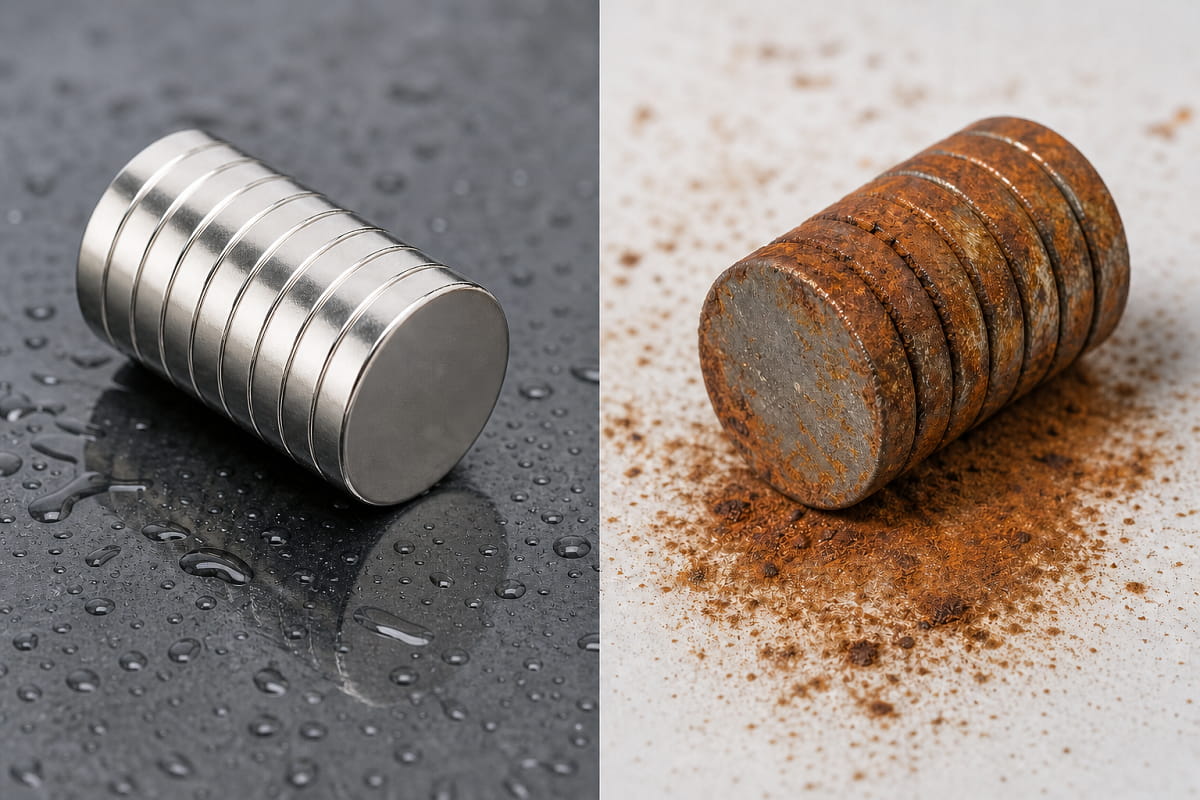
- Rare earth magnets (like neodymium): These can lose a significant chunk of strength, especially if cut improperly. They’re also super brittle.
So you don’t lose the magnetism. You just spread it across two smaller magnets.
A Quick Word on Safety
If you’re actually planning to cut a magnet, don’t just grab a hacksaw and go to town.
A few things to keep in mind:
- Wear protective gear. Safety goggles and gloves are a must. Magnet fragments can be sharp.
- Use the right tools. A diamond-tipped saw or laser cutter gives clean cuts without wrecking the magnetic properties.
- Watch the fragments. Tiny shards can go airborne. Handle them carefully.
Strong magnets (especially neodymium) can also snap together with surprising force. So keep your fingers clear.
The Bottom Line
So let’s circle back to where we started.
What happens if you cut a bar magnet in half? You don’t get an isolated North or South pole. You get two complete, smaller magnets, each with its own North and South pole.
Cut it crosswise, and the pieces attract. Cut it lengthwise, and they repel. And no matter how many times you slice it, those magnetic domains keep right on doing their job — at least until you reach the atomic scale, where the rules change completely.
It’s one of those simple questions that turns out to have a surprisingly deep answer.
And now? You know exactly what’s going on.