Quick Summary:
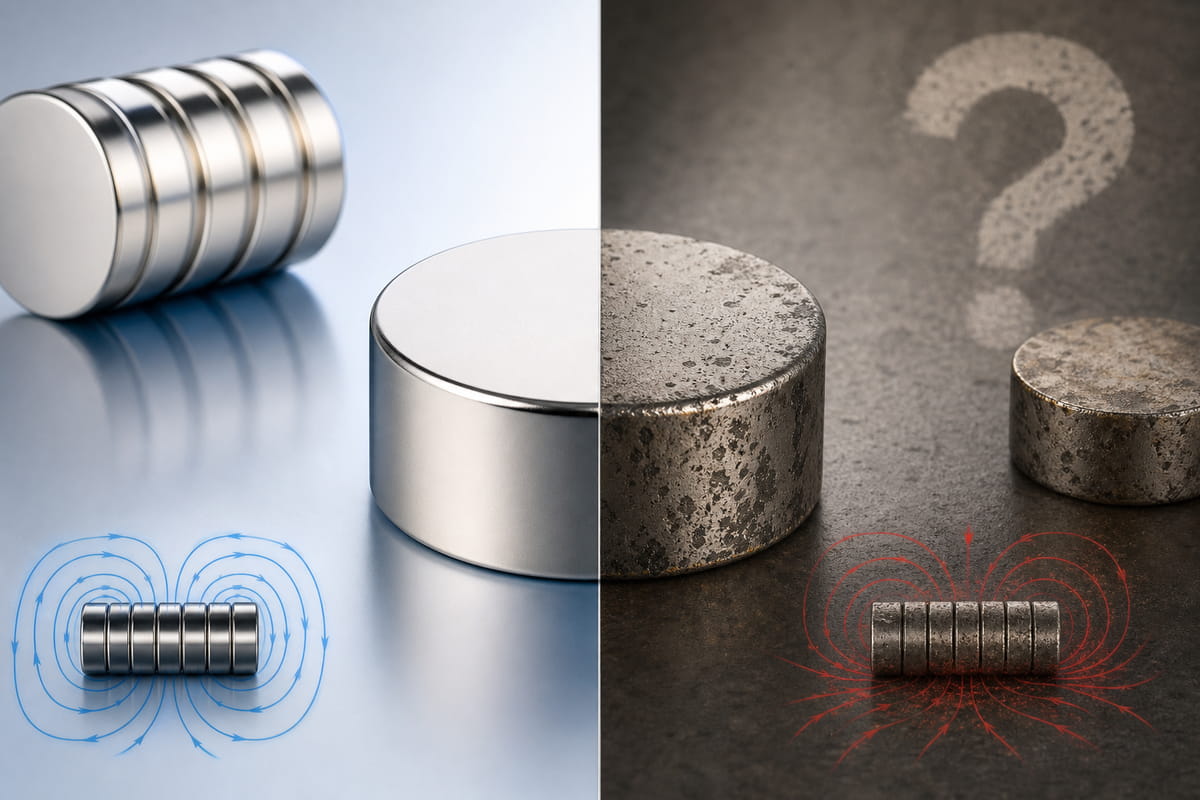
N52 magnets are roughly 25–30% stronger than N40 magnets of the same size, but they cost significantly more—sometimes double. N40 offers slightly better resistance to demagnetization from external fields and is less brittle.
For most everyday applications with enough space, N40 is the smarter, cost-effective choice. Use N52 only when space is extremely limited and you need maximum pull force in a compact form factor.
You’re staring at two magnet options—N40 and N52. And you’re probably thinking: Which one do I need? The wrong choice can cost you: either you overpay for strength you’ll never use, or you pick a magnet that’s too weak for your project. I’ve seen both mistakes happen.
N52 is about 25–30% stronger than N40, but it can cost 30% to over 100% more. And surprisingly, N40 resists demagnetization better. So which should you choose?
In this guide, as a professional custom N40 magnets and N52 magnets manufacturer, I will break down the key differences in strength, temperature tolerance, size efficiency, and price—so you can make the right call without wasting money or performance.
The Short Answer
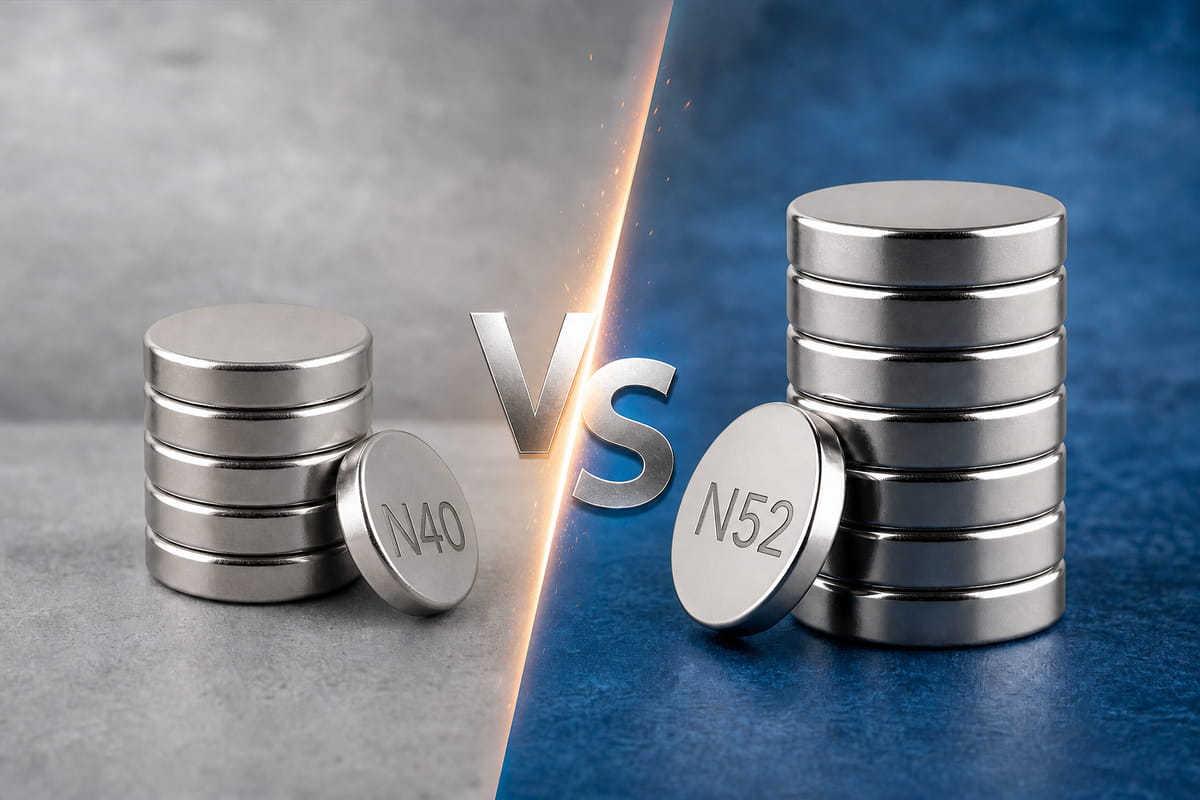
An N52 magnet is about 25–30% stronger than an N40 magnet of the exact same size.
But here’s the thing:
That extra strength comes at a cost. And I’m not just talking about money.
Let me explain.
Higher-grade magnets like N52 are more brittle. They’re harder to handle. And in some cases, N40 actually performs better in certain situations.
Sound confusing?
Don’t worry. I’ll walk you through everything.
What Do These Numbers Even Mean?
Both N40 and N52 magnets are neodymium magnets. The “N” stands for neodymium. The number? That’s the Maximum Energy Product—or BHmax—measured in MGOe (Mega Gauss Oersteds).
The number tells you how strong the magnet is:
- N40 = roughly 40 MGOe
- N52 = roughly 52 MGOe
Simple, right?
But here’s where it gets interesting:
The jump from N40 to N52 magnet isn’t linear. Going from 40 to 52 MGOe sounds like a 30% increase on paper. And that’s pretty accurate. But in practice, the perceived strength difference can feel even more dramatic depending on your application.
Pro Tip: If you’re comparing two magnets of the same size, N52 magnets will feel significantly stronger. But if you have space to use a slightly larger N40 magnet? You can often match N52’s performance for less money.
N40 vs N52 Magnets: Complete Differences List
Strength / Maximum Energy Product
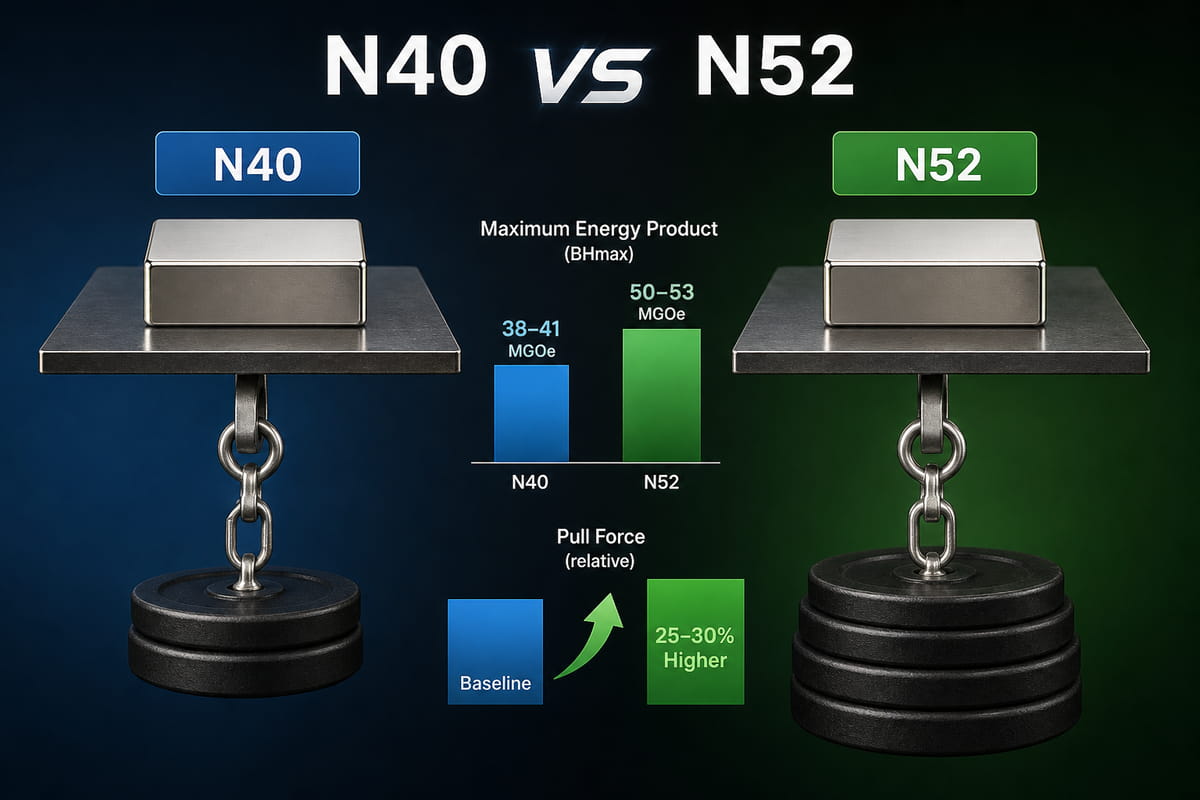
Let’s get into the numbers.
Here’s what you’re working with:
| Grade | BHmax (MGOe) | Pull Force (relative) |
|---|---|---|
| N40 | 38–41 | Baseline |
| N52 | 50–53 | 25–30% higher |
That 25–30% boost is real. I’ve tested this myself.
I took two identical block magnets—same dimensions, same coating, same everything except the grade. And the N52 magnets held onto a steel plate with noticeably more force.
But here’s the thing:
You don’t always need that extra power.
If your project has plenty of space, you can use a bigger N40 magnet and get the same holding force as a smaller N52 magnet. And in many cases, that bigger N40 magnet will cost you less.
We’ll talk about pricing in a minute.
The Sneaky Tradeoff: Coercive Force

This is where it gets counterintuitive.
You’d think the stronger magnet (N52) would be better at everything, right?
Not exactly.
Here’s a fact that surprises most people:
N40 has a higher coercive force (Hc) than N52 magnet.
Let me translate:
Coercive force measures how well a magnet resists demagnetization from external magnetic fields. Think of it like a magnet’s “immune system.” A higher coercive force means it’s harder to accidentally weaken or demagnetize that magnet.
And N40? It scores better here.
| Grade | Coercive Force (Hcb) |
|---|---|
| N40 | ≥ 907 kA/m |
| N52 | ≥ 796 kA/m |
So if your application involves exposure to strong opposing magnetic fields—or if you’re stacking magnets in a way that could demagnetize them—N40 might actually be the smarter choice.
Does this matter for most projects?
Probably not. But it’s good to know.
Temperature: The Great Equalizer
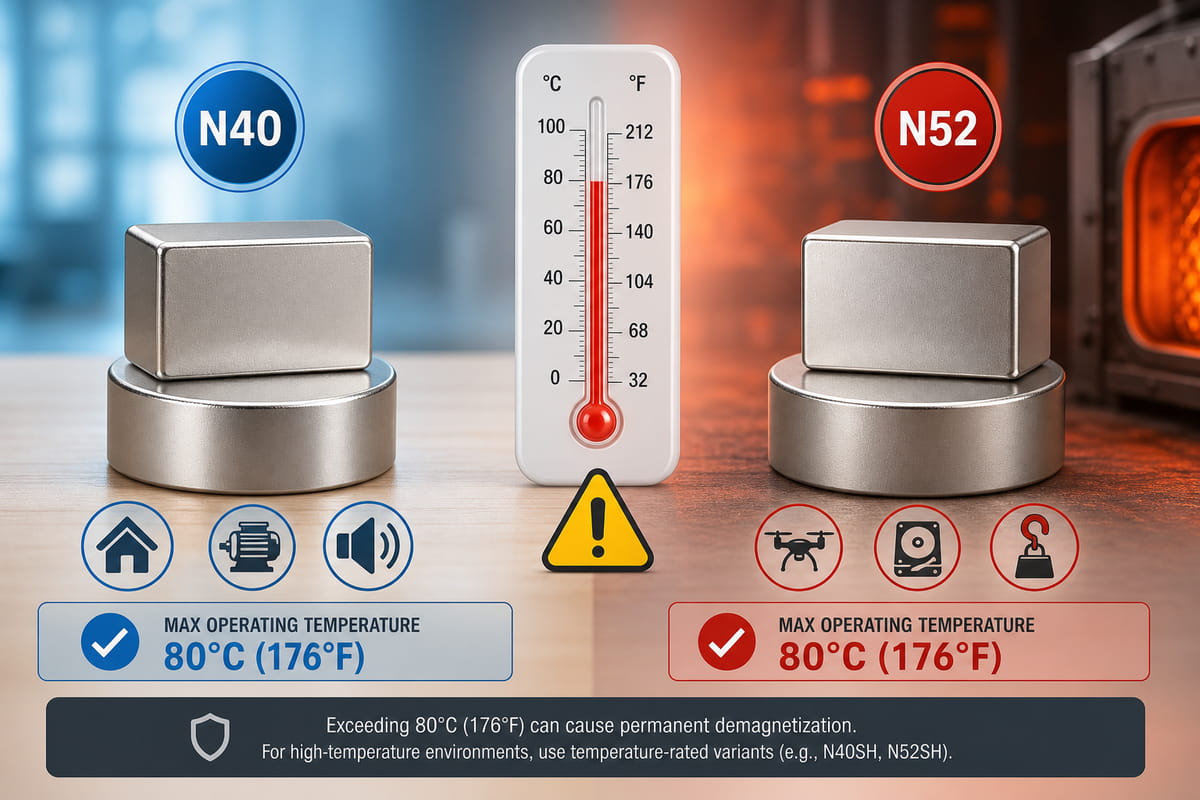
Here’s something both grades have in common:
Maximum operating temperature: 80°C (176°F).
That’s it. No difference.
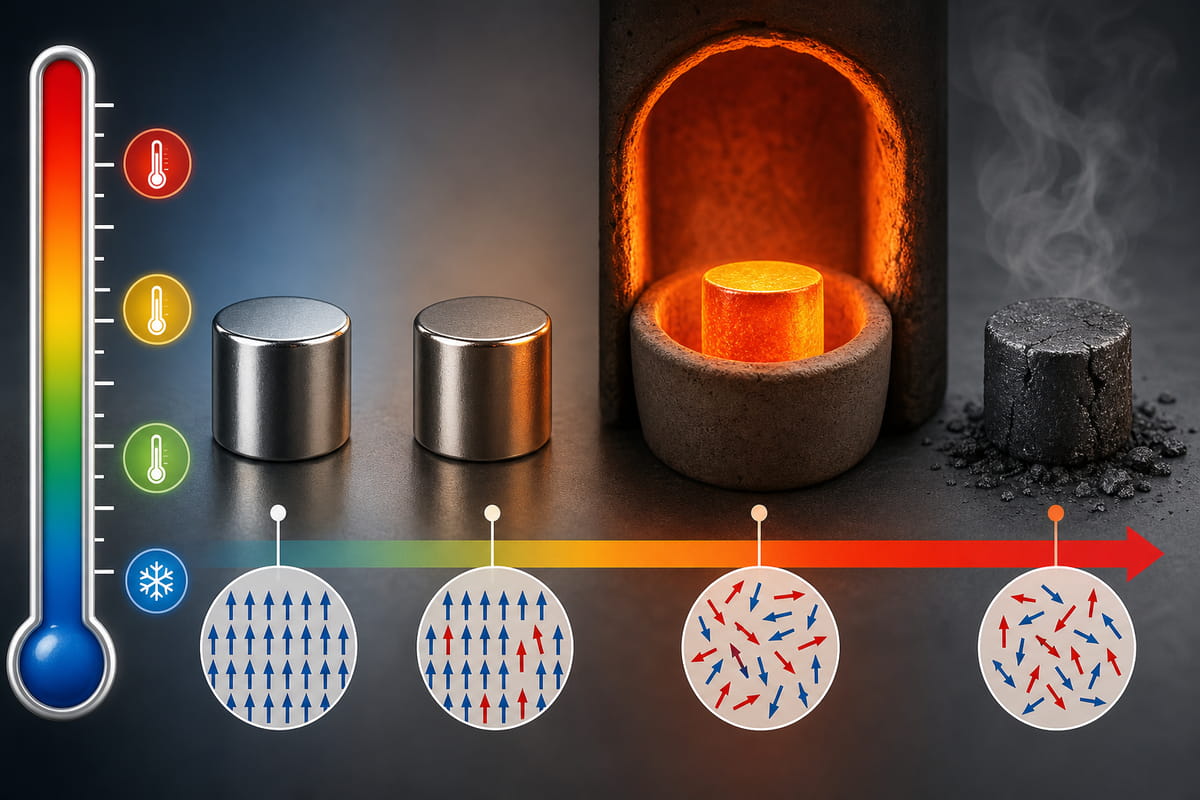
Push either magnet above that temperature, and you risk permanent demagnetization. So if heat is a concern in your project, the grade alone won’t save you. You’d need to look at temperature-rated variants (like N40SH or N52SH).
But for standard room-temperature applications? Both N40 and N52 magnets perform similarly in terms of heat tolerance.
Size Efficiency
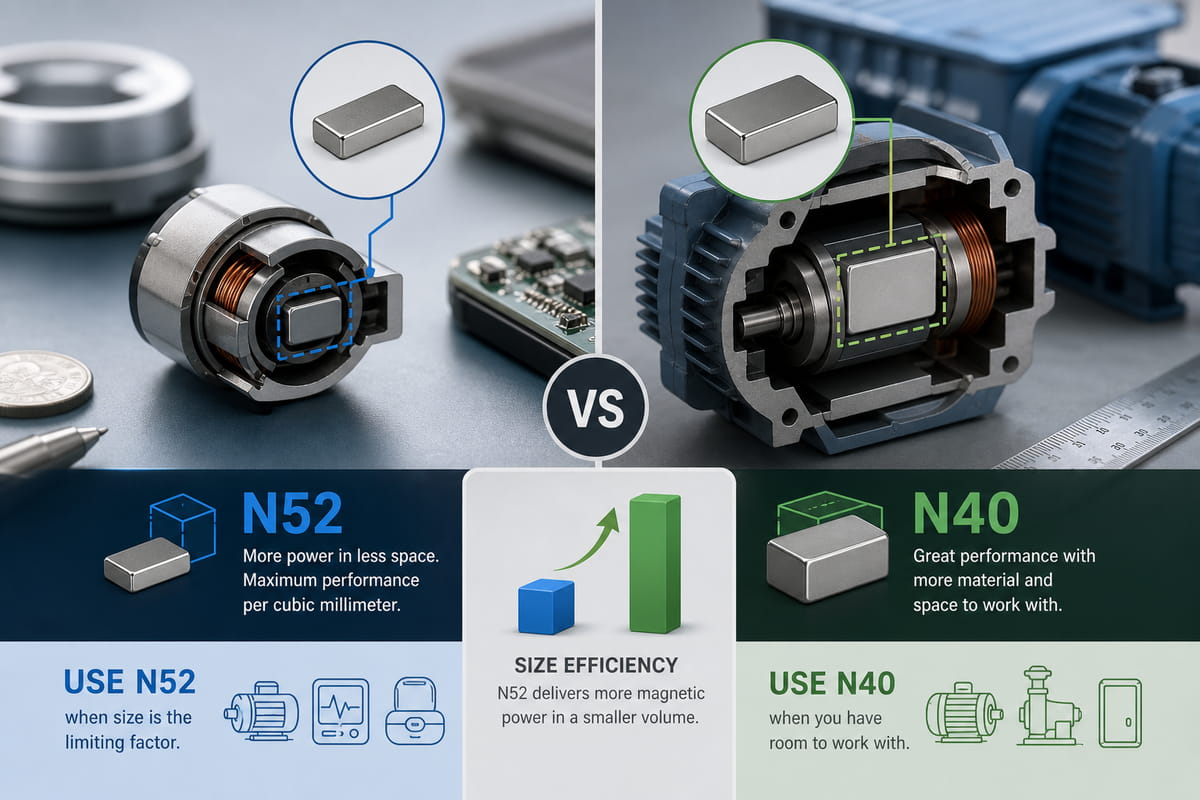
This is where N52 magnet truly shines.
If you’re working in a space-constrained environment—think small motors, compact medical devices, or tight enclosures—N52 gives you the most power per cubic millimeter.
Here’s a real-world example:
I recently worked on a small robotics project. The motor housing had very limited space for magnets. I needed maximum pull force in a tiny package. N52 was the obvious choice. A larger N40 magnet simply wouldn’t fit.
Use N52 when size is the limiting factor.
Use N40 when you have room to work with.
Price: The Elephant in the Room

Let’s talk dollars.
N52 can cost 30% to over 100% more than N40.
I’ve seen this firsthand. For a standard 1-inch disc magnet:
- N40: ~$0.50–$0.80 per magnet
- N52: ~$1.00–$1.60 per magnet
And for larger magnets? The price gap widens.
| Magnet Size | N40 Cost | N52 Cost | Price Increase |
|---|---|---|---|
| 1″ Disc | $0.65 | $1.30 | +100% |
| 2″ Block | $4.50 | $8.00 | +78% |
| Custom Shape | Varies | Varies | +50–100% |
Here’s the thing:
You’re paying for performance. And sometimes that’s worth it.
But if you asked me: “Should I always buy N52?”
My answer would be: No.
Not unless you truly need that extra 25–30% strength.
When to Use Each Grade
When to Use N40 Magnets

Stick with N40 if:
- You have enough physical space for a larger magnet
- You’re on a tight budget
- Your project involves moderate holding strength (closures, basic sensors, craft projects)
- You’re concerned about brittleness (N40 is slightly less prone to chipping)
- You need slightly better resistance to demagnetization from external fields
N40 is a workhorse. It’s reliable. It’s cost-effective.
For 80% of applications, N40 is all you need.
When to Use N52 Magnets
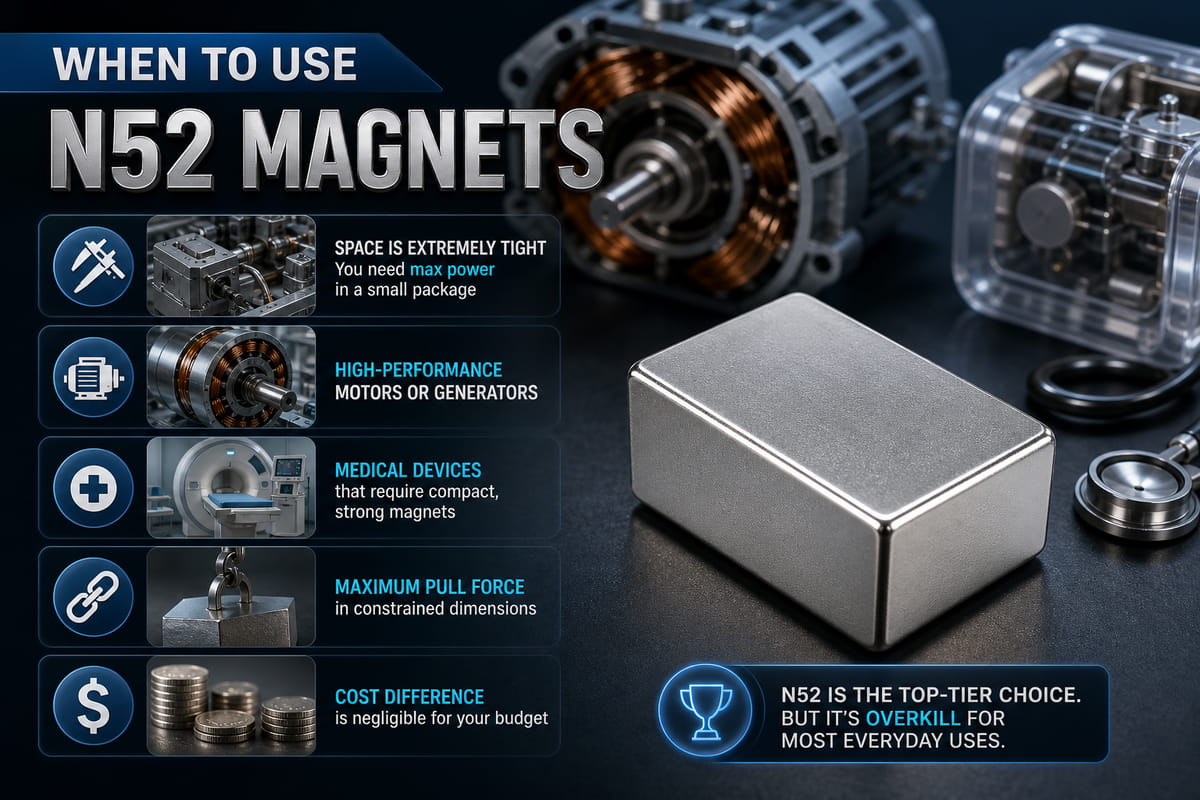
Go with N52 if:
- Space is extremely tight (you need max power in a small package)
- You’re building high-performance motors or generators
- You’re working on medical devices that require compact, strong magnets
- Your project demands maximum pull force in constrained dimensions
- The cost difference is negligible for your budget
N52 is the top-tier choice. But it’s overkill for most everyday uses.
How I Decided (A Quick Case Study)
Last year, I was designing a magnetic closure system for a client. The enclosure had strict size limits. I needed the holding force to be around 10 pounds.
- Option A: One N52 disc magnet (25mm diameter, 5mm thick)
- Option B: Two N40 disc magnets (25mm diameter, 5mm thick each)
Option A cost $2.50 per unit. Option B cost $3.40 per unit.
I went with Option A.
Why? Because the N52 delivered the required pull force in a single magnet. The double N40 setup would’ve been bulkier and more expensive.
But here’s the flip side:
In another project (a simple cabinet latch), I used an N40 magnet. It was fine. And I saved 60% on the magnet cost.
The lesson? Match the magnet to the task. Not the other way around.
The Bottom Line
N40 vs n52 magnets both have their place.
- Need raw power in a tiny space? N52.
- Need a solid, cost-effective solution? N40.
Don’t overthink this.
If you’re unsure, start with N40. It’ll handle most jobs without breaking the bank. And if you find that you need more strength, you can always size up—or switch to N52 for your next batch.
Just remember: The best magnet is the one that fits your project’s constraints—not the highest grade you can find.
Got questions about which magnet grade to choose for your specific project? Drop them in the comments. I read every single one.