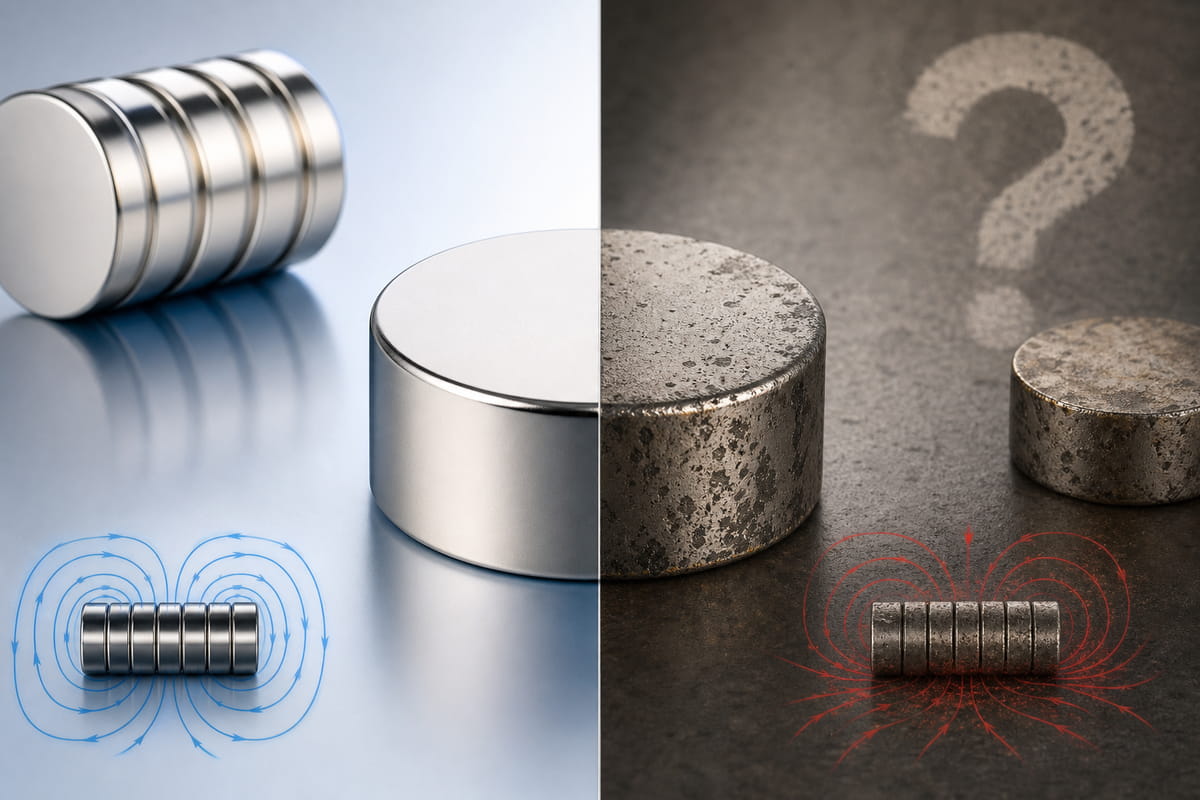
Quick Summary:
N52 magnets are about 10–20% stronger than N45s, but they cost 15–25% more. Choose N45 if you have standard force requirements and some room to work with. It’s cost-effective, easier to source, and covers most applications. Only choose N52 when you absolutely need maximum power in a minimal footprint—like compact electronics or medical devices.
In practical use, the strength difference between the two often narrows to just a few percent. Unless you need maximum force in a minimal footprint, start with N45—test it first, and only upgrade to N52 if your performance requirements demand it.
You’re trying to decide between N45 vs n52 magnets, and you want to know which one is right for your project. The numbers look confusing. The specs sound similar. And nobody wants to waste money on the wrong magnet.
Here’s the reality: N52 magnets are about 10–20% stronger per volume, but they cost 15–25% more and are more brittle. In real-world applications—with air gaps, rough surfaces, or coatings—that strength difference often shrinks significantly. Meanwhile, a slightly larger N45 magnet can match the performance of a smaller N52.
In this article, as a professional custom N45 magnets and N52 magnets manufacturer, I will break down the head‑to‑head comparison, gives you a simple decision framework, and shows you when each grade actually makes sense. By the end, you’ll know exactly which grade fits your project, your budget, and your space constraints.

What Do Those Numbers Actually Mean?
The “N” stands for Neodymium. The number after it (45 or 52) tells you the maximum energy product of the magnet.
Think of it like horsepower for a car.
More horsepower = more pulling power.
The energy product is measured in Mega Gauss Oersteds (MGOe).
N45 magnets: 43–46 MGOe N52 magnets: 49–53 MGOe
That’s the basic difference.
But here’s the thing:
The real question isn’t “which is stronger?”
It’s “which one makes sense for YOUR specific application?”
Let me explain.
N45 Magnets: The Workhorse
I personally recommend N45 magnets for most projects.
Why?
They offer the sweet spot between performance and cost.
Here’s what you get:
- Solid magnetic strength (14-17 kG surface field)
- Great for everyday applications
- More affordable than N52
- Easier to source in bulk
In my experience, N45 magnets work perfectly for:
- Industrial automation components
- Consumer electronics
- Sensors and control systems
- Magnetic assemblies
- Audio equipment
The bottom line?
If you have moderate space constraints and standard force requirements, N45 is your best bet.
N52 Magnets: The Powerhouse
N52 magnets are the strongest commercially available standard neodymium magnets.
Period.
Here’s what you get:
- Maximum energy product up to 53 MGOe
- About 10–20% more pull force than N45 (same size)
- The strongest option in a small footprint
- Ideal for compact designs
I’ve seen N52 magnets used in:
- Miniaturized electronics
- Medical devices
- Aerospace components
- High-efficiency motors
- Precision mechanical systems
But here’s the catch:
You’re going to pay more.
And I mean significantly more.
Pro Tip: Just because N52 is stronger doesn’t mean you should automatically choose it. In many cases, a slightly larger N45 magnet can match the performance of a smaller N52.
N45 vs N52 Magnets: Head to Head Comparison
Let me break this down in a way that’s easy to digest.
Strength
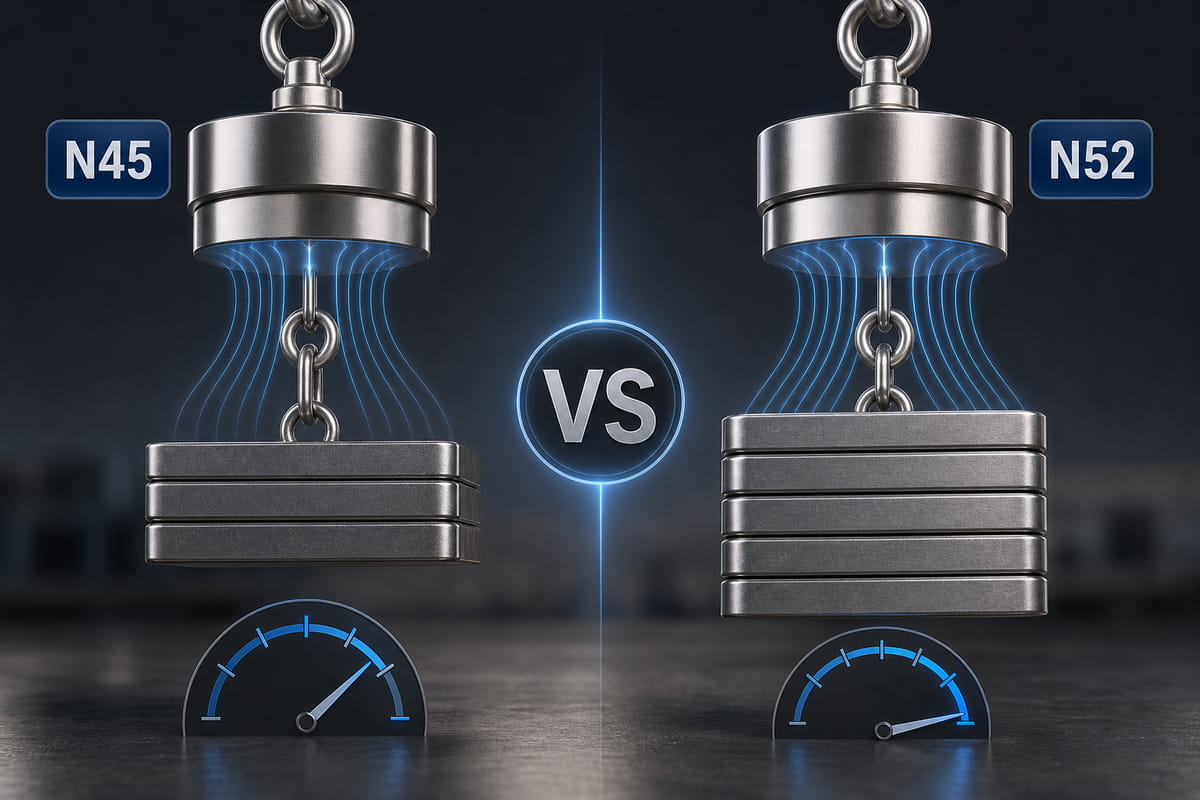
Under ideal test conditions, an N52 magnet delivers about 10% to 16% stronger pull force per unit volume than an N45.
That sounds impressive.
But here’s the reality:
In real-world applications—with air gaps, rough surfaces, or coatings—that difference often shrinks significantly.
I’ve tested this myself.
The difference between N45 and N52 in practical use? Much smaller than the specs suggest.
Cost
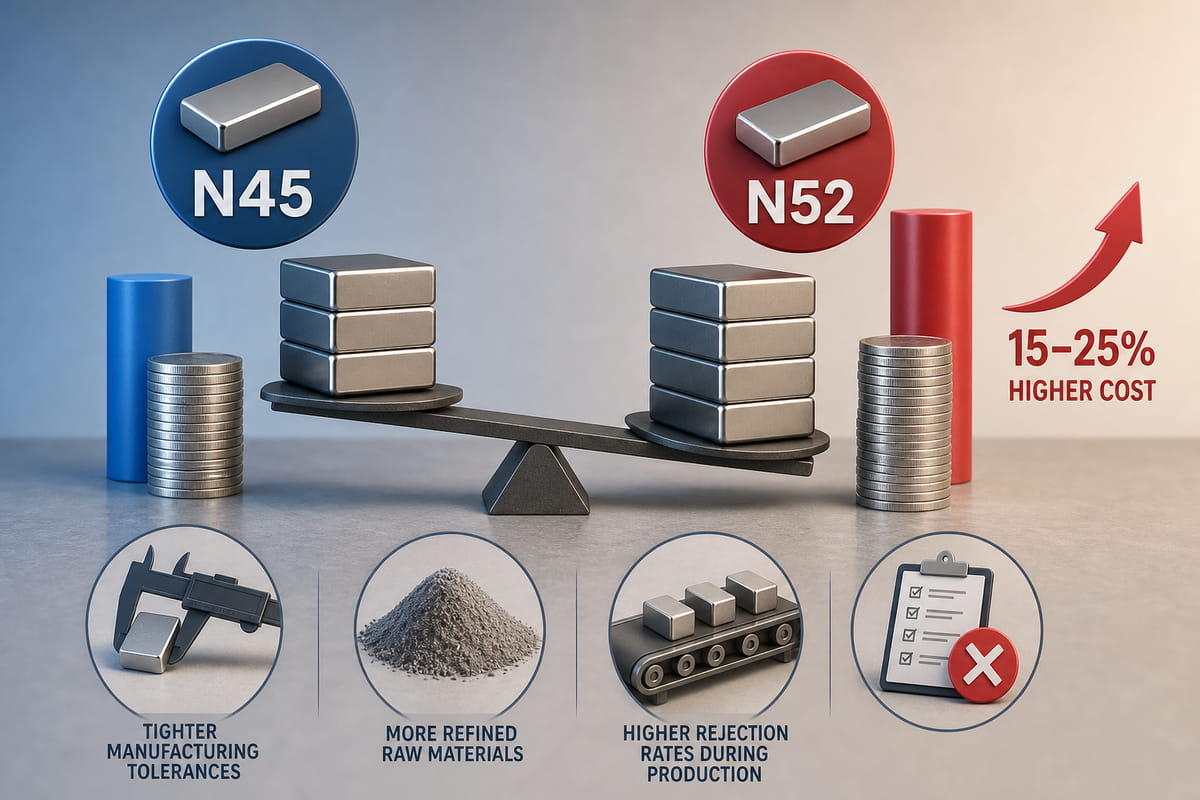
N52 magnets are more expensive. No way around it.
We’re talking 15–25% higher than N45 for the same size and shape.
Why?
Tighter manufacturing tolerances. More refined raw materials. Higher rejection rates during production.
Temperature Resistance

Here’s something most people overlook:
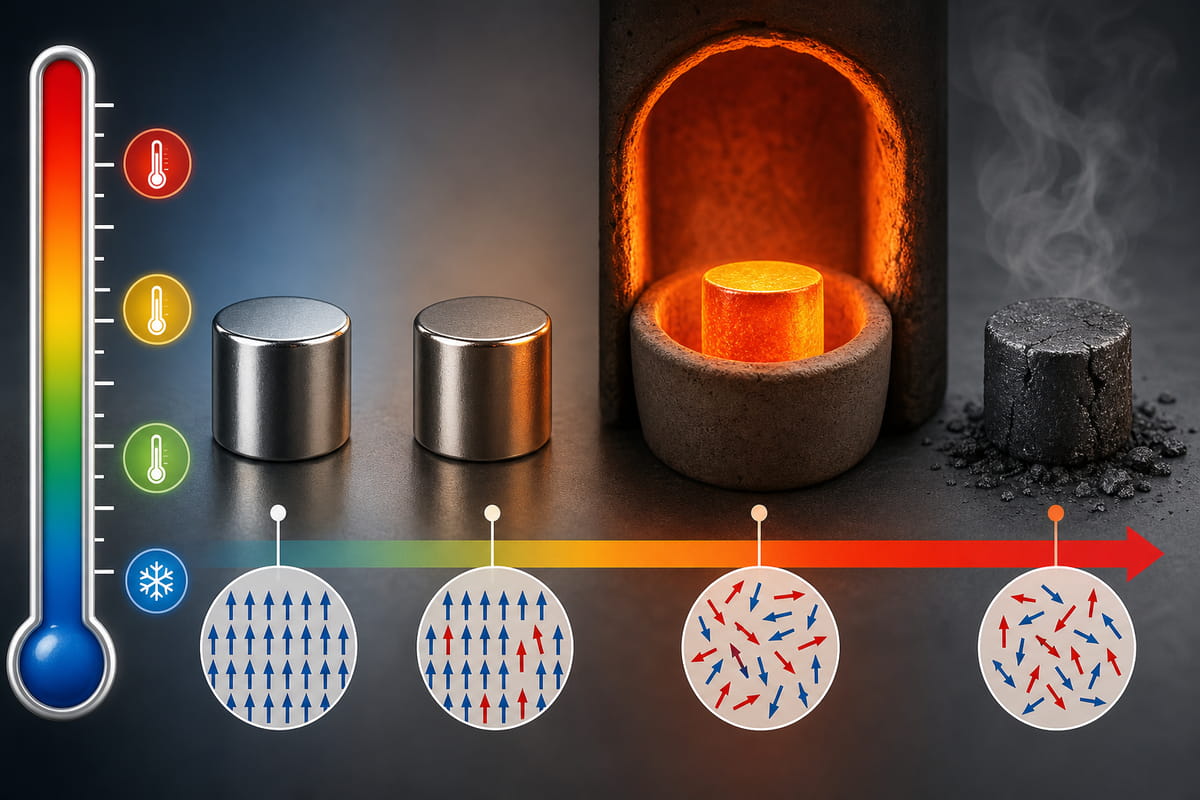
Both N45 and N52 have the same max operating temperature: 80°C (176°F)
Need higher heat tolerance?
You need to look at specialized grades like N45SH or N52SH.
The “SH” suffix means they can handle up to 150°C.
Durability

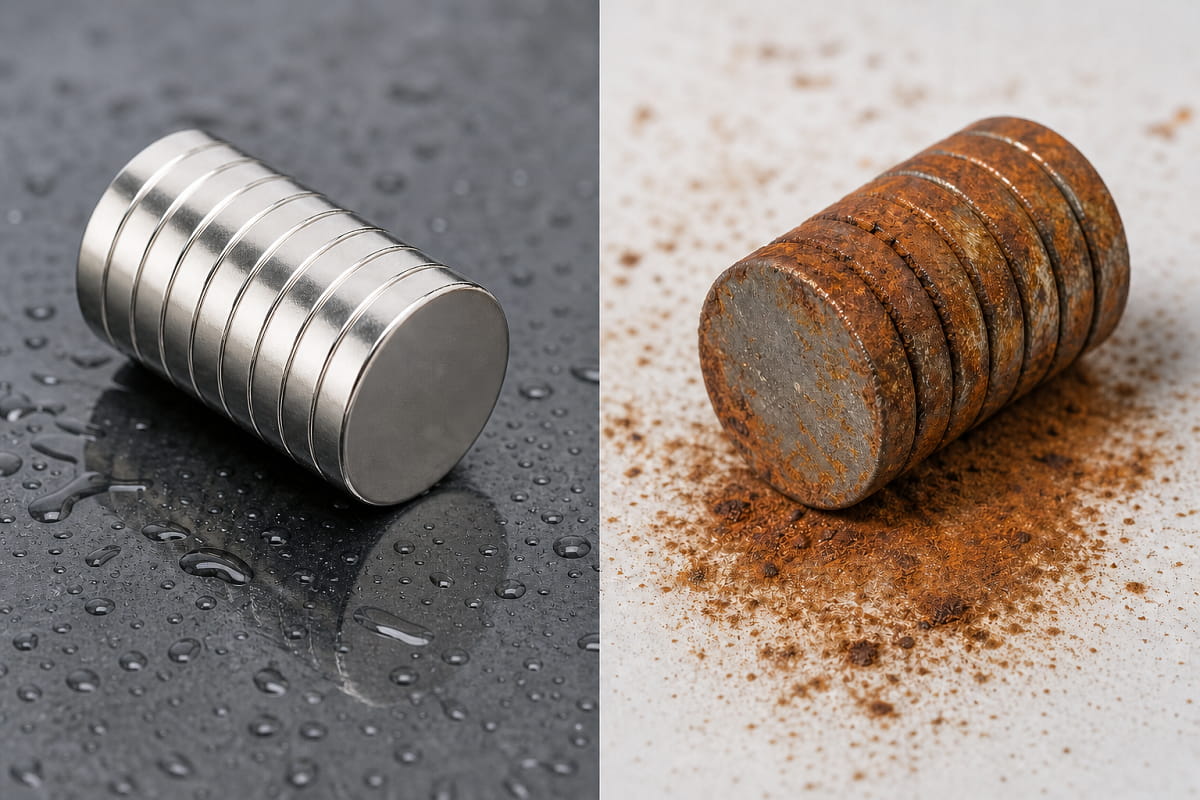
Both grades are brittle. Both need protective coatings to prevent corrosion.
But here’s a key difference:
Higher-grade magnets (like N52) tend to be more brittle than lower grades.
Why?
The manufacturing process for high-energy magnets makes them more prone to cracking.
I’ve seen N52 magnets shatter from a drop that wouldn’t phase an N45.
When to Choose Each
When to Choose N45 Magnets
Alright, let me give you some clear guidance.
Choose N45 when:
- Cost is a primary concern
- You have space to increase magnet volume
- Your force requirements are standard
- You need long-term reliability
- You’re designing for mass production
In my experience, N45 is the “smart choice” for 80% of applications.
When to Choose N52 Magnets

Choose N52 when:
- Maximum force is required in minimal space
- You’re designing miniaturized electronics
- Weight reduction is critical
- You need the absolute strongest option available
- Performance trumps cost
Real-World Example
Let me share a quick story.
A while back, I was helping a client design a compact sensor assembly.
We had very limited space—about the size of a quarter.
The initial design called for N52 magnets.
But here’s what we discovered:
By increasing the magnet volume by just 15%, we could use N45 magnets and match the performance of the smaller N52.
Cost savings? About 20%.
The takeaway?
Sometimes a bigger N45 magnet beats a smaller N52.
Common Mistakes People Make
I see these mistakes all the time:
1. Buying N52 “just because”
Just because N52 is stronger doesn’t mean you need it. If N45 meets your requirements, save your money.
2. Ignoring real-world performance
The specs on paper don’t always translate to real-world conditions. Always test before committing to a large order.
3. Forgetting about coatings
Both N45 and N52 need protection from corrosion. Don’t skip the coating step.
4. Overlooking temperature limits
Standard N45 and N52 both max out at 80°C. If your application runs hot, you need a different grade entirely.
Quick Decision Framework
Here’s my simple framework for choosing between N45 vs n52 magnets:
| Factor | Pick N45 | Pick N52 |
|---|---|---|
| Budget | Tight | Flexible |
| Space | Adequate | Minimal |
| Force | Standard | Maximum |
| Temperature | ≤80°C | ≤80°C |
| Volume | High | Low |
The Bottom Line
Here’s what I want you to remember:
N45 vs n52 magnets both have their place.
N45 is the cost-effective workhorse that works for most applications.
N52 is the powerhouse you bring in when nothing else will do.
My advice?
Start with N45.
Test it.
If it meets your needs, stick with it.
If not, upgrade to N52.
That approach has saved my clients thousands of dollars over the years.
And it’ll work for you too.
Still unsure about N45 vs n52 magnets?
Drop me a comment below. I’m happy to help you figure out which grade works best for your specific project.