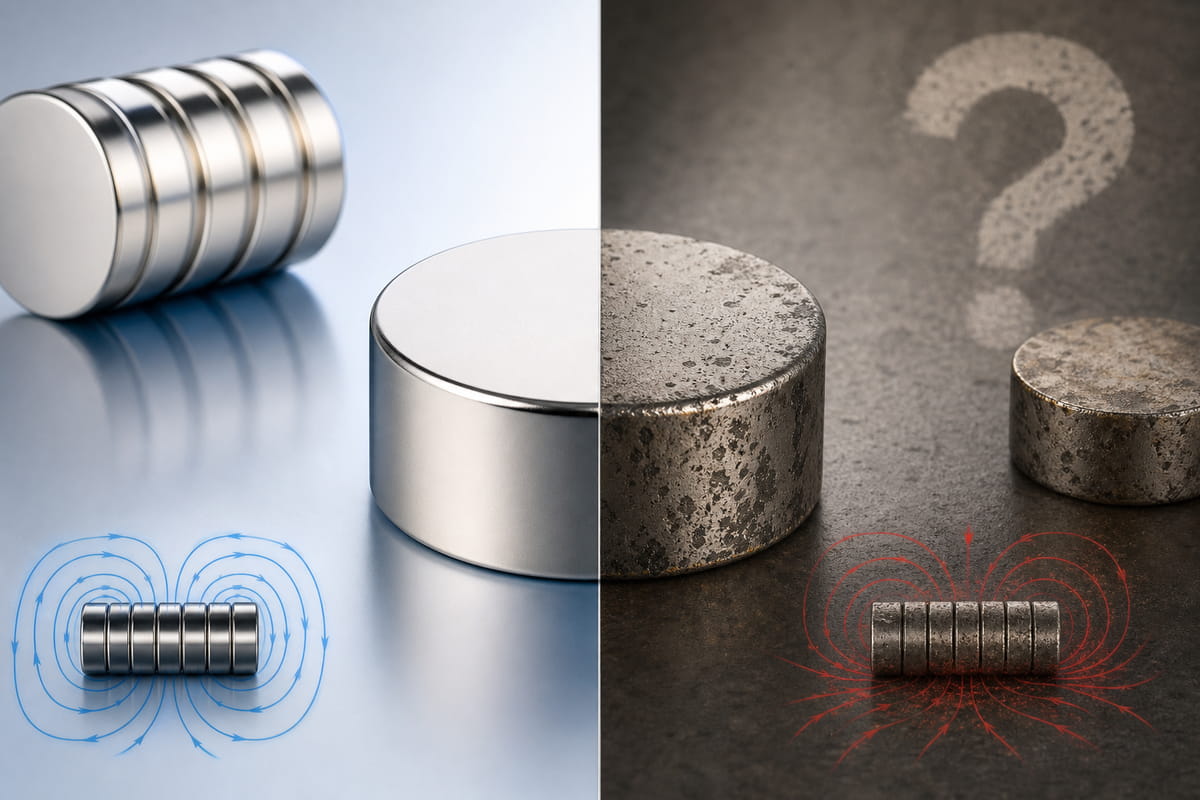
An N54 magnet is the strongest commercially available grade of permanent neodymium magnet (NdFeB). The “N” stands for Neodymium. The “54” refers to its maximum energy product—about 54 MGOe (Mega-Gauss Oersteds).
N54 magnets are about 5-8% stronger than the popular N52 grade. That extra punch might not sound like much. But when you’re working in tight spaces where every millimeter matters? That difference can be a game-changer.
In this guide, as a professional custom N54 magnets manufacturer, I will share everything about it that you should know.
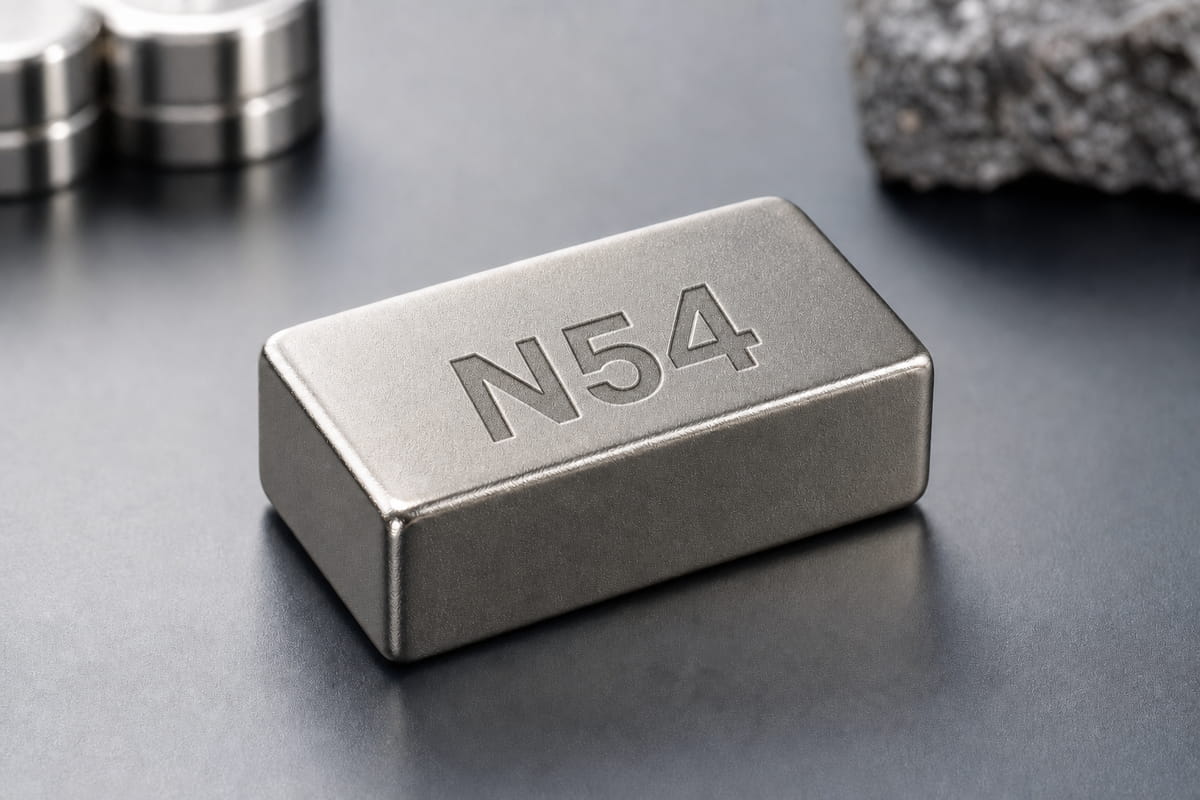
Breaking Down the N54 Grade
Neodymium magnets come in different grades. N35, N38, N42, N45, N48, N50, N52… and N54 sits right at the top.
The number = strength. Simple as that.
Here’s what makes N54 special:
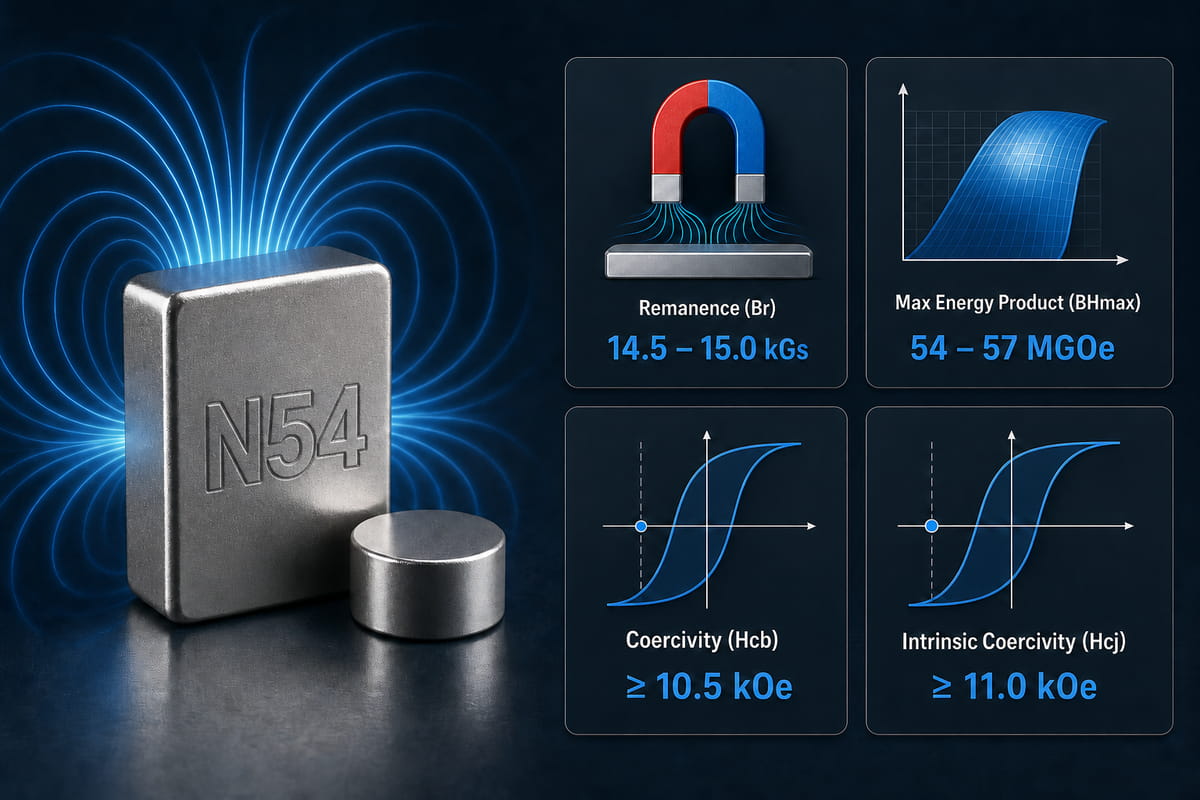
- Remanence (Br): 14.5 – 15.0 kGs
- Max Energy Product (BHmax): 54 – 57 MGOe
- Coercivity (Hcb): ≥ 10.5 kOe
- Intrinsic Coercivity (Hcj): ≥ 11.0 kOe
These numbers translate to one thing: serious magnetic power in a compact package.
N54 vs. N52: The Real Comparison
People always ask me: “Should I just go with N52?”
And honestly? For most applications, N52 is the smarter choice. Here’s why:
| Feature | N52 | N54 |
|---|---|---|
| Remanence (Br) | 14.2 – 14.6 kGs | 14.5 – 15.0 kGs |
| BHmax | ~52 MGOe | ~54 MGOe |
| Strength | Strong | ~3-5% stronger |
| Temp. Limit | 80°C | 80°C |
| Cost | Moderate | High |
But here’s the thing: That 3-5% extra strength from N54 comes with trade-offs.
The Pros of N54 Magnets
1. Maximum strength in minimum space
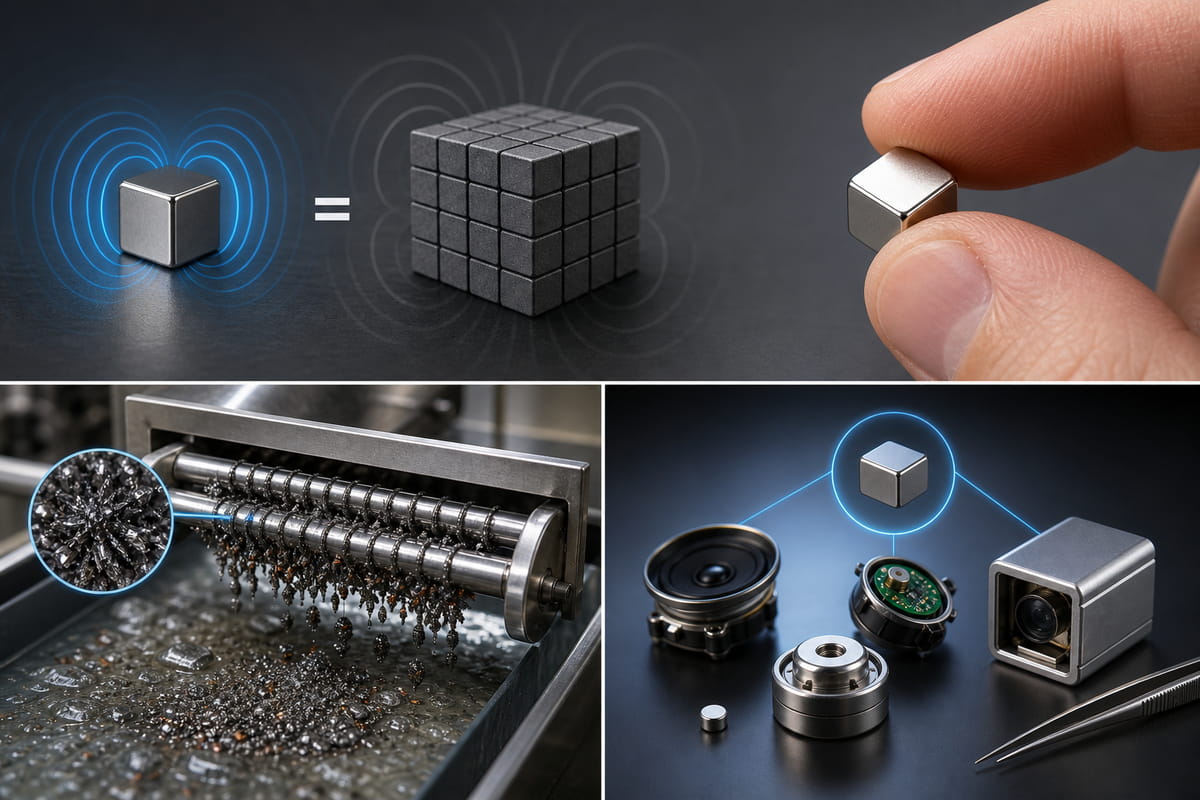
This is the big one. If your design has strict size constraints, N54 lets you squeeze out every last bit of magnetic force.
2. Higher magnetic flux density
Perfect for applications like magnetic separation or filtration where surface gauss needs to hit extreme levels.
3. Excellent for micro-parts
Think tiny sensors, miniature speakers, or precision instruments where every fraction of a Tesla matters.
The Cons of N54 Magnets
1. Higher cost per unit
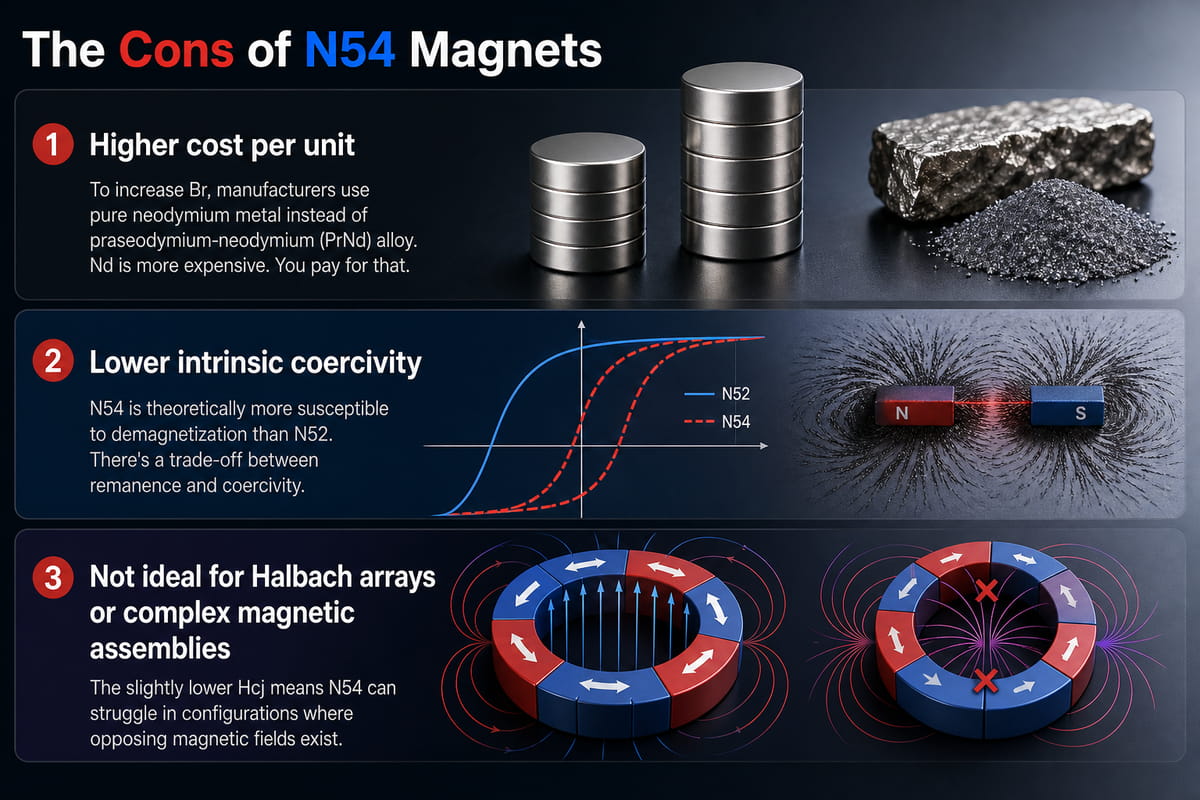
To increase Br, manufacturers use pure neodymium metal instead of praseodymium-neodymium (PrNd) alloy. Nd is more expensive. You pay for that.
2. Lower intrinsic coercivity
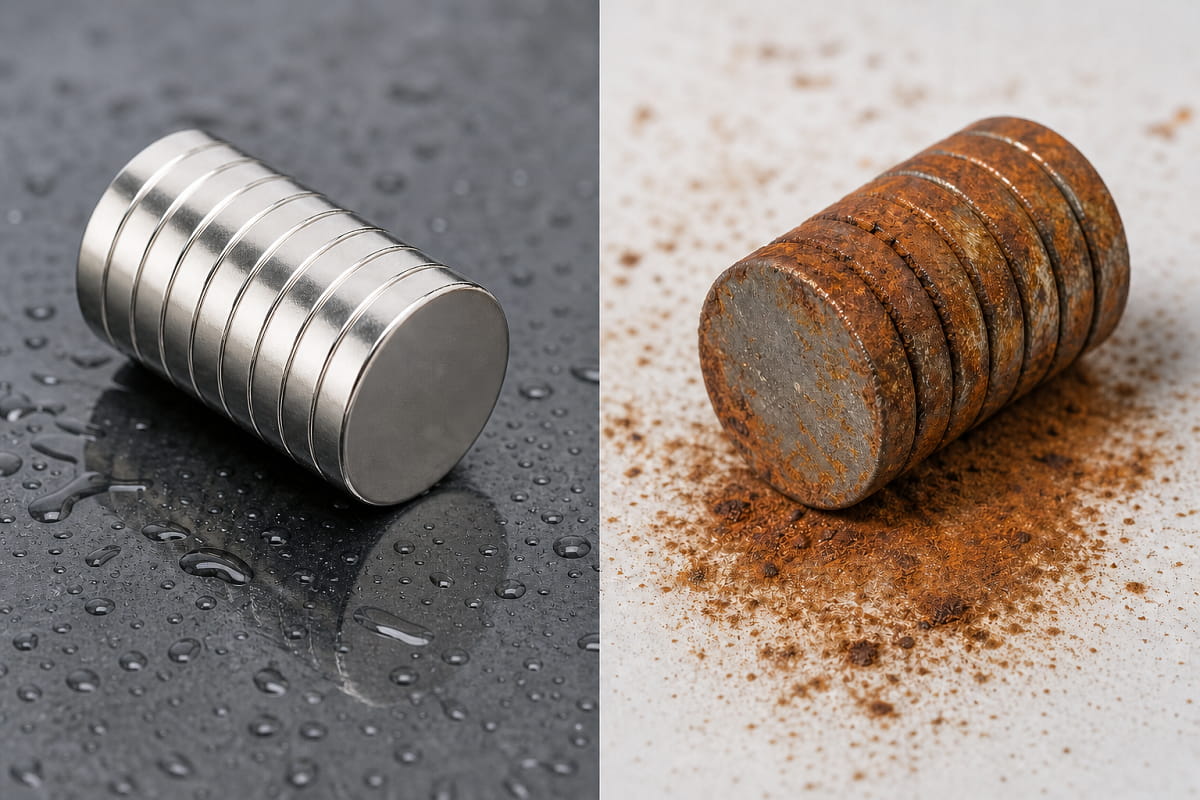
N54 is theoretically more susceptible to demagnetization than N52. There’s a trade-off between remanence and coercivity.
3. Not ideal for Halbach arrays or complex magnetic assemblies
The slightly lower Hcj means N54 can struggle in configurations where opposing magnetic fields exist.
Pro Tip: If size isn’t a hard constraint, you’re better off using a larger N52 magnet. You’ll get similar or better performance at a fraction of the cost.
What Is an N54 Magnet Made Of?
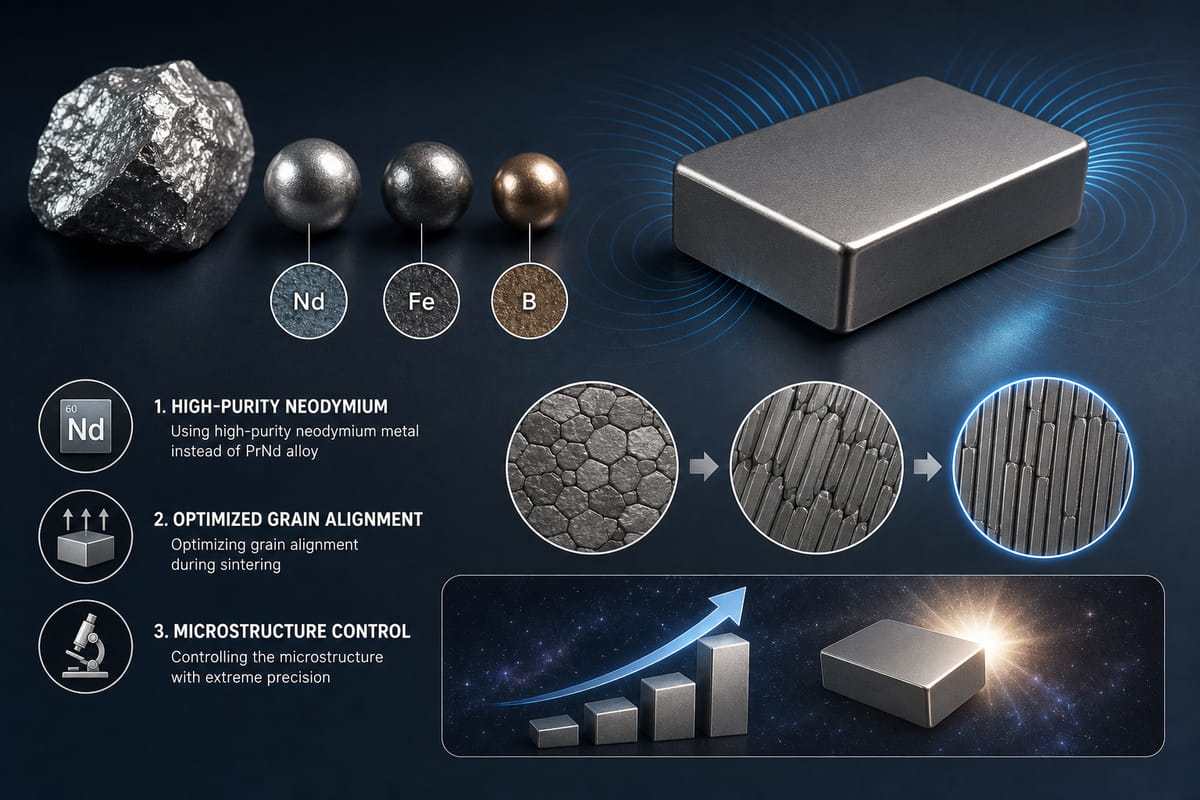
All neodymium magnets share the same basic recipe: neodymium, iron, and boron (Nd₂Fe₁₄B).
But N54 takes it a step further.
To hit that 54 MGOe energy product, manufacturers need to:
- 1. Use high-purity neodymium metal instead of PrNd alloy
- 2. Optimize grain alignment during sintering
- 3. Control the microstructure with extreme precision
The result? A magnet that pushes the theoretical limits of what’s possible with NdFeB.
Common Applications for N54 Magnets
So where do these bad boys actually get used?
Miniature Electronics
- Microphones – Need strong magnetic fields in tiny spaces
- Compact speakers – Especially in premium headphones and earbuds
- Sensors – Hall effect sensors that require ultra-sensitive detection
Precision Instruments
- Medical devices – MRI systems and diagnostic equipment
- Actuators – Where precise movement control matters
- High-end research tools – Scientific instruments that demand stable magnetic fields
Industrial Applications
- Magnetic separation – Pulling weakly magnetic materials out of product streams
- Magnetic filtration – Removing fine ferrous particles from liquids
- Holding latches – Compact assemblies that need serious grip
Automotive & Aerospace
- Electric motors – Especially in high-performance applications
- Power tools – Where torque density is critical
- Robotics – Precision joints and actuators
Temperature Considerations
Here’s something most people overlook:
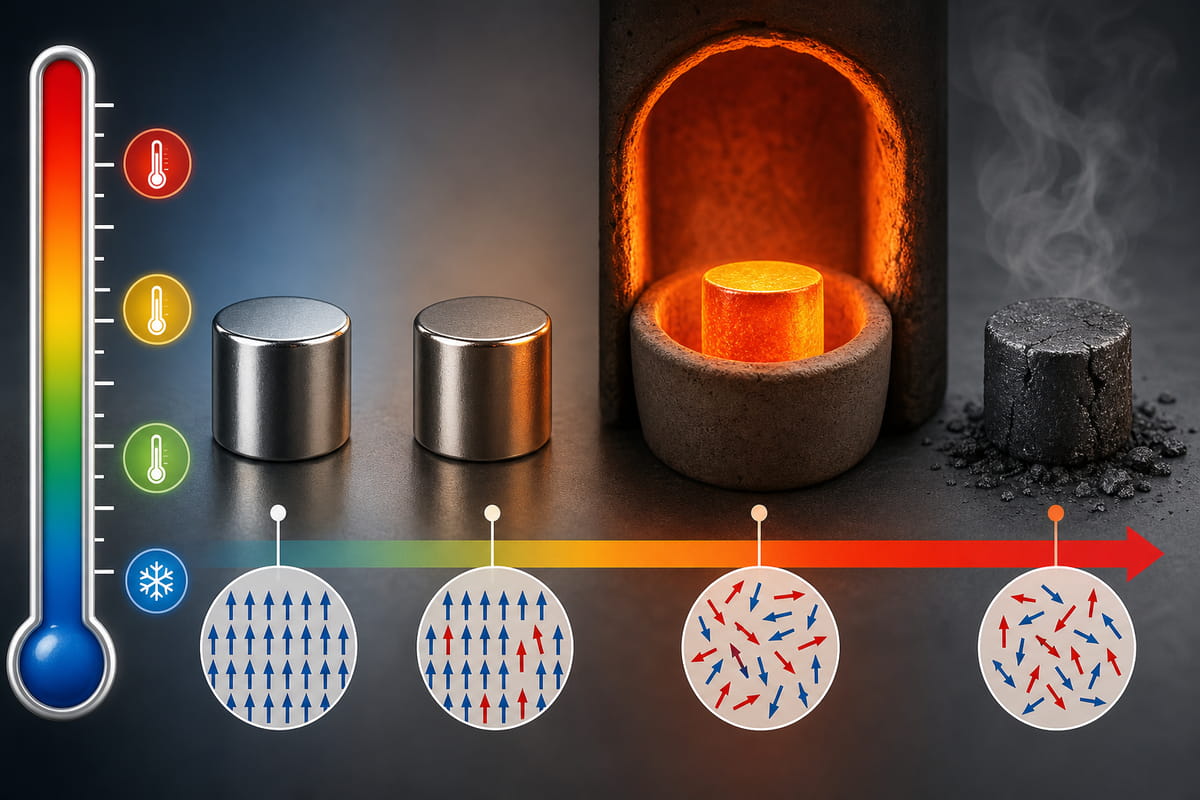
Standard N54 magnets have a max operating temperature of 80°C (176°F) .
Push them past that? You risk permanent demagnetization. And no, cooling them back down won’t fix it.
Need higher temps? Look into the heat-resistant variants:
- N54H – Up to 120°C
- N54SH – Up to 150°C
- N54UH – Up to 180°C
These use different alloying elements (like dysprosium or terbium) to improve thermal stability. But they cost more and have slightly lower Br.
Bottom line: Always check your operating temperature before choosing N54.
Is N54 Dangerous?
These magnets are incredibly strong. And yes, they can be dangerous if mishandled.
- Pinch injuries – Two N54 magnets snapping together can crush skin or break bones
- Shattering – Neodymium magnets are brittle. They can crack or chip on impact
- Swallowing hazards – If ingested, they can cause serious internal damage
Safety tips:
- Always wear gloves when handling
- Keep them away from children and pets
- Store them with spacers between magnets
- Never put them near pacemakers or medical implants
Where to Buy N54 Magnets
Not many manufacturers produce them. And even fewer sell them to retail customers.
Most N54 magnets are made for specialized industrial applications. You won’t find them at your local hardware store.
Your best bet? Contact a reliable supplier directly.
Look for:
- Reputation and experience – Ask about their track record with N54
- Customization options – Shapes, sizes, coatings
- Test reports – Demand actual performance data, not just specs on paper
- Lead times – Custom N54 magnets can take weeks to manufacture
N54 vs. N55: What’s the Difference?
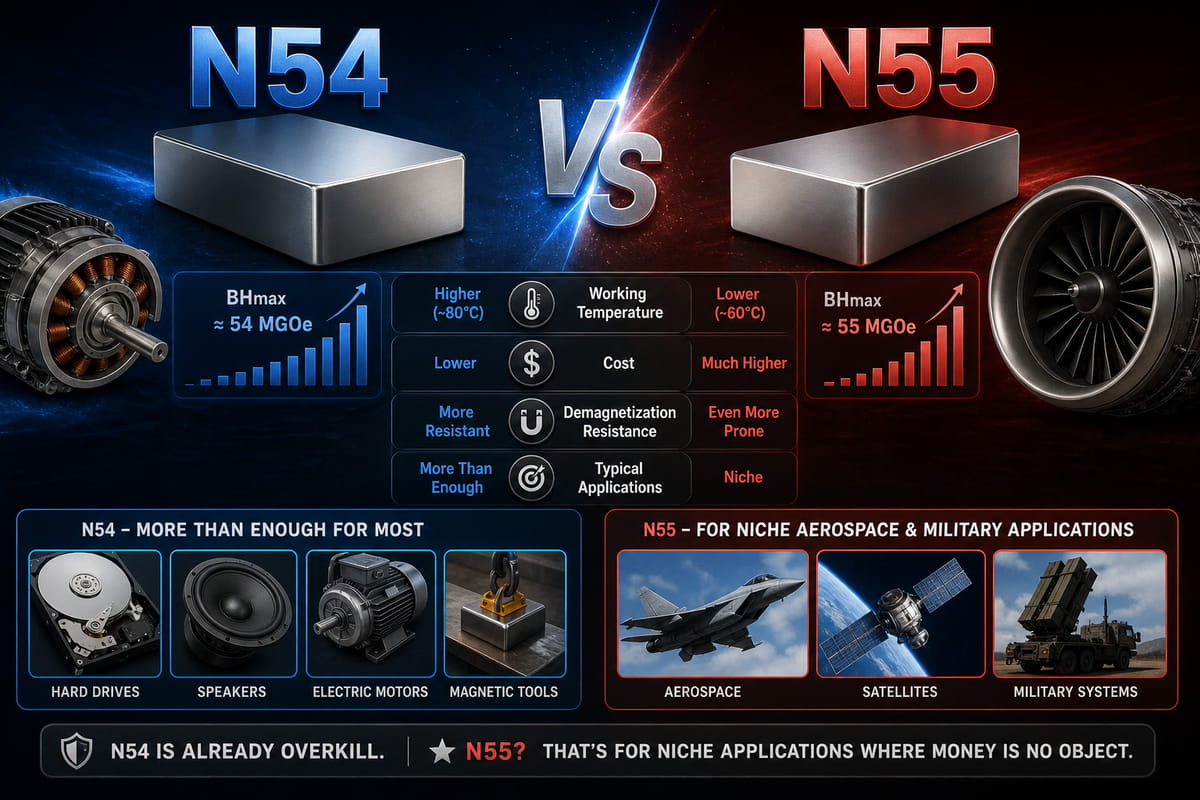
The short answer: N55 is what some manufacturers call the next step up from N54. It’s not an official standard—more of a marketing distinction.
In reality, N55 pushes BHmax to about 55 MGOe. But the trade-offs are even more severe:
- Lower working temperature (around 60°C)
- Much higher cost
- Even more prone to demagnetization
For most people, N54 is already overkill. N55? That’s for niche aerospace and military applications where money is no object.
The Hidden Weakness of N54
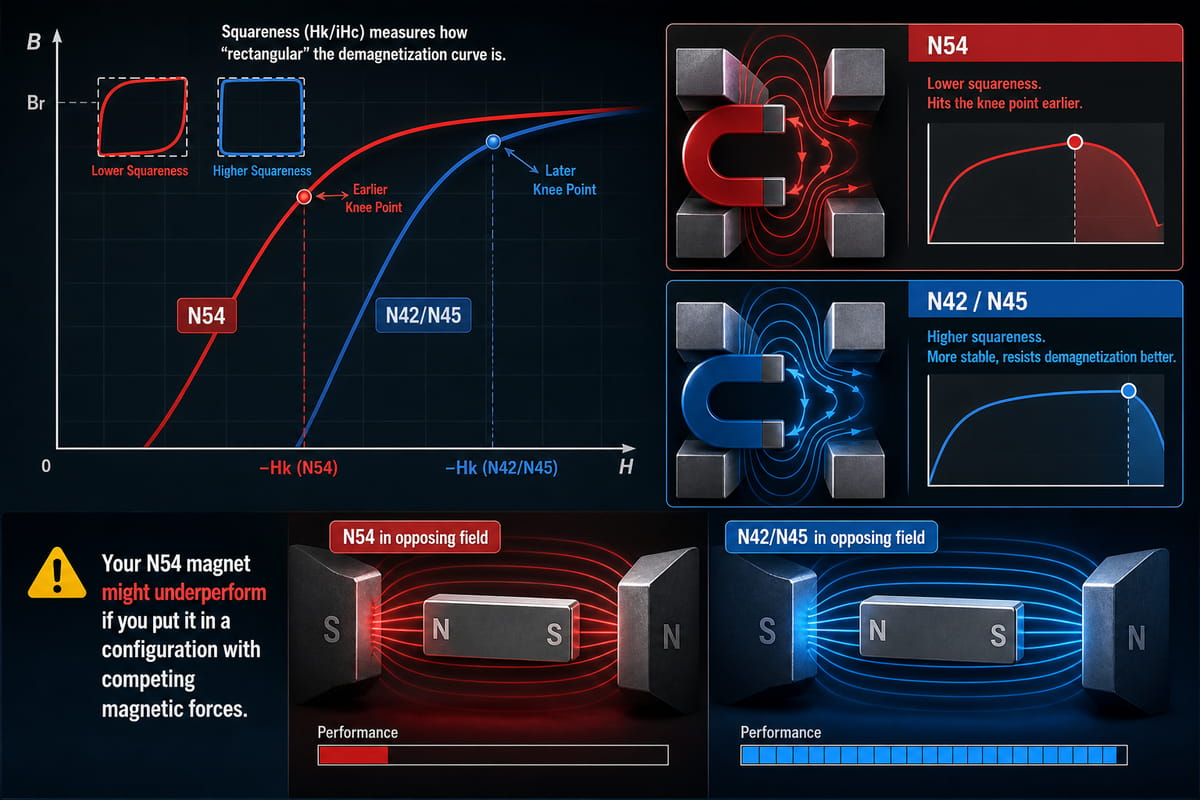
N54 sounds amazing on paper. But in practice, it has a significant vulnerability:
Low squareness ratio.
Squareness (Hk/iHc) measures how “rectangular” the demagnetization curve is. Higher values mean more stable performance.
N54 magnets typically have lower squareness than mid-grade magnets (like N42 or N45). That means they hit their “knee point” earlier when exposed to reverse magnetic fields.
Your N54 magnet might underperform if you put it in a configuration with competing magnetic forces.
Moral of the story: Don’t just chase the highest number. Match the magnet to your specific application.
How to Choose: N52 vs. N54
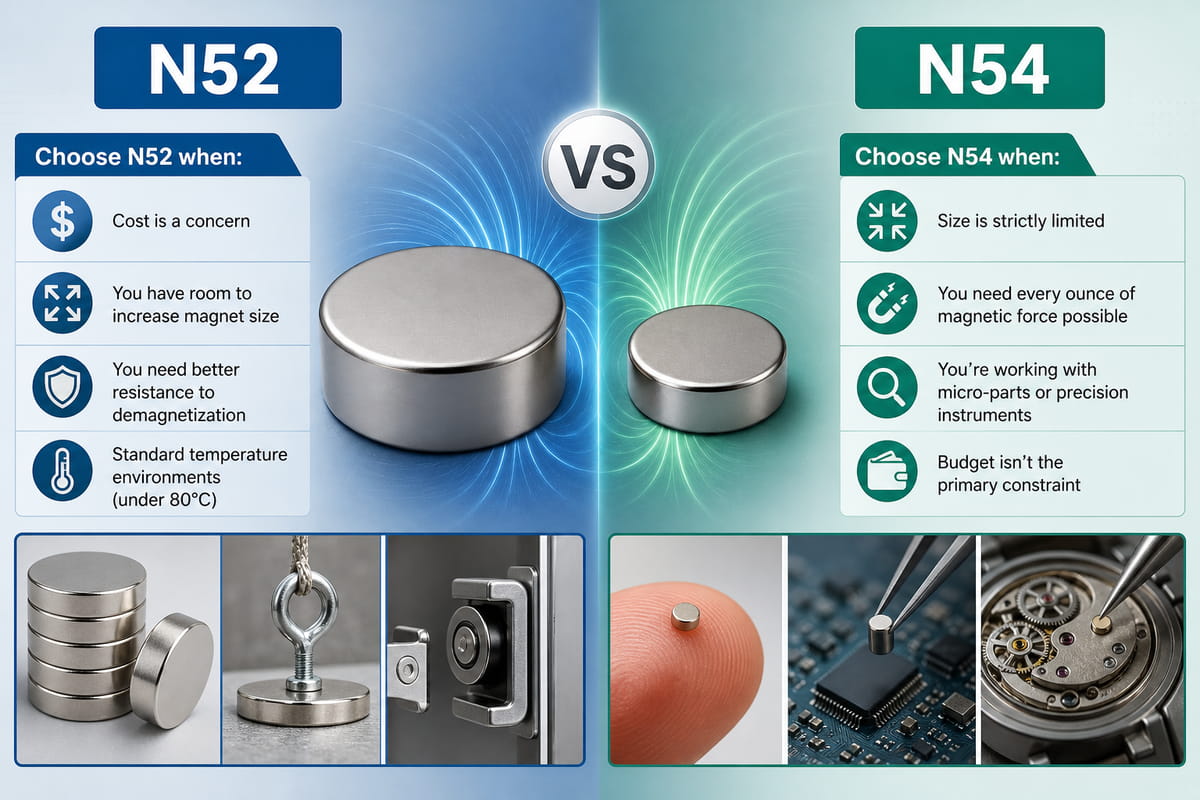
Choose N52 when:
- Cost is a concern
- You have room to increase magnet size
- You need better resistance to demagnetization
- Standard temperature environments (under 80°C)
Choose N54 when:
- Size is strictly limited
- You need every ounce of magnetic force possible
- You’re working with micro-parts or precision instruments
- Budget isn’t the primary constraint
The Bottom Line on N54 Magnets
So what is an n54 magnet when you strip away all the technical jargon?
It’s the peak of what’s commercially possible with neodymium. A magnet that pushes the physical limits of magnetic energy density.
But here’s the catch:
More power = more cost. More power = more fragility. More power = more risk.
N54 isn’t for everyone. Frankly, it’s not for most people.
But for specific applications—where every millimeter of space is spoken for and every fraction of a Tesla matters—N54 is the answer.
Just make sure you need it before you buy it.